


Listen to the article
Americans Share Harrowing Accounts of Cartel Violence in Mexico Following Kingpin’s Death
MEXICO CITY — American tourists and residents caught in the wave of violence that swept through parts of Mexico this week have begun sharing their firsthand experiences of the chaos that erupted following the death of notorious cartel boss Nemesio Oseguera Cervantes, known as “El Mencho.”
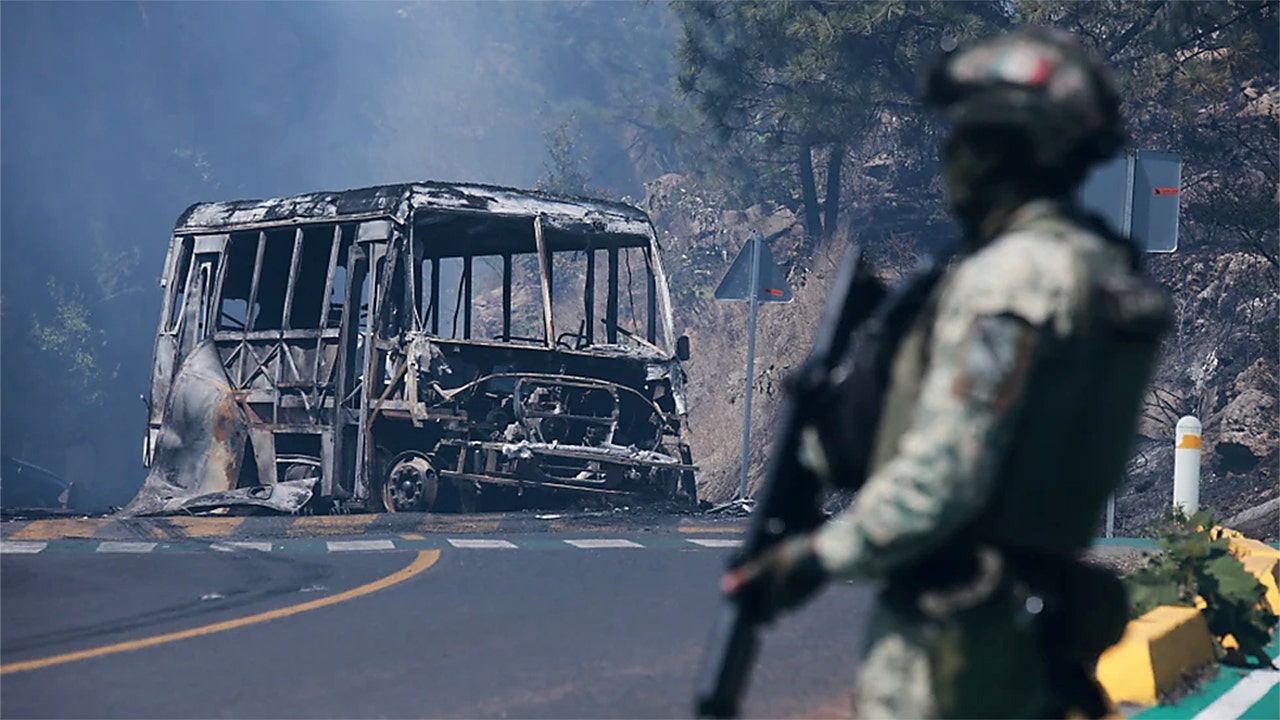
The violence, which has now begun to subside, included armed clashes between rival criminal organizations and Mexican security forces, coordinated vehicle burnings, and temporary highway blockades. These tactics are typical responses to major disruptions in cartel leadership structures, according to security experts.
Colorado resident Scott Posilkin described his terrifying encounter while vacationing in Puerto Vallarta, a popular tourist destination on Mexico’s Pacific coast that saw significant unrest.
“My group was seven people, and we were on our way to the main port in Puerto Vallarta with a local shuttle driver when we saw a bus stopped horizontally across the road in front of us,” Posilkin told Fox News Digital. “At first, we thought it was an accident, but then we saw people running full speed away from the bus.”
The situation quickly escalated as Posilkin’s group found themselves trapped between multiple roadblocks. “We saw a man with a gun come around the far side of the bus. He waved it at us and gave us a hand signal to turn around, which we immediately did. We tried to head in the opposite direction, but we encountered another burning car, which left us essentially trapped.”
Seeking safety, Posilkin’s group fled to the beach where locals advised them to get out on the water. “From the water, we could see what looked like much of the town burning,” he recounted. Their return to shore proved equally challenging, with the beach eerily deserted.
Despite the frightening circumstances, Posilkin emphasized that cartel members did not appear to target tourists. “There were cartel members on a motorcycle who yelled ‘Viva Mexico’ at us, but we did not feel that they were threatening us in any way. Both our shuttle driver and the locals assured us that the cartel was not interested in harming Americans.”
The violence following El Mencho’s death spread well beyond tourist areas. Rodolfo Flores, an American citizen working in Mexico’s energy sector, witnessed the aftermath in Querétaro, a normally peaceful central Mexican city.
“On Sunday I saw a convenience store in Querétaro that had been burned down with a Molotov bomb,” Flores said. “On the way to Mexico City, we saw cars and trucks that had been set on fire. This is just one example of how vulnerable we are, and it’s astonishing how these criminal organizations can terrorize the population.”
Security analysts note that such displays of force typically follow major leadership changes within cartels. The Jalisco New Generation Cartel (CJNG), which El Mencho headed until his death, has grown to become one of Mexico’s most powerful and violent criminal organizations over the past decade, with operations extending across much of the country.
The intensity of the violence highlighted the CJNG’s extensive reach and organizational capabilities. One American, who requested anonymity due to safety concerns, described a narrow escape from Coalcoman in Michoacán state, an area known for cartel activity.
“As I left town, I saw them burning cars and trucks, pulling people out of their vehicles, and setting them on fire,” the witness recounted. “All along the way, I kept seeing burning cars and armed people. I was fortunate that they didn’t stop me.”
The situation appears to be stabilizing. On Tuesday afternoon, the U.S. Embassy in Mexico updated its guidance, no longer urging U.S. citizens to shelter in place. Mexican authorities have deployed additional security forces to affected areas, particularly in tourist zones like Puerto Vallarta, where the economic impact of prolonged unrest could be severe.
Tourism represents a crucial sector of Mexico’s economy, accounting for approximately 8.5% of the country’s GDP and employing millions of Mexicans. Previous outbreaks of violence in tourist areas have typically led to temporary declines in visitor numbers, though the industry has shown resilience over time.
Despite his frightening experience, Posilkin expressed gratitude for the local residents who helped during the crisis. “I want to emphasize how above and beyond the locals went to help us during an incredibly stressful situation. Everyone we interacted with had grown up here, and none of them had ever seen anything like this before… This experience hasn’t changed my love for travel or for Mexico, though it was a serious ordeal.”
For Mexico, the death of El Mencho and the subsequent violence represent another chapter in its long-running struggle against powerful criminal organizations, whose influence extends deep into many communities and institutions across the country.
Fact Checker
Verify the accuracy of this article using The Disinformation Commission analysis and real-time sources.

10 Comments
While the situation appears to have stabilized for now, this incident highlights the ongoing challenges Mexico faces in curbing cartel violence. Addressing the root causes, such as drug trafficking and corruption, will be crucial to achieving lasting peace and security.
You make a good point. Relying solely on heavy-handed crackdowns is unlikely to provide a sustainable solution. A more comprehensive strategy focused on reducing the cartels’ power and influence will be essential.
The accounts of tourists caught in the violence are harrowing. This incident serves as a sobering reminder of the fragility of the security situation in parts of Mexico. Strengthening intelligence-sharing and cross-border operations should be a top priority to protect innocent civilians.
Absolutely. Combating cartel-related violence requires a multi-faceted approach involving law enforcement, military, and economic reforms. The safety of both local residents and foreign visitors must be the primary concern.
This is a tragic situation, but not entirely unexpected given the volatile nature of Mexico’s cartel conflicts. While the violence is concerning, I’m hopeful the authorities can stabilize the situation and protect innocent civilians caught in the crossfire.
You’re right, this type of cartel-related violence is all too common in parts of Mexico. Securing the safety of tourists and residents must be the top priority for Mexican officials.
This situation highlights the ongoing challenge of maintaining security and stability in regions dominated by powerful criminal organizations. While the authorities seem to have regained control, I hope they can implement lasting solutions to prevent such chaos from erupting again.
You raise a good point. Temporary crackdowns may provide short-term relief, but lasting progress will require comprehensive strategies to undermine the cartels’ economic and political power bases.
The accounts from American tourists are deeply unsettling. It’s a stark reminder of the dangers that can arise when cartel power structures are disrupted. Strengthening cross-border cooperation to combat organized crime should be a key focus going forward.
Agreed. Tackling the root causes of cartel violence, like drug trafficking and corruption, will require sustained, coordinated efforts between the US and Mexico. The safety of all citizens must come first.