


Listen to the article
Beijing Harnesses AI and Social Media to Reshape Global Narratives
China’s Communist government has evolved far beyond the days of rigid, dogmatic messaging. Having effectively controlled the domestic internet through censorship, Beijing has now turned its attention outward, leveraging the power of social media and artificial intelligence to craft sophisticated narratives that often target the United States and its leadership.
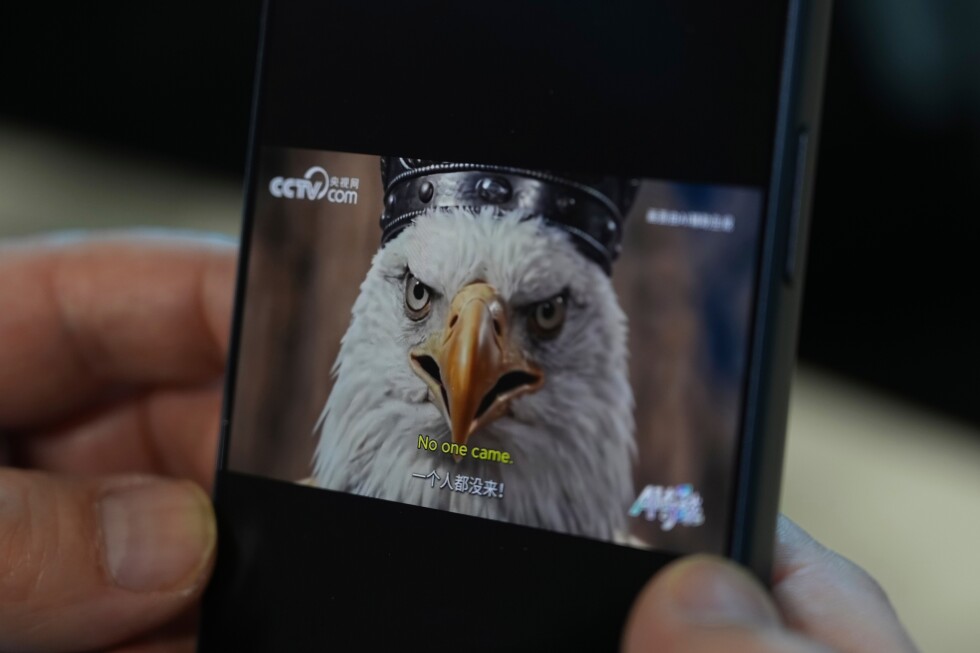
A striking example is a recent five-minute AI-generated animation modeled after classic martial arts films. Released by China Central Television (CCTV), the video presents an allegorical take on tensions in Iran. The animation depicts a white eagle in regal attire—representing the United States—unleashing an evil laugh before attacking Persian cats in black cloaks, symbolizing Iranians who vow to fight after losing their leader and blocking a crucial trade route.
This sophisticated animation has resonated widely, going viral in China before reaching international audiences through social media platforms. One English-subtitled version posted on X garnered more than one million views in just a few days.
The AI-generated short is not an isolated effort. Chinese state media has produced several similar animations in recent months, portraying the U.S. as a global bully. These videos have addressed everything from former President Donald Trump’s interest in acquiring Greenland to American influence in the Western Hemisphere.
Andrew Chubb, a senior lecturer at Lancaster University specializing in political propaganda, notes the subtlety of this approach: “It’s hardly even like propaganda—it almost seems more just a historical fiction dramatization of the situation.”
This shift in messaging strategy aligns with Chinese President Xi Jinping’s push to enhance China’s global communication capabilities, countering what Beijing perceives as biased Western narratives about China. The effort comes amid an intensifying global information war, with the U.S. State Department warning that foreign messaging campaigns on digital platforms “pose a direct threat to U.S. national security and fuel hostility toward American interests.”
Professor Shi Anbin, director of the Israel Epstein Center for Global Media and Communications at Tsinghua University, explains that AI-generated “infotainment” distributed through social media channels is becoming a routine part of China’s messaging strategy. “It is a new way for Chinese mainstream media to engage global Gen Z audience and social media users to understand Chinese standpoint and viewpoint of international affairs,” Shi said.
The transformation in China’s communication approach represents a significant departure from its past. Party newspapers once featured slogan-heavy, hollow-sounding speeches praising the country while denouncing Western influence. Students and junior officials often complained about the dry study materials required to pass exams on party history and ideology.
Recognizing young people’s disengagement with traditional propaganda, Beijing has embraced contemporary formats. The government now incorporates popular web language to retell party history, uses rap music to celebrate party achievements, and recruits popular actors and singers for patriotic films. Even anti-corruption television series have become hits through engaging plots and quality acting.
Wang Zichen, deputy secretary-general for the Beijing-based think tank Center for China & Globalization, explains that state media outlets are actively experimenting with nontraditional formats, including short-form, digitally native content using AI. “Whatever one thinks about the format, the message itself clearly resonates with increasingly larger audiences, which helps explain why such content gains traction online,” Wang said.
To reach global audiences, China has invested significantly in building what officials call a social media “matrix”—a network of accounts managed by diplomats, state media, influencers, and automated bots across platforms like X and Facebook. These accounts are quick to seize opportunities to promote China’s perspective on international events.
In February, the official Xinhua News Agency released an AI-generated music video criticizing U.S. interest in Greenland, featuring a bald eagle in military uniform singing, “Anything I want, I’ll get it. One way or another, I’ll get it.” The following month, after Trump convened the “Shield of the Americas” summit, Xinhua posted another video showing a bald eagle caging small birds while saying, “Sometimes, security comes with a little control.”
These sophisticated messaging techniques reflect China’s growing confidence in the global information space and signal a new phase in how nations compete to shape international narratives through cutting-edge digital technologies.
Fact Checker
Verify the accuracy of this article using The Disinformation Commission analysis and real-time sources.

16 Comments
The use of AI to create this type of content is both impressive and concerning. While the animation is visually compelling, the underlying messaging seems quite one-sided and aimed at shaping global perceptions in China’s favor.
Agreed. It’s crucial that the international community remains vigilant and critical when evaluating the growing influence of AI-driven propaganda efforts.
The animation is certainly visually striking, but it’s concerning to see how it presents a one-sided and potentially misleading perspective on the geopolitical situation. The use of AI to produce this kind of content is worrying.
You make a good point. The potential for AI to be used for propaganda and disinformation is a growing concern that will need to be addressed.
This animation is a striking example of how China is using AI and social media to project a specific geopolitical narrative. It’s a sophisticated approach, but one that raises concerns about the spread of biased and potentially misleading information.
You’re right, the potential for AI-generated content to be used for propaganda is a significant issue that will require close monitoring and scrutiny.
This AI-generated animation is certainly eye-catching. It’s interesting to see how China is leveraging technology to shape global narratives, even if the messaging seems quite one-sided.
I agree, the visual storytelling is quite sophisticated. It will be worth watching how this type of content resonates internationally.
The use of AI to produce this kind of propaganda is concerning. While the animation is well-crafted, it seems to present a very biased and distorted view of the geopolitical tensions.
You raise a fair point. It’s important to be critical of the intentions and potential impacts of this kind of content, especially when it’s algorithmically generated.
This is a fascinating example of how governments are harnessing new technologies to shape global narratives. I’m curious to see how the international community responds to these types of AI-driven propaganda efforts.
Agreed, the implications of using AI for political messaging are quite complex. It will be important to monitor the spread and influence of this kind of content.
While the production value of this AI-generated animation is impressive, the messaging seems quite heavy-handed and biased. It’s a concerning example of how governments are leveraging technology to influence global narratives.
Absolutely. The ability to create such polished and persuasive content using AI raises important questions about the integrity of information we’re exposed to online.
This AI-generated animation is a thought-provoking example of how governments are leveraging new technologies to craft and disseminate their preferred narratives. While the production value is high, the content appears to present a very biased and distorted view of the geopolitical situation.
You make a fair point. The potential for AI to be used to spread disinformation and manipulate public opinion is a significant concern that will require careful attention and response.