


Listen to the article
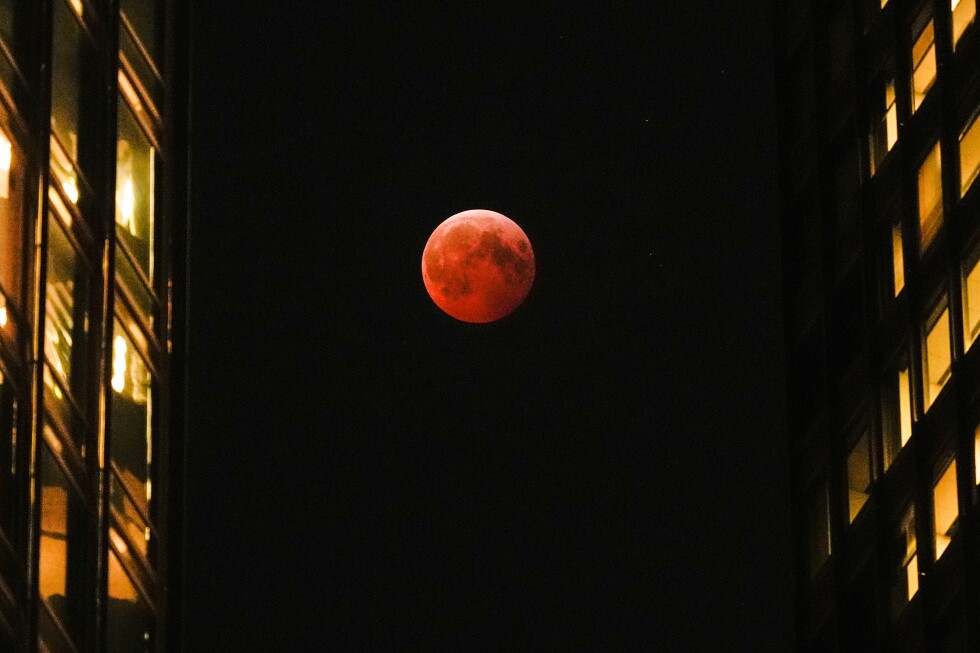
A blood-red moon will soon grace the skies in a rare total lunar eclipse that astronomers and sky watchers won’t want to miss—the next one won’t occur until late 2028.
The celestial spectacle will be visible Tuesday morning across North America, Central America, and the western part of South America. Viewers in Australia and eastern Asia can catch the event Tuesday night. Partial phases of the eclipse, showing small bites taken out of the moon, will be observable from Central Asia and much of South America, while Africa and Europe will miss out entirely.
This total lunar eclipse comes just two weeks after the stunning “ring of fire” solar eclipse that captivated viewers, including penguins, in Antarctica. The timing is no coincidence—solar and lunar eclipses tend to follow each other closely due to the precise alignment of celestial bodies.
“Compared to a solar eclipse, the lunar eclipse is a little more of a relaxed pace,” explains Catherine Miller of Middlebury College’s Mittelman Observatory. Unlike solar eclipses, which require special viewing equipment to protect the eyes, lunar eclipses can be safely observed with the naked eye.
The science behind the spectacle involves the precise alignment of the sun, Earth, and moon. During a total lunar eclipse, Earth positions itself directly between the sun and a full moon, casting a shadow that completely covers the lunar surface. The moon’s distinctive reddish-orange color—hence the term “blood moon”—results from sunlight filtering through Earth’s atmosphere and scattering onto the lunar surface.
The entire eclipse unfolds over several hours, with the totality phase—when the moon is completely within Earth’s shadow—lasting about an hour. This extended viewing window gives observers multiple opportunities to witness different stages of the event.
“You don’t have to be out there the whole time to see the shadows moving,” advises astronomer Bennett Maruca from the University of Delaware. Sky watchers can step outside periodically to observe Earth’s shadow gradually darkening the moon until it reveals the striking reddish-orange orb.
For optimal viewing, experts recommend finding a location with clear, unobstructed views of the sky. Weather conditions will play a crucial role in visibility, so checking local forecasts ahead of time is advisable. No special equipment is necessary, though binoculars or a small telescope can enhance the experience by revealing more detail on the lunar surface.
Timing is crucial for catching the eclipse, as the exact hours vary by location. Astronomy enthusiasts should consult online celestial calendars or forecasting apps to determine the precise timing for their area.
This celestial event highlights the regular rhythm of solar and lunar eclipses that occur throughout the year. NASA notes that between four and seven eclipses take place annually, forming predictable patterns based on the orbits of Earth and the moon. The alignment necessary for eclipses creates a “season” during which multiple events can occur within weeks of each other.
Looking ahead, sky watchers will have another opportunity to witness a partial lunar eclipse in August. That event will be visible across the Americas, Europe, Africa, and western Asia, providing a preview before the long wait until the next total lunar eclipse in 2028.
For astronomy educators, these events present valuable opportunities to engage the public with science. Many observatories and astronomy clubs organize viewing parties during eclipses, making the cosmic phenomena accessible to communities while explaining the underlying astronomical principles.
The Associated Press Health and Science Department receives support from the Howard Hughes Medical Institute’s Department of Science Education and the Robert Wood Johnson Foundation. The AP maintains full editorial control over all content.
Fact Checker
Verify the accuracy of this article using The Disinformation Commission analysis and real-time sources.

8 Comments
I’m curious to learn more about the science behind the blood moon phenomenon. The article mentions it’s caused by the Earth’s atmosphere refracting sunlight onto the lunar surface – a fascinating optical effect. I wonder if there are any other factors that contribute to the distinctive reddish hue.
Unlike solar eclipses, lunar eclipses can be safely observed with the naked eye. That’s a nice perk, as it allows more people to enjoy the spectacle without needing specialized equipment. The vivid red hue is quite mesmerizing to see in person.
Agreed, the accessibility of lunar eclipses is a big part of their appeal. No need for special glasses or filters, just step outside and gaze upwards. A true celestial wonder that everyone can appreciate.
Just two weeks after the solar eclipse in Antarctica, now we get to witness a total lunar eclipse spanning multiple continents. Nature’s light shows never cease to amaze. I wonder if this timing is purely coincidental or if there’s some deeper astronomical pattern at play.
Good point. The article notes that solar and lunar eclipses often occur in close succession due to the alignment of celestial bodies. It’s a fascinating bit of cosmic choreography to observe.
Fascinating celestial event! I’m looking forward to seeing the moon turn blood red. Will be a great opportunity for amateur astronomers and stargazers alike to observe this rare total lunar eclipse.
Agreed, lunar eclipses are always mesmerizing to watch. The reddish hue is caused by the Earth’s atmosphere refracting sunlight onto the moon’s surface – a beautiful natural phenomenon.
This blood moon will be visible across North and South America, as well as Australia and eastern Asia. It’s always exciting when major astronomical events can be witnessed by such a wide swath of the globe. I hope the skies cooperate for optimal viewing conditions.