


Listen to the article
Music Therapy Brings Joy to Dementia Patients in Historic Amsterdam Venue
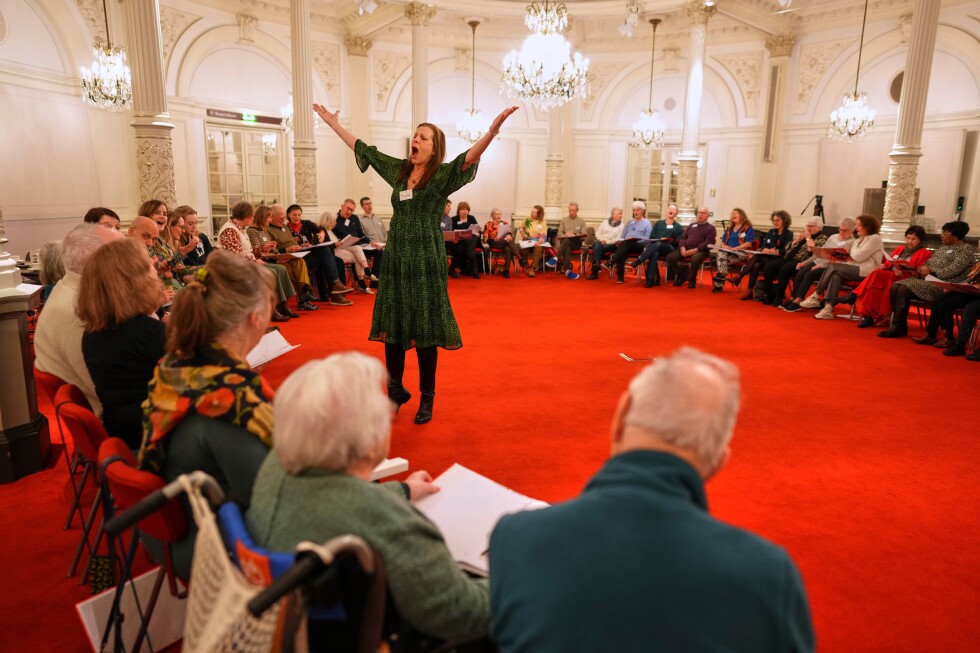
In the elegant Mirror Hall of Amsterdam’s renowned Concertgebouw concert hall, a unique form of therapy unfolds beneath 14 crystal chandeliers. Megan Worthy, 58, who suffers from a rare form of early-onset dementia, sits in a circle with other participants, their voices rising together in song.
“It’s pretty brutal,” Worthy says of her neurological condition, posterior cortical atrophy, which progressively impairs her vision and cognitive functions. “I’m starting to lose everything, you know, and this is really rewarding and seeing all these people, yeah, it did make me have a lot of memories.”
The “singing circle,” organized by opera singer Maartje de Lint, caters specifically to seniors with what she describes as “vulnerable brains” – many suffering from various forms of dementia, Alzheimer’s, or Parkinson’s disease. The weekly sessions, costing 20 euros ($23.50) per participant, have become a lifeline for many attendees.
For Worthy, who grew up singing in a choir in Canberra, Australia, the musical sessions transport her back to her youth, temporarily bridging the gap that her condition continually widens. Her daughter, Bronte Henfling, accompanies her to these sessions, finding value beyond the music itself.
“Just hearing everyone come together and sing… it reminds us that we’re all human and there’s a humanity out there which is really pleasing and nice to be a part of,” Henfling explains. She adds that simply visiting a venue for something other than a medical appointment provides a welcome change of perspective.
Dementia affects millions worldwide, manifesting as a progressive loss of memory, reasoning, language skills, and other cognitive functions. While Alzheimer’s remains the most recognized form, numerous other types exist, each with distinctive symptoms and underlying biology. Vascular dementia, for example, results from small strokes that impair blood flow to the brain.
De Lint, who moves energetically around the circle, often kneeling to connect with participants, believes in the power of music as therapy. “We always say, music is like vitamins,” echoes Selien Kneppers, 78, a regular attendee who once managed a Dutch boogie woogie and blues band.
“It’s like actually a training for the brain, for the body, to get more resilient and understand the perspective that you still have,” De Lint explains. Her organization conducts similar workshops across the Netherlands and throughout Europe.
The emotional impact of these hour-long sessions is palpable. Tissues are regularly distributed as participants and caregivers are moved to tears. During one session, participants sang classics ranging from Elvis Presley’s “Love Me Tender” to Frank Sinatra’s “Fly Me to the Moon” and the spiritual “Amazing Grace,” creating moments of deep connection – one man tenderly reached out to touch the face of the woman seated beside him as they sang.
The scientific community increasingly recognizes the therapeutic potential of music for neurological conditions. Neurobiologist Brankele Frank, who is not affiliated with De Lint’s initiative, confirms that singing can benefit those with neurodegenerative diseases.
“Music speaks to brain areas that haven’t really been degenerated yet,” Frank told The Associated Press. “Their verbal skills often are compromised, but music speaks to parts of the brain that don’t necessarily need verbal skills. And so it taps into their emotion, their sense of self, their identity.”
Current research explores music’s benefits for various conditions, including dementia, traumatic brain injuries, Parkinson’s disease, and stroke recovery. Music engages multiple brain regions simultaneously, strengthening neural connections between areas governing language, memories, emotions, and movement.
This emerging field of music therapy represents a non-pharmacological approach to improving quality of life for those with neurological conditions. For participants like Worthy, the singing circles offer more than just cognitive stimulation – they provide community, dignity, and moments of joy amid progressive illness.
As healthcare systems worldwide grapple with rising dementia cases, innovative approaches like De Lint’s singing circles may offer complementary support to traditional medical interventions, highlighting the importance of treating not just the condition, but the whole person.
Fact Checker
Verify the accuracy of this article using The Disinformation Commission analysis and real-time sources.

7 Comments
This is a great example of how the arts can be leveraged to enhance quality of life, even in the face of cognitive decline. The Concertgebouw’s singing circle sounds like a truly enriching and inclusive community initiative.
The Concertgebouw, with its stunning architecture, seems like the perfect setting for this type of music therapy. I can only imagine how uplifting it must be for the attendees to sing in such an iconic, historic venue.
It’s heartening to see how this singing circle has become a lifeline for participants like Megan Worthy. Connecting through music must be so rewarding, especially for those grappling with cognitive decline. Kudos to the organizers for creating this enriching community space.
Absolutely. Singing together in a supportive, judgment-free environment sounds incredibly beneficial for both the participants’ mental and emotional wellbeing.
As someone who enjoys choral singing, I can attest to the restorative power of communal music-making. It’s wonderful to see this opportunity extended to those living with dementia, who may find comfort and familiarity in the shared experience.
Agreed. The therapeutic effects of singing in a group setting are well-documented, and it’s heartening to see this applied to support vulnerable populations like those with dementia.
What a wonderful initiative to support those living with dementia. The power of music to evoke memories and bring joy is truly remarkable. I hope more venues follow the Concertgebouw’s lead in offering these meaningful, therapeutic sessions.