


Listen to the article
Venezuela Navigates Uncertain Future 30 Days After Maduro’s Capture
Time in Venezuela has taken on a surreal quality since the U.S. military operation that resulted in President Nicolás Maduro’s capture 30 days ago. For many Venezuelans, change seems to be happening both at breakneck speed and frustratingly slowly, creating a national atmosphere of confusion, cautious hope, and lingering fear.
In Caracas, government billboards demanding Maduro’s release contrast sharply with the political reality unfolding on the ground. Citizens are grappling with fundamental questions about their new leadership under acting President Delcy Rodríguez – whether she truly governs independently, represents continuity of Maduro’s policies, or is simply following Washington’s directives.
“It’s an important change, certainly, but everything is the same, everything,” said Julio Castillo, a 74-year-old retiree in Caracas. “I feel as if nothing much has happened.”
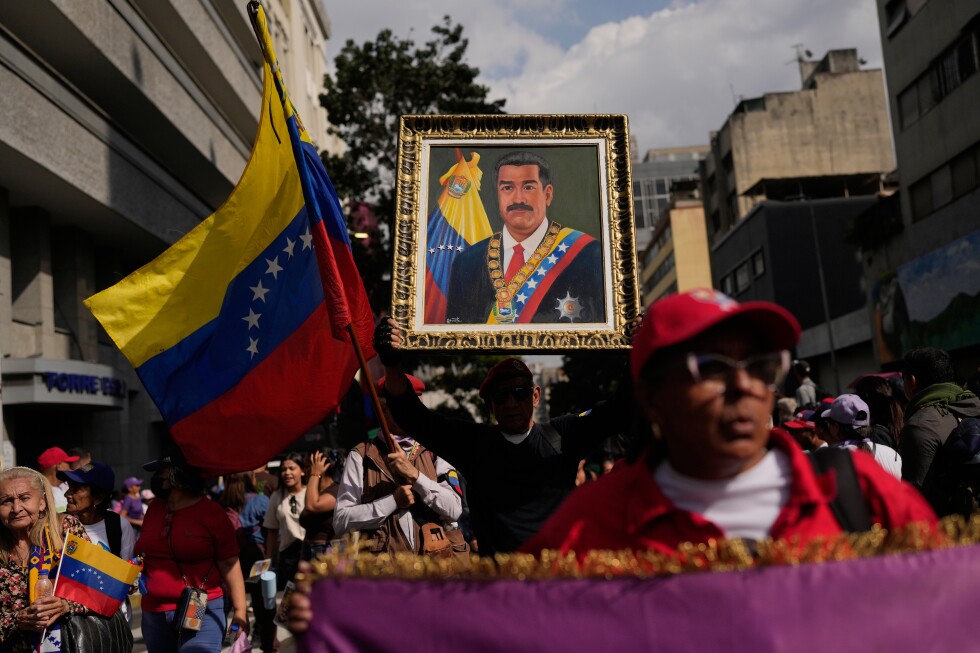
For government loyalists, the situation represents a profound crisis. They view Maduro and first lady Cilia Flores’ capture as a kidnapping, and Rodríguez has repeatedly pledged to fight for their release. The ruling Socialist party has organized demonstrations to show continued support for Maduro, who was handpicked by the late Hugo Chávez as his successor before dying in 2013.
However, the government’s rhetoric has notably shifted from threats of war with the United States to acknowledgment of their military disadvantage. José Vivens, a justice of the peace and Maduro supporter, expressed this changing stance: “The Venezuelan state, and Venezuelans, are accepting this new situation in which we are acting under coercion. They kidnapped our commander. And we have to give in because we have to live for another battle.”
Vivens was at his apartment when he heard the military operation unfolding nearby. “They’ve invaded us,” he initially thought as helicopters flew dangerously close to his building. Hours later, he learned that U.S. special forces had captured Maduro at a nearby compound.
Rodríguez has attempted to project strength and sovereignty despite the circumstances. “The people of Venezuela do not accept orders from any external factor,” she declared during a meeting with oil executives. “The people of Venezuela have a government, and this government obeys the people.”
Yet her actions tell a different story. In perhaps the most significant reversal of Chavismo economic doctrine, Rodríguez has overseen the swift approval of a new energy law that opens Venezuela’s oil sector to privatization – a fundamental departure from socialist principles established under Chávez. This move follows President Donald Trump’s assertion that his administration would take control of Venezuela’s oil exports and revitalize the industry through foreign investment.
The situation has left opposition supporters confused and frustrated. Many expected that Maduro’s removal would lead to opposition leader and Nobel Peace Prize laureate María Corina Machado taking power. Instead, the Trump administration has chosen to work with Rodríguez, a decision that has perplexed Maduro’s opponents.
Nevertheless, small signs of political opening have emerged. Opposition leaders who had been in hiding for more than a year have begun speaking publicly. A private television channel recently aired footage of Machado addressing reporters in Washington – something unthinkable just weeks ago. Additionally, groups of citizens have maintained vigils outside prisons, demanding the release of political prisoners.
“I believe that Venezuela’s destiny cannot be an oil agreement and a dictatorship headed by Delcy Rodríguez, because we could simply define that as a continuation of the dictatorship,” said opposition leader Andrés Velásquez, who recently reappeared after more than a year in hiding.
Despite these developments, fear continues to shape public behavior. Many Venezuelans still self-censor, avoiding political discussions in social media posts and carefully monitoring their communications. No large anti-government demonstrations have materialized, nor have there been public celebrations of Maduro’s capture. Wanted posters for opposition presidential candidate Edmundo González remain displayed in government buildings.
The psychological impact of the January 3 operation has been profound, particularly for those living near the site of Maduro’s capture. Margaret García described how her son couldn’t sleep for days afterward and feared returning to school. “We thought we were going to die,” she recalled of the moment her family heard a helicopter open fire near their apartment building.
Many Venezuelans fear potential further U.S. military action if Rodríguez fails to meet Washington’s expectations, though U.S. Secretary of State Marco Rubio has explicitly stated: “We are not postured to nor do we intend or expect to have to take any military action in Venezuela at any time.”
For ordinary Venezuelans like García, a teacher, the immediate concern is economic survival. Public sector workers earn roughly $160 monthly, while private sector employees average about $237 – stark figures compared to Venezuela’s official minimum wage of just 130 bolivars ($0.35), unchanged since 2022 and far below the UN’s extreme poverty threshold of $2.15 daily.
“We see that a negative moment has brought us positive things,” García said, referring to potential economic improvements that Rodríguez has suggested will accompany Venezuela’s oil sector revitalization.
As Venezuela moves into its second month of this unprecedented political arrangement, citizens remain caught between hope for economic relief and fear of renewed turmoil – with no clear resolution in sight.
Fact Checker
Verify the accuracy of this article using The Disinformation Commission analysis and real-time sources.

8 Comments
This is a complex and delicate transition that will require nuanced policymaking and diplomacy. It will be interesting to see how the new administration navigates the balance between continuity and change, and whether they can forge a path that brings stability and prosperity to Venezuela.
This is a pivotal moment for Venezuela. While the change in leadership is significant, it’s clear that uncertainty and unease still linger among the populace. I’m curious to see how the new acting president navigates the complex political landscape and addresses the fundamental challenges facing the country.
Agreed, the transition of power brings both hope and concern. It will be important to monitor how the new administration’s policies and actions play out on the ground.
This is a pivotal moment for Venezuela, and the nation’s future hangs in the balance. The new leadership must find a way to bridge the divides, address the economic and humanitarian crises, and restore hope and trust among the Venezuelan people. The path forward will not be easy, but the stakes are high.
The contrasting scenes of government billboards and the political reality on the streets highlight the fragility of the situation in Venezuela. It will be critical for the new leadership to bridge the divides and chart a path forward that addresses the needs and concerns of all Venezuelans, not just political loyalists.
Absolutely. Rebuilding trust and fostering a sense of unity will be essential if the country is to move beyond the current turmoil.
The capture of President Maduro is a significant development, but as the article suggests, the real test will be in how the new leadership governs and addresses the deep-rooted challenges facing the country. I hope they can find a way to bring about positive change while maintaining stability.
Well said. The road ahead will be arduous, but the opportunity for meaningful reform is there if the new administration can chart the right course.