


Listen to the article
The United States military has deployed an unprecedented force to the Caribbean Sea and waters off Venezuela’s coast as part of what officials describe as anti-drug trafficking operations. Since this summer, approximately 15,000 personnel have been positioned in the region, marking the largest American military buildup in the area in generations.
This massive deployment represents a significant escalation in the Trump administration’s pressure campaign against Venezuelan President Nicolás Maduro, who faces narco-terrorism charges in the United States. Since early September, the operation has included strikes against suspected drug-running vessels that have reportedly resulted in more than 100 casualties.
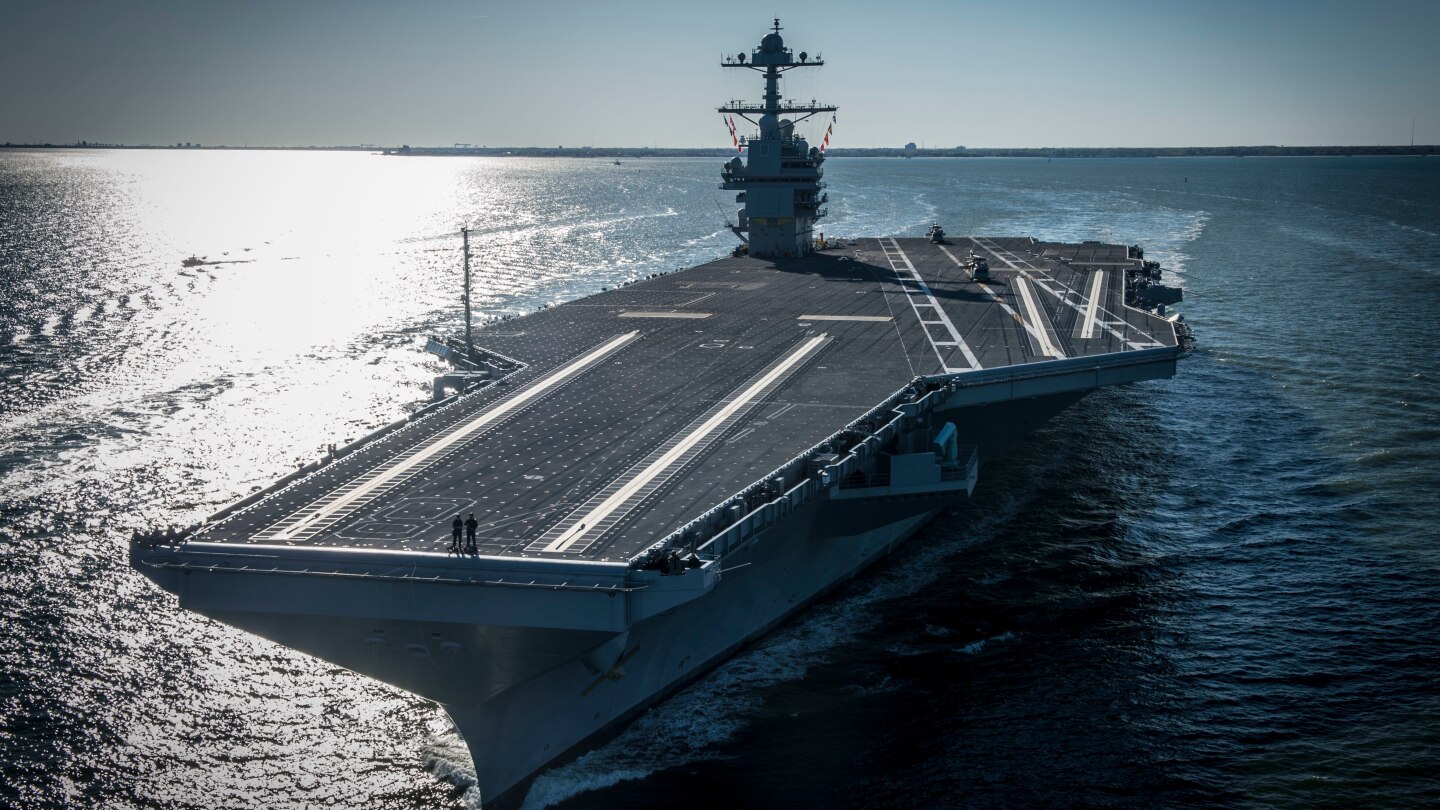
The naval component of this force is particularly substantial, featuring 11 warships led by the USS Gerald R. Ford, America’s largest aircraft carrier. The fleet includes five destroyers, two cruisers, and three amphibious assault ships that comprise an amphibious readiness group carrying a Marine expeditionary unit.
These amphibious vessels are equipped with Marine helicopters, Osprey tilt-rotor aircraft, and Harrier jets capable of transporting Marines or conducting strikes against land and sea targets. Meanwhile, the USS Ford carries multiple squadrons of fighter jets and other aircraft, significantly boosting the force’s offensive capabilities.
Military analysts note that the destroyers and cruisers typically deploy with Tomahawk cruise missiles, which can strike targets hundreds of miles inland from their launch positions at sea. Additionally, a U.S. Navy submarine capable of launching cruise missiles is operating in the broader South American region, further extending the military’s reach.
The air component of this deployment has seen considerable reinforcement as well. A squadron of advanced U.S. Marine Corps F-35B Lightning II jets has been stationed at an airstrip in Puerto Rico since mid-September. U.S. Navy EA-18G “Growler” electronic warfare jets have also been observed operating from the island territory.
MQ-9 Reaper drones, capable of long-distance surveillance and armed with laser-guided missiles, have been spotted by commercial satellites and photojournalists in Puerto Rico. The Navy is reportedly operating P-8 Poseidon maritime patrol aircraft in the region, while the Air Force has deployed the heavily armed AC-130J Ghostrider, which can deliver precision fire against ground targets.
The Pentagon has conducted numerous training flights in the area, including missions by B-52 Stratofortress and B-1 Lancer bombers. At least one such operation was described in military photos as a “bomber attack demo,” suggesting a demonstration of force. In a particularly notable incident, a pair of F/A-18 fighter jets recently flew over the Gulf of Venezuela—reportedly the closest American warplanes have approached Venezuelan airspace during this campaign.
The Gulf of Venezuela, which is bounded by the South American nation and spans only about 150 miles at its widest point, saw these fighter jets maintain presence for more than 30 minutes, in what regional security experts interpret as a clear signal to the Maduro regime.
Of the 15,000 personnel deployed to the region, nearly 10,000 are sailors and Marines aboard the various warships. U.S. Southern Command has declined to provide a detailed breakdown of the remaining forces, citing operational security concerns.
Southern Command spokesperson Lt. Col. Emanuel Ortiz confirmed via email that the total figure “includes all military services and government civilians in support of this mission,” though specific numbers regarding drones, aircraft, and ground crew remain undisclosed.
This buildup occurs against the backdrop of deteriorating economic and humanitarian conditions in Venezuela and heightened tensions between Washington and Caracas. The scale of the deployment suggests that anti-drug operations may be just one aspect of a broader strategic positioning in the region, as the United States maintains pressure on a government it has repeatedly characterized as illegitimate.
Fact Checker
Verify the accuracy of this article using The Disinformation Commission analysis and real-time sources.

5 Comments
This seems like a pretty massive deployment of US forces to the Caribbean. I’m curious to see how this plays out and what the long-term implications might be for regional stability and US-Venezuela relations.
Wow, 15,000 US personnel and a huge naval force in the Caribbean – that’s a huge show of force. I wonder if this is just about counter-narcotics, or if there are deeper strategic considerations at work when it comes to the US and Venezuela.
Interesting to see such a large US military presence near Venezuela. I wonder what the strategic objectives are – drug interdiction, pressuring Maduro, or something else? Either way, it seems like a significant escalation of tensions in the region.
This is a pretty dramatic escalation of the US military presence near Venezuela. I’ll be curious to see how the Maduro government responds, and whether this ratchets up tensions further in the region.
The scale of this US military buildup near Venezuela is quite remarkable. I’d be interested to know more about the specific reasoning and goals behind this operation. Is it primarily focused on anti-drug efforts, or are there broader geopolitical factors at play?