


Listen to the article
A South Korean court on Thursday sentenced former President Yoon Suk Yeol to life imprisonment for his brief declaration of martial law in December 2024, ruling that his actions constituted rebellion against the state. The verdict marks a dramatic conclusion to a case that has shaken South Korea’s democratic foundations and represents an unprecedented legal reckoning for a former head of state.
Yoon, who remained defiant throughout the 10-month trial, had insisted his declaration of martial law was a legitimate exercise of presidential authority aimed at countering his political opponents. The court, however, determined that his actions amounted to an illegal attempt to seize control of the legislature and election offices while planning to arrest political rivals.
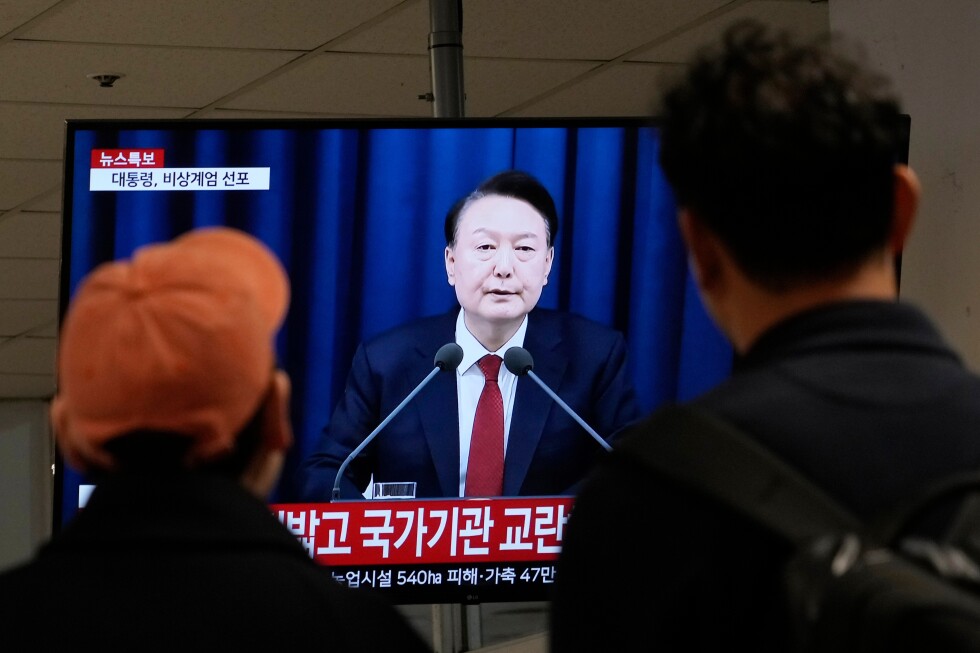
The crisis began on December 3, 2024, when Yoon made a surprise late-night television announcement declaring martial law across South Korea. In his address, he characterized the opposition-controlled National Assembly as a “den of criminals” that was paralyzing government affairs and vowed to “eradicate” what he called “anti-state” liberal opponents. Hundreds of heavily armed troops and police immediately surrounded the National Assembly building.
The legislature responded swiftly. Shortly after midnight, National Assembly Speaker Woo Won Shik announced plans to counter Yoon’s decree through “constitutional procedure.” By 1 a.m., 190 lawmakers, including 18 from Yoon’s own People Power Party, voted unanimously to lift the martial law. Military forces began withdrawing, and by 4:30 a.m., the martial law was formally lifted following an emergency Cabinet meeting.
The political fallout was immediate. Prosecutors detained then-Defense Minister Kim Yong Hyun for his role in planning and executing the martial law declaration. Days later, on December 14, the National Assembly impeached Yoon with a decisive 204-85 vote, temporarily transferring power to Prime Minister Han Duck-soo.
The legal pursuit of Yoon proved challenging. When investigators first attempted to detain him at the presidential residence in Seoul on January 3, 2025, they were blocked by presidential security forces. It wasn’t until January 15 that anti-corruption investigators and police successfully raided the presidential compound and detained Yoon—making him the first sitting South Korean president to be arrested.
On January 26, the Seoul Central District Prosecutors’ Office indicted Yoon for orchestrating an attempted rebellion. Prosecutors described his actions as an illegal bid to seize control of democratic institutions and arrest political opponents. The indictment triggered violent protests from Yoon’s supporters, who broke into the courthouse, smashing windows and equipment, resulting in approximately 90 arrests.
The Constitutional Court formally removed Yoon from office on April 4, 2025, upholding the National Assembly’s impeachment and triggering a special election. Democratic Party candidate Lee Jae Myung, Yoon’s liberal rival, was elected as South Korea’s new president on June 3.
As investigations progressed, Yoon faced additional charges, including allegations that he ordered drone flights over North Korea to deliberately stoke tensions and justify his martial law plans. His inner circle also faced legal consequences, with former Prime Minister Han receiving a 23-year prison sentence for abetting Yoon’s actions, and Yoon’s wife, Kim Keon Hee, sentenced to 20 months for corruption.
Throughout the proceedings, Yoon maintained that his actions were necessary and legitimate responses to what he characterized as obstruction by his liberal rivals, who held a majority in the National Assembly. His defense team has not yet announced whether they will appeal the life sentence.
The conviction of Yoon represents the most severe punishment of a former South Korean head of state in the country’s democratic history and signals the judiciary’s strong stance against attempts to undermine constitutional order. Political analysts note that the case has deeply polarized South Korean society, with conservatives viewing the prosecution as politically motivated and progressives seeing it as a necessary defense of democratic principles.
Fact Checker
Verify the accuracy of this article using The Disinformation Commission analysis and real-time sources.

12 Comments
The former president’s actions seem to have been a clear abuse of power. While the details may be nuanced, the court’s verdict underscores the importance of checks and balances in a healthy democracy. South Koreans will be watching closely to see how this case unfolds.
While the former president’s actions were extreme, I’m concerned that this conviction could set a dangerous precedent for the politicization of the judiciary. Careful oversight and impartiality will be essential as this case progresses.
This is a complex and sensitive issue, with strong arguments on both sides. While I respect the court’s decision, I hope the former president is treated fairly and given the opportunity to appeal. Preserving democratic norms is paramount, but so is due process.
That’s a fair perspective. Upholding the rule of law is essential, but it’s also important to ensure a fair and impartial judicial process. South Korea’s stability and democratic progress will depend on how this case is ultimately resolved.
This is a troubling situation that highlights the fragility of democratic institutions, even in relatively stable countries like South Korea. I hope the judicial process is transparent and that the country can emerge from this crisis with its democratic foundations strengthened.
Agreed. Maintaining public trust in the legal system will be crucial. South Koreans deserve to have confidence that their democratic rights and freedoms will be protected, regardless of political affiliations.
This is a concerning development for South Korea’s democracy. While the former president may have believed his actions were justified, the court’s ruling suggests he overstepped his authority. It will be important to see how the country moves forward and upholds the rule of law.
Absolutely. The conviction of a former head of state is always a serious matter. South Koreans will no doubt be closely watching to ensure a fair and transparent process as this case unfolds.
This case underscores the importance of strong, independent institutions that can hold even the highest-ranking officials accountable. South Korea’s democracy has faced significant challenges, and this verdict will be a crucial test of its resilience.
Absolutely. The country’s democratic future will depend on its ability to navigate this crisis in a way that upholds the rule of law and protects the integrity of its political system.
The declaration of martial law is a very serious matter, and I’m glad the courts have held the former president accountable. It’s critical that democratic institutions and the rule of law are protected, even in the face of political turmoil.
I agree. South Korea’s democracy has weathered many challenges, and this case will test its resilience. Maintaining faith in the judicial system will be crucial going forward.