


Listen to the article
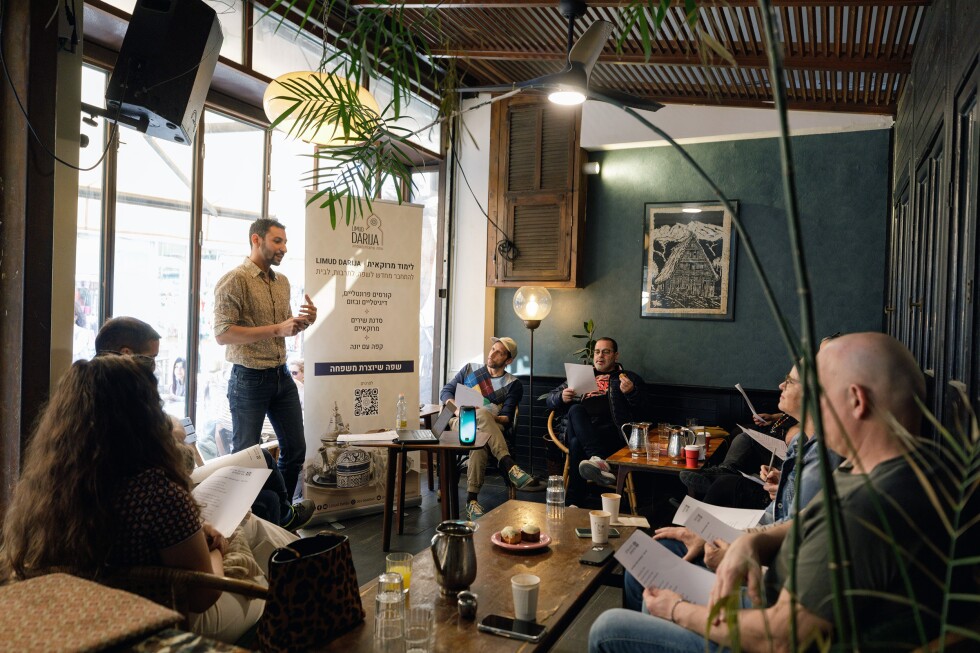
The melodic sounds of Moroccan Arabic, known as Darija, fill the virtual classroom as Yona Elfassi guides his students through pronunciation exercises. For these participants, mostly Israeli Jews of Moroccan descent, these lessons represent more than language acquisition—they are reclaiming a piece of their heritage that many thought was lost forever.
Growing up in the ancient city of Fez, Morocco, Elfassi was immersed in a rich tapestry of cultures and languages. His childhood home echoed with Moroccan Arabic, French, and Hebrew prayers from synagogue visits, while his father also spoke Amazigh, the Berber language. This multicultural environment was complemented by diverse musical traditions—from Andalusian and Flamenco to classical Moroccan and popular chaabi music.
“We weren’t a family of professional musicians, but we were a family that lived with music,” explains Elfassi, 37, who now holds doctorates in sociology and political science from Sciences Po Bordeaux and in anthropology and history from Ben-Gurion University of the Negev.
Elfassi represents a diminishing demographic. Today, only about 2,500 Jews remain in Morocco, where they once constituted 5% of the population. Major waves of emigration throughout the 20th century scattered the community across the globe, with approximately 50,000 Moroccan Jews now living in France, 25,000 in Canada, 25,000 in the United States, and roughly one million in Israel—where they form one of the country’s largest ethnic groups.
His academic research into Moroccan Jewish identity eventually evolved into something more personal: a mission to reconnect diaspora Moroccan Jews with their ancestral language and culture. “As a sociologist, I was fueled by the conviction that academic research ought to forge connections and deepen understanding beyond the academy,” Elfassi says.
This conviction led him to establish Limud Darija as the pandemic restrictions eased. This educational platform offers hybrid language courses combining virtual instruction with in-person gatherings in Israel. The curriculum extends beyond mere vocabulary and grammar to include music workshops featuring Sephardic liturgical poems with Judeo-Arabic pronunciation and melodies from renowned 20th-century Moroccan artists like Haja El Hamdaouia and Abdelhadi Belkhayat.
The program has flourished rapidly, now boasting over 500 active participants. “Our mission is connecting people across generations, helping participants reclaim lost voices and fostering resilience and a sense of belonging through cultural practices,” Elfassi explains.
Unexpectedly, Elfassi’s social media presence on Instagram and TikTok has attracted attention from Muslim Moroccans, who are heartened to see Moroccan Jews preserving their shared linguistic heritage. This cultural exchange has flowed in both directions, with Muslims expressing interest in learning Hebrew, prompting Elfassi to create a WhatsApp group dedicated to teaching Hebrew to Darija-speaking Muslims.
“Through this shared connection, divisions begin to fade,” Elfassi observes. “The Israelis the Muslim Moroccans meet are seen as Moroccans like themselves, as family. They are talking a common language, talking about what unites them.” He emphasizes that these interactions focus on cultural bonds rather than political differences, allowing participants to “humanize everyone as individuals, as human beings.”
The impact of Limud Darija extends to participants’ personal lives. Yehudit Levy, a retired Israeli schoolteacher who has studied with Elfassi for three years, describes how the classes have rekindled forgotten memories: “My parents talked between them in Moroccan language, but by the time I was an adult, I forgot. Since I started to learn with Yona, everything comes up—songs, music, food, poetry, all the traditional things. I smell Morocco when I am in the class.”
Noam Sibony, a 28-year-old neuroscience researcher and musician in Toronto, applied lessons from Limud Darija during nine months of volunteer work in Lod, Israel, where he worked with Arab and Jewish youth at a community center. The program showed him how language learning can build bridges that transcend regional conflicts.
The value of such cultural preservation extends beyond the Moroccan Jewish diaspora. Habiba Boumlik, a professor at LaGuardia University in New York who co-founded the New York Forum of Amazigh Film, sees parallels between Elfassi’s work and her own efforts to preserve Tamazight, the language of North Africa’s Indigenous Berber people.
“I give credit to people who invest in learning language,” Boumlik notes. “Even if people aren’t fluent, they can do so much with the language, and they will go to Morocco and connect more deeply.”
She points out that Darija’s close relationship with Judeo-Arabic dialects creates potential for mutual linguistic enrichment, similar to how Judeo-Arabic expressions have influenced Modern Hebrew.
For Elfassi, these interpersonal connections represent grassroots peacebuilding. “For me, peace will start with people, not with the decision-makers,” he says. “Peace is just two people talking to each other, having respect for each other and having a conversation where they can disagree, but where they always show respect for the humanity of the other.”
Fact Checker
Verify the accuracy of this article using The Disinformation Commission analysis and real-time sources.

14 Comments
It’s impressive how the instructor, Yona Elfassi, has such a diverse cultural and linguistic background himself. Integrating Moroccan Arabic, French, Hebrew, and Amazigh in his upbringing must have provided him with unique insights to share with his students.
Elfassi’s personal experience growing up in a multicultural environment is likely a big part of what makes him so effective as a language teacher. He can draw on that rich tapestry of influences to make the lessons more meaningful and engaging for his students.
It’s fascinating to learn about the multilingual upbringing of someone like Yona Elfassi, who grew up speaking Moroccan Arabic, French, Hebrew, and Amazigh. That kind of linguistic fluency and cultural awareness is becoming increasingly rare, so initiatives to pass it on are vital.
I agree, Elfassi’s background makes him exceptionally well-suited to lead these language courses and share his deep understanding of Moroccan Jewish culture. His personal experiences lend authenticity and nuance to the lessons.
The virtual language lessons described in the article are an innovative way to reach a broader audience and connect Moroccan Jews around the world with their cultural roots. Leveraging technology to teach endangered languages is a smart approach in today’s global landscape.
I agree, the virtual format of these language courses allows them to have a wider impact and engage participants who may be scattered across different countries. Maintaining that connection to Moroccan Jewish culture is invaluable, even as the community’s physical presence in the region diminishes.
The diverse musical influences mentioned, from Andalusian to Flamenco to classical Moroccan, highlight just how rich and interconnected the cultural fabric of Morocco is. Celebrating that diversity through language education is an important way to bridge divides.
Absolutely, the musical traditions described are a wonderful example of the vibrant cultural exchange that has occurred in Morocco over the centuries. Preserving that heritage through language learning is a noble endeavor.
This is a fascinating story about preserving and reviving an important part of Moroccan Jewish cultural heritage. The language lessons described seem like a great way to reconnect younger generations with their roots and bridge divides between communities.
I’m glad to see initiatives like this that aim to preserve cultural and linguistic diversity. It’s wonderful that these language lessons are helping to keep the Darija dialect alive and pass it on to the next generation.
The dwindling Jewish population in Morocco is concerning, but initiatives like this language course seem like an important step in preserving that community’s cultural heritage. Keeping the Darija dialect alive is crucial, especially as fewer native speakers remain.
I agree, it’s critical to document and revitalize endangered languages and cultures before they are lost forever. This language course appears to be doing valuable work in that regard, which is admirable.
The fact that only around 2,500 Jews remain in Morocco today, down from 5% of the population, is a sobering statistic. Preserving the Darija language and other elements of Moroccan Jewish heritage is crucial to preventing the complete erosion of this community’s cultural identity.
Absolutely, with such a small Jewish population left in Morocco, efforts to revive the language and traditions are all the more important. This course seems like a meaningful way to keep that part of Moroccan history and diversity alive.