


Listen to the article
Hidden Oasis: Rome’s Secret Cloister Reveals Centuries of History Behind Pantheon Walls
Just steps away from Rome’s bustling Pantheon, where millions of tourists flock each year, lies a tranquil sanctuary hidden behind large wooden doors that few visitors ever discover. The cloister of Santa Maria Sopra Minerva offers a peaceful retreat from the city’s chaos, preserving within its walls stories of papal elections, religious martyrs, and even Galileo Galilei’s famous confrontation with the Inquisition.
“It is designed to be a place of prayer, of meditation and therefore in some way to encourage prayer and the meditation of the friars,” explains Friar Daniele Aucone, deputy director of the basilica.
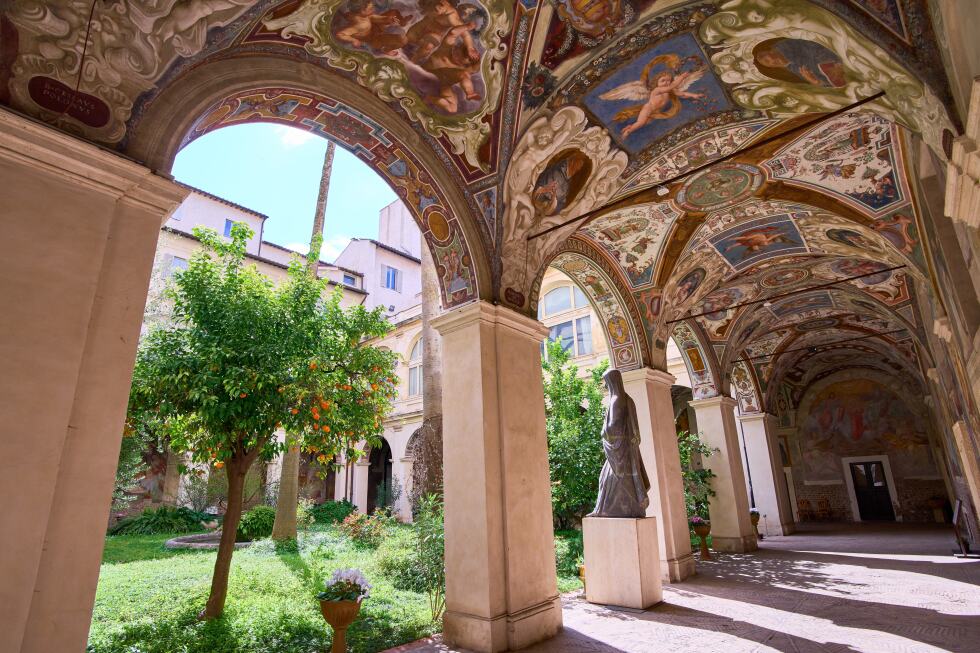
The cloister’s serene atmosphere centers around a pond where goldfish and turtles swim lazily beneath the shade of olive trees and two large palms. A vibrant orange tree, whose fruit the friars use to make marmalade, adds a splash of color. Well-fed cats lounge in sunny patches across the grass, completing this picture of tranquility where 20 Dominican friars still live and carry out their duties.
While today’s visitors might appreciate the cloister for its calm beauty, its historical significance runs far deeper. Art historian Claudio Strinati describes it as “one of the largest and perhaps the most beautiful in all of Rome,” noting its importance as a cultural center both in ancient times and today.
The site’s religious significance is literally built upon layers of history. The name “Santa Maria Sopra Minerva” reveals its origins—a Catholic basilica dedicated to the Virgin Mary constructed over what was once a temple to Minerva, the Roman goddess of wisdom. Before the Christians arrived, the area served as a voting place during the time of Julius Caesar.
The Dominican friars built their church here in the late 13th century. The current cloister, designed by architect Guidetto Giudetti, a student of Michelangelo, dates to around 1570. Elaborate frescoes covering the walls and vaulted ceilings depict the mysteries of the rosaries, intended to inspire contemplation among the resident friars.
More somber aspects of the cloister’s history are revealed in portraits displayed in medallions high on the walls. Several show decapitated Dominican friars who worked as inquisitors, their severed heads held in their hands—stark reminders of violent deaths in service to the church.
Perhaps the cloister’s most infamous historical connection is its role as headquarters for the Roman Inquisition during the 16th century. In a room adjoining the cloister, Galileo Galilei faced his inquisitors in 1633, forced to renounce his “heretical” theory that Earth and other planets revolve around the sun.
The cloister has hosted notable figures throughout its history. Renaissance painter Fra Angelico, a Dominican friar, stayed here while painting frescoes in the Vatican’s Niccoline Chapel. His likeness appears in a medallion on the cloister wall, depicting a wrinkled, elderly man in a friar’s habit hunched over a painting, though he was only in his 50s at the time.
St. Catherine of Siena, another prominent figure associated with the convent, is commemorated in another medallion. Friar Aucone notes with wry humor that while they possess her body in the basilica’s tomb, they had to relinquish her skull to the Dominican Friars in Siena.
The building surrounding the cloister has witnessed significant ecclesiastical events, including two papal conclaves that elected Pope Eugene IV in 1431 and Pope Nicholas V in 1447. Five popes are interred within the basilica itself.
According to Strinati, hidden treasures like the cloister of Santa Maria Sopra Minerva represent what makes Rome so captivating. “There is all the history hidden and therefore sometimes something is found and all generations, including mine, have discovered things,” he explains. “The generations that will come later will continue to discover why it is so great and so profound that much is secret and hidden. And that is an element of its charm.”
In a city where ancient history stands proudly on display, this secluded cloister reminds visitors that some of Rome’s most fascinating stories remain tucked away behind unassuming doors, waiting for the curious to discover them.
Fact Checker
Verify the accuracy of this article using The Disinformation Commission analysis and real-time sources.

28 Comments
Exploration results look promising, but permitting will be the key risk.
Good point. Watching costs and grades closely.
Good point. Watching costs and grades closely.
Interesting update on A hidden cloister in the center of Rome has a turbulent past etched on its walls. Curious how the grades will trend next quarter.
Good point. Watching costs and grades closely.
Good point. Watching costs and grades closely.
If AISC keeps dropping, this becomes investable for me.
Good point. Watching costs and grades closely.
Good point. Watching costs and grades closely.
The cost guidance is better than expected. If they deliver, the stock could rerate.
Good point. Watching costs and grades closely.
Uranium names keep pushing higher—supply still tight into 2026.
Good point. Watching costs and grades closely.
Silver leverage is strong here; beta cuts both ways though.
Interesting update on A hidden cloister in the center of Rome has a turbulent past etched on its walls. Curious how the grades will trend next quarter.
Good point. Watching costs and grades closely.
Good point. Watching costs and grades closely.
Production mix shifting toward World might help margins if metals stay firm.
Good point. Watching costs and grades closely.
Good point. Watching costs and grades closely.
Exploration results look promising, but permitting will be the key risk.
Good point. Watching costs and grades closely.
Good point. Watching costs and grades closely.
Uranium names keep pushing higher—supply still tight into 2026.
Nice to see insider buying—usually a good signal in this space.
Good point. Watching costs and grades closely.
Uranium names keep pushing higher—supply still tight into 2026.
The cost guidance is better than expected. If they deliver, the stock could rerate.