


Listen to the article
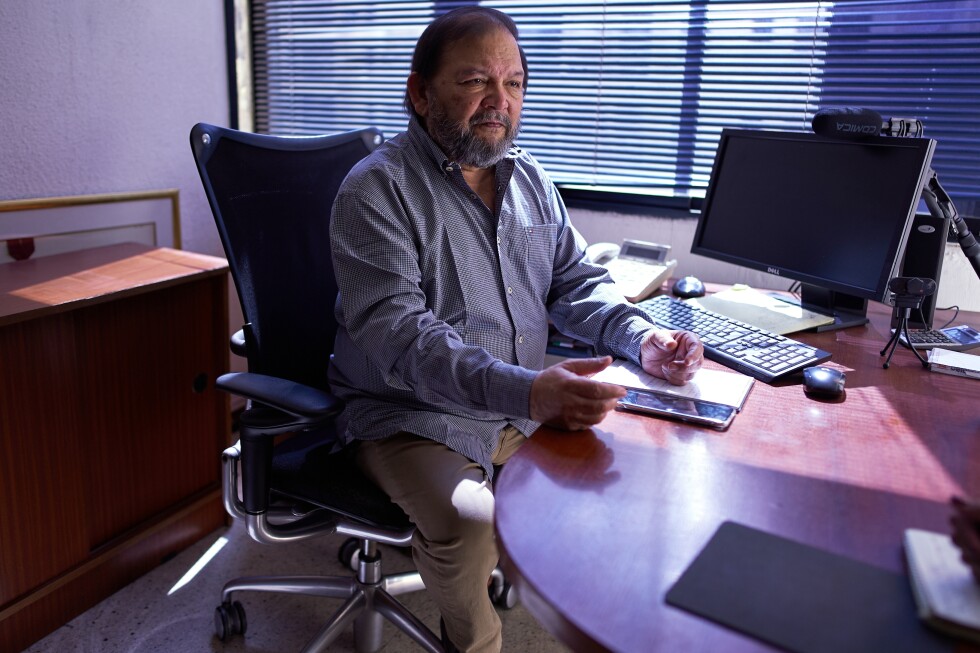
Andrés Velásquez didn’t stick around to become another government critic jailed after Venezuela’s 2024 presidential election. The former governor, who had campaigned for President Nicolás Maduro’s opponent, grew a thick beard, sent his children into exile, and avoided public events that might expose him to arrest.
But in the aftermath of Maduro’s overthrow by the United States, Velásquez found the courage to speak out. On January 19, he appeared in a video supporting Maduro’s removal while calling for new elections. Days later, he recorded a short video outside the infamous Helicoide prison in Caracas, demanding the release of all political prisoners.
“We must dismantle the entire repressive apparatus in the hands of the state,” Velásquez declared. “Venezuela will be free!”
Velásquez isn’t alone. Since Maduro’s ouster, numerous critics have emerged from hiding to test the boundaries of political expression after years of self-imposed silence. Families of jailed activists are protesting outside prisons, while freed detainees defy the gag orders typically imposed as conditions for release. Media outlets have begun reopening their airwaves to critical voices banished in recent years.
This political liberalization, although still in its early stages, has been compared by Velásquez to glasnost, the era of reforms and public debate that preceded the Soviet Union’s collapse. Unlike other democratic openings, however, this one is occurring largely under the Trump administration’s guidance, which has used financial incentives and threats of additional military strikes to fulfill the president’s pledge to “run” Venezuela from Washington.
The Trump administration’s ultimate goal remains unclear. While the White House has praised acting President Delcy Rodríguez’s willingness to partner with the U.S. to develop Venezuela’s vast oil reserves, combat criminal networks, and curb the influence of American adversaries Iran and Russia, opposition figures worry that demands for elections and democratic restoration could be indefinitely delayed.
Last week, Rodríguez, a longtime Maduro ally, announced plans for a general amnesty that could free hundreds of opposition leaders, journalists, and human rights activists detained for political reasons. She also announced the closure of Helicoide, vowing to transform the spiral-shaped building—once a futuristic architectural icon turned symbol of Maduro’s repression—into a sports and cultural complex.
“May this law serve to heal the wounds left by the political confrontation fueled by violence and extremism,” she said, surrounded by ruling-party loyalists.
Pedro Vaca, the Inter-American Commission on Human Rights’ top freedom of expression expert, cautions that these “breadcrumbs” offered by Rodríguez’s administration cannot replace an independent judiciary and law enforcement.
“Venezuela’s civic space is still a desert,” said Vaca, who has been seeking permission to lead an assessment mission to the country. “The few critical voices emerging are seeds breaking through hardened ground, surviving not because freedom exists, but because repression has loosened while remaining ever-present.”
Political pluralism has been severely eroded in Venezuela since Maduro succeeded Hugo Chávez in 2013. The repression intensified following the July 2024 elections, when Maduro launched a wave of arbitrary detentions while rejecting evidence showing he had lost to opposition candidate Edmundo González by more than a two-to-one margin.
In an interview, Velásquez said he will continue pushing the boundaries of permitted political activity but remains cautious since the state’s repressive apparatus remains under Rodríguez and her allies’ control.
“We must continue winning back lost terrain, challenging power. An opportunity has opened up and we can’t let it close again,” he said. “But the biggest obstacle we have to overcome is fear.”
Media outlets have also begun exercising more freedom. Venevision, which like most private networks abandoned critical coverage in recent years, has reopened its airwaves to opposition voices, covering opposition leader María Corina Machado’s activities in Washington since Maduro’s capture. Globovisión invited back prominent commentator Vladimir Villegas, whose political talk show was abruptly canceled in 2020 after he criticized Maduro.
However, some of Rodríguez’s allies appear intent on suppressing criticism. Interior Minister Diosdado Cabello—wanted by the U.S. on drug charges—accused media of participating in a plot by Nobel Prize winner Machado to create chaos in Venezuela after Venevision covered her meeting with Secretary of State Marco Rubio.
Even on state television, traditionally a bastion of pro-government propaganda, cracks are appearing. During Rodríguez’s recent tour of a university campus in Caracas, state TV showed her calmly separating from her security detail to “exchange ideas” with student protesters—a scene unimaginable weeks ago under Maduro, who banned live broadcasts of his public appearances after several embarrassing disruptions.
While Venezuela’s democratic future remains uncertain, government critics hope Rodríguez has unleashed forces beyond her control. Meanwhile, they continue drawing inspiration from those who suffered repression firsthand, like journalist Carlos Julio Rojas, who spent 638 days in a Venezuelan prison where he claims he was repeatedly handcuffed, denied sunlight, and confined to a tiny cell without a bed.
Upon his release last month as part of Rodríguez’s goodwill gesture, Rojas says he was instructed never to discuss the abuse. His mandated silence lasted barely two weeks.
“For me, not speaking meant I still felt imprisoned. Not speaking was a form of torture,” said Rojas, who was accused without evidence of participating in a 2024 assassination plot against Maduro. “So, today, I decided to remove the gag and speak.”
Fact Checker
Verify the accuracy of this article using The Disinformation Commission analysis and real-time sources.

17 Comments
The bravery of Venezuelans like Velásquez in speaking out against the Maduro regime is admirable, but the path to true democratic reform remains uncertain and fraught with risk. The international community must continue to apply pressure and provide support to protect the rights of Venezuelan citizens.
It’s heartening to see Venezuelans like Velásquez finding the courage to speak out against the repressive Maduro government. However, the path to true democratic reform remains uncertain and fraught with risk.
While the bravery of dissidents like Velásquez is commendable, the entrenched power of the Maduro regime should not be underestimated. Rebuilding Venezuela’s democratic institutions will require sustained effort and international support.
The resilience of Venezuelan citizens in the face of authoritarianism is admirable. While the road to true democratic reform remains uncertain, their willingness to test the limits of free speech is a glimmer of hope.
The emergence of critical voices challenging the Maduro regime is an encouraging development, but the road ahead for Venezuela’s democratic transition remains long and arduous.
Agreed. The international community must continue to support the efforts of Venezuelan citizens to reclaim their political freedoms and build a more just and accountable system of governance.
Cautious optimism for Venezuela’s democratic future. The emerging voices of opposition challenging the authoritarian status quo are an encouraging sign, though the path ahead remains fraught with risk and uncertainty.
Indeed, the bravery of dissidents like Velásquez in speaking out is commendable, but the entrenched power structures of the Maduro regime will not give up easily.
This is a complex and delicate situation. While the desire for free speech and political reform is understandable, the potential for backlash and crackdown from the government remains a major concern.
Agreed. The international community will need to carefully monitor the situation and apply pressure to protect the rights of Venezuelan citizens.
Dismantling the repressive apparatus built up under Maduro’s rule will be a massive challenge. The opponents of the regime face an uphill battle, but their determination to speak out is a positive step.
Rebuilding democratic institutions and the rule of law in Venezuela will require sustained effort and support from the international community. The path forward is fraught with obstacles.
This is a complex and delicate situation that requires careful monitoring and support from the international community. While the emergence of critical voices is encouraging, the entrenched power of the Maduro regime remains a formidable obstacle to democratic reform.
The willingness of Venezuelans to test the limits of free speech is a positive sign, but the path to true democratic reform remains fraught with risk and uncertainty. The international community must remain vigilant in protecting the rights of Venezuelan citizens.
Agreed. The road ahead for Venezuela will be long and difficult, but the determination of its people to reclaim their political freedoms is a source of hope.
This is a delicate and complex situation that bears close watching. The emergence of critical voices is a positive sign, but the entrenched power of the Maduro regime should not be underestimated.
Agreed. The international community will need to provide support and pressure to protect the rights of Venezuelan citizens and nurture the growth of democratic institutions.