


Listen to the article
Thousands of Gaza Patients Await Evacuation as Rafah Border Reopens
Fifteen-year-old Rimas Abu Lehia sits in her wheelchair, tears streaming down her face as she describes her daily struggles. “I wish I didn’t have to sit in this chair,” she says. “I need help to stand, to dress, to go to the bathroom.”
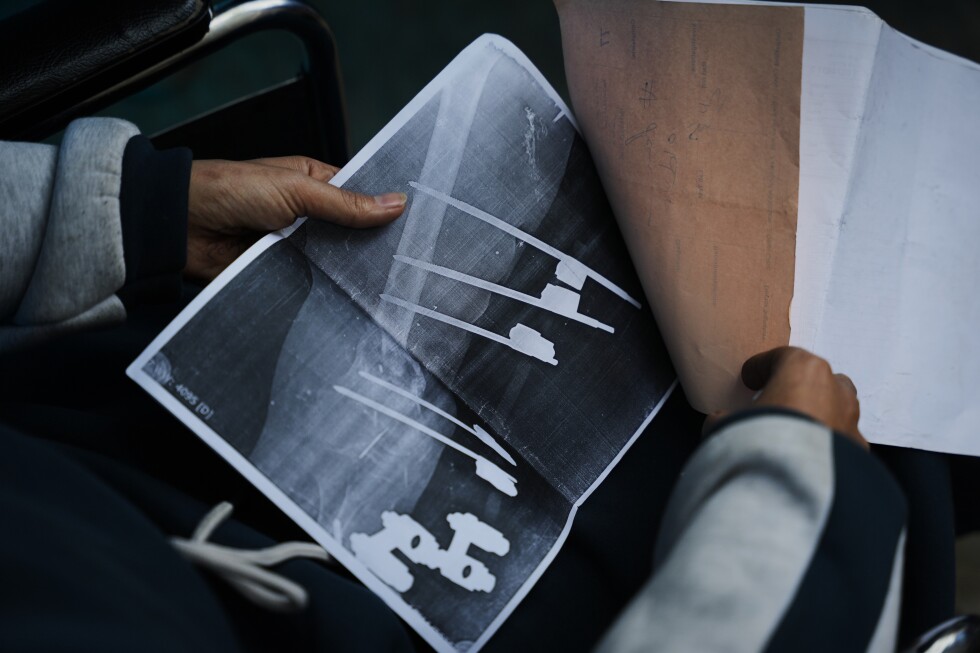
Abu Lehia was wounded five months ago when Israeli troops opened fire toward Palestinians mobbing an aid truck for food in Gaza. A bullet shattered her left knee, and now her best chance of walking again depends on surgery abroad.
She is one of more than 20,000 Palestinians, including 4,500 children, who have been waiting—some for over a year—for evacuation to receive treatment for war wounds or chronic medical conditions, according to the Gaza Health Ministry.
Their hopes have hinged on the reopening of the Rafah border crossing between Gaza and Egypt, a key point under the nearly 4-month-old ceasefire between Israel and Hamas. Israel announced the crossing will open in both directions Sunday, allowing “limited movement of people only.”
Israeli Prime Minister Benjamin Netanyahu has stated Israel will permit 50 patients a day to leave Gaza, while some officials have mentioned up to 150 daily. This marks a significant increase from the approximately 25 patients per week allowed to exit since the ceasefire began, according to UN figures. However, even at the higher rate, it would take between 130 to 400 days to evacuate everyone in need.
Gaza’s healthcare infrastructure has been devastated by Israel’s military campaign following the Hamas-led attack on southern Israel in October 2023. The few remaining functional hospitals are overwhelmed with casualties and face critical shortages of medical supplies amid Israeli restrictions on aid entry.
These facilities are unable to perform complex surgeries for many wounded Palestinians, including thousands of amputees, or treat numerous chronic conditions. Gaza’s only specialized cancer hospital was shut down early in the war and later destroyed by Israeli troops in early 2025. The military claimed without providing evidence that Hamas militants were using the facility, though it was located in an area under Israeli control for most of the war.
The World Health Organization reports that more than 10,000 patients have left Gaza for treatment abroad since the war began. However, after Israeli forces seized and closed the Rafah crossing in May 2024, evacuations dropped dramatically to around 17 patients weekly until the current ceasefire, with the exception of a brief surge during a two-month ceasefire in early 2025.
According to the Health Ministry, approximately 440 of those seeking evacuation have life-threatening injuries or diseases. Tragically, more than 1,200 patients have died while waiting for evacuation, the ministry reported Tuesday.
A UN official, speaking on condition of anonymity, explained that many countries have been reluctant to accept patients because Israel would not guarantee their return to Gaza. Most evacuees have gone to Egypt, the United Arab Emirates, Qatar, and Turkey.
Israel has also banned sending patients to hospitals in the Israeli-occupied West Bank and East Jerusalem since the war began—cutting off what was previously the main treatment pathway for Palestinians needing specialized care unavailable in Gaza. Five human rights groups have petitioned Israel’s High Court of Justice to remove this ban, though the court has yet to rule.
Cancer patients represent a significant portion of those needing evacuation. Gaza has more than 11,000 cancer patients, with approximately 75% of necessary chemotherapy drugs unavailable, according to the Health Ministry. At least 4,000 cancer patients require urgent treatment abroad.
Ahmed Barham, a 22-year-old university student battling leukemia, underwent two lymph node removal surgeries in June, but the disease continues to spread “at an alarming rate,” according to his father, Mohamed Barham.
“There is no treatment available here,” the elder Barham said. His son, who has lost 35 kilograms (77 pounds), was recently placed on the urgent referral list but still awaits confirmation of travel. “My son is dying before my eyes,” the father lamented.
Fourteen-year-old Mahmoud Abu Ishaq has waited more than a year for treatment abroad. He suffered a retinal detachment when his family home’s roof collapsed during an Israeli strike on the southern town of Beni Suhaila. “Now he is completely blind,” his father, Fawaz Abu Ishaq, explained. “We are waiting for the crossing to open.”
For Abu Lehia, her injury occurred while searching for her younger brother, who had gone looking for food from aid trucks. At that time, with Gaza near famine, crowds regularly waited for trucks, and Israeli troops often fired on these gatherings, claiming they were firing warning shots. However, Gaza health officials report hundreds were killed over several months during these incidents.
Despite multiple surgeries at Nasser Hospital, doctors were unable to repair Abu Lehia’s knee and have advised she needs knee replacement surgery outside Gaza. Though officials told the family last month she would be evacuated in January, nothing has happened yet.
“Her condition is getting worse day by day,” her father, Sarhan Abu Lehia, said. “She sits alone and cries.”
Fact Checker
Verify the accuracy of this article using The Disinformation Commission analysis and real-time sources.

24 Comments
Interesting update on A bullet shattered her knee. Now a Gaza teen’s chances of walking depend on Rafah crossing’s opening. Curious how the grades will trend next quarter.
Good point. Watching costs and grades closely.
Good point. Watching costs and grades closely.
Production mix shifting toward World might help margins if metals stay firm.
Good point. Watching costs and grades closely.
I like the balance sheet here—less leverage than peers.
Good point. Watching costs and grades closely.
The cost guidance is better than expected. If they deliver, the stock could rerate.
Good point. Watching costs and grades closely.
Nice to see insider buying—usually a good signal in this space.
Good point. Watching costs and grades closely.
Good point. Watching costs and grades closely.
I like the balance sheet here—less leverage than peers.
Good point. Watching costs and grades closely.
Nice to see insider buying—usually a good signal in this space.
I like the balance sheet here—less leverage than peers.
Interesting update on A bullet shattered her knee. Now a Gaza teen’s chances of walking depend on Rafah crossing’s opening. Curious how the grades will trend next quarter.
Good point. Watching costs and grades closely.
Good point. Watching costs and grades closely.
Interesting update on A bullet shattered her knee. Now a Gaza teen’s chances of walking depend on Rafah crossing’s opening. Curious how the grades will trend next quarter.
Good point. Watching costs and grades closely.
Good point. Watching costs and grades closely.
I like the balance sheet here—less leverage than peers.
Good point. Watching costs and grades closely.