


Listen to the article
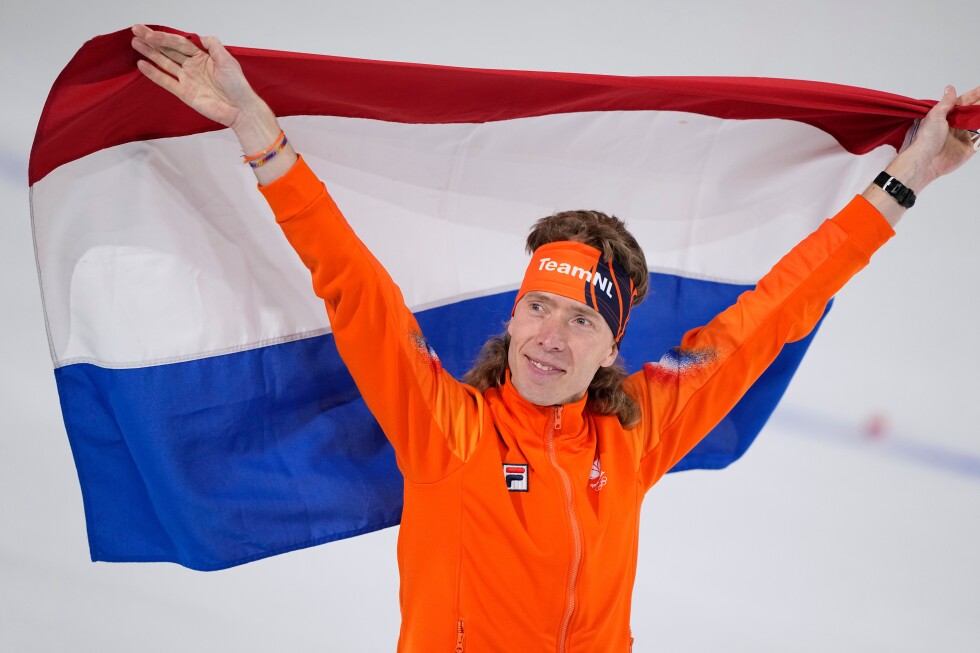
In a remarkable display of endurance and athletic excellence, Jorrit Bergsma made Olympic history Saturday at the Milan Cortina Games, becoming the oldest long track speedskating gold medalist ever at age 40.
The Dutch veteran dominated the mass start event with such a commanding lead that he celebrated his victory well before crossing the finish line. Down the backstretch, Bergsma spread his arms wide, blew kisses to enthusiastic Dutch supporters clad in orange and wearing mullet wigs matching his distinctive hairstyle, and even applauded back at the crowd.
“Unbelievable. Unbelievable,” Bergsma said afterward, his gold medal hanging from his neck. “I’m a 40-year-old guy… It is crazy. This one was really unexpected.”
The achievement shatters age barriers in the sport. The previous record for oldest Olympic champion in long track speedskating belonged to Ireen Wust, who was 35 when she won gold for the Netherlands in the 1,500 meters at the 2022 Beijing Games. The men’s record had stood for nearly a century, held by Finland’s Clas Thunberg, who was 34 when he claimed the 1,500 meters at the 1928 St. Moritz Olympics.
American speedskating sensation Jordan Stolz, who at 21 is nearly half Bergsma’s age, expressed admiration for the Dutch veteran’s achievement. Stolz, who finished fourth in Saturday’s mass start after collecting two golds and a silver earlier in the Games, called Bergsma’s performance “super incredible” and described him as “super nice, super relaxed.”
Stolz’s coach, Bob Corby, characterized the performance as “pretty phenomenal.” Both Stolz and Bergsma were surprised by the race’s tactical dynamics, as competitors in the main pack showed little interest in chasing down Bergsma, who established an early lead alongside Denmark’s Viktor Hald Thorup, the eventual silver medalist.
“I knew this final is going to be a tough one. It’s going to be a tough cookie. Nobody wanted to do the first move, so I did it,” explained Bergsma, who is this season’s World Cup champion in the mass start. “I didn’t expect it. Nobody responded. Nobody wanted to close the gap for each other. I’m still mind blown that I won the gold medal here today.”
The victory adds to Bergsma’s impressive Olympic legacy, which began a dozen years ago at the 2014 Sochi Games, where he won gold in the 10,000 meters and bronze in the 5,000 meters. His career Olympic haul now includes a silver in the 10,000 meters from 2018, and another bronze at that same distance in Milan Cortina.
Bergsma’s success resonated with other veteran competitors. American Mia Manganello, who at 36 claimed bronze in the women’s mass start behind Netherlands’ Marijke Goenewoud, joked after what she called her final career race that no one should mention to her coach what Bergsma accomplished at 40.
“So well-deserved. He’s a great racer, a great competitor,” Manganello said. “It shows this sport has a lot of maturity and the longevity of it.”
Bergsma’s historic achievement highlights not only his exceptional physical condition and strategic racing acumen but also reflects broader trends in elite sports, where improved training methods, nutrition, and recovery techniques are extending competitive careers. His victory stands as a testament to perseverance and demonstrates that in endurance sports like speedskating, experience and tactical wisdom can sometimes trump youthful vigor.
The Dutch dominance in speedskating continues to be a notable storyline of these Winter Games, with the Netherlands consistently producing world-class talent in a sport that has become deeply embedded in the nation’s sporting culture and national identity. Bergsma’s gold adds another illustrious chapter to his country’s rich speedskating tradition, while also inspiring older athletes across all winter sports.
Fact Checker
Verify the accuracy of this article using The Disinformation Commission analysis and real-time sources.

9 Comments
Bergsma’s victory is a truly remarkable accomplishment. Not only did he win gold, but he did so in such a dominant fashion. His celebration on the backstretch just adds to the sense of triumph and joy.
This is a historic moment in Olympic speedskating. Bergsma’s age-defying performance will surely inspire other athletes to push the boundaries of what’s possible, even as they get older. It’s a testament to the power of the human spirit.
The mass start event is already so intense, but for a 40-year-old to win it is just mind-blowing. Bergsma’s victory is a true underdog story and shows that age is just a number when it comes to elite athleticism.
Exactly, Bergsma’s achievement shatters the notion that speedskating is a young person’s sport. His win is a testament to the power of determination and hard work, regardless of age.
Wow, what an incredible achievement! It’s amazing to see a 40-year-old athlete dominate the competition and make history. Bergsma’s endurance and skill are truly inspirational.
Shattering age records in speedskating is no easy feat. Bergsma’s victory is a testament to his dedication and passion for the sport. It’s great to see an athlete of his caliber still performing at the highest level.
Agreed, it’s really impressive that Bergsma was able to pull off this win at such an advanced age for a speedskater. He must have incredible discipline and drive to maintain that level of performance.
It’s always great to see an underdog story like this play out on the Olympic stage. Bergsma’s victory is a reminder that age is just a number, and that true champions are forged through years of dedication and hard work.
It’s fascinating to see the generational gap in this event, with the 21-year-old Stolz competing against the 40-year-old Bergsma. This just goes to show the incredible longevity of some athletes in the sport of speedskating.