


Listen to the article
West African Content Creators Pledge to Combat Disinformation in EU-Backed Initiative
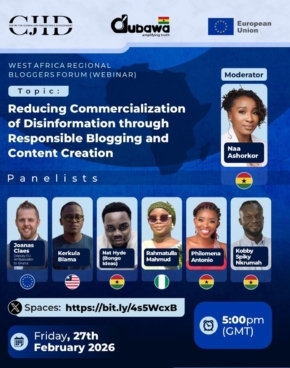
Content creators from across West Africa have made a collective commitment to promote information integrity amid growing concerns about the spread of disinformation in the region. The pledge came during a recent webinar jointly hosted by the European Union (EU) in Ghana, the Centre for Journalism, Innovation and Development (CJID), and DUBAWA Ghana.
The virtual event brought together bloggers, tech experts and social media influencers from Nigeria, Liberia and Ghana, who acknowledged the alarming trend of commercialized disinformation on social platforms and committed to confronting these practices within their spheres of influence.
Deputy EU Ambassador Jonas Claes emphasized the escalating nature of the problem, noting that while Ghana faced relatively mild risks a few years ago, the situation has deteriorated significantly. “Online actors increasingly engage in the manipulation of information with the express purpose to undermine stability, create tensions or harm EU-Ghana relations,” Claes said. “The EU suffers from it, Ghana suffers from it, and the EU-Ghana relation suffers from it.”
The webinar featured prominent voices from the West African digital ecosystem, including Kerkula Blama, CEO of Chase, a digital platform in Liberia; Ghanaian social media personality Nat Hyde (known as Bongo Ideas); Rahmatulla Mahmud from Nigeria; and Ghanaian content creators Philomena Antonio and Kobby Spiky Nkrumah.
In a candid moment during the discussions, Blama admitted to previously spreading disinformation himself but described how his perspective transformed after participating in training provided by DUBAWA, a fact-checking organization. “I will continue utilizing the skills I have learned from DUBAWA and desist from posting anything that will be seen as disinformation,” he pledged.
The issue of platform responsibility also featured prominently in the discussions. Antonio, a Ghanaian philanthropist and content creator, called on technology companies and social media platforms to strengthen their mechanisms for identifying and removing false content. “I pledge not to post any information I have not fact-checked,” she stated, highlighting the personal responsibility content creators must assume.
Similarly, Hyde acknowledged the commercial pressures associated with blogging but emphasized his commitment to verification processes. “I will ensure that every information I put out is fact-checked and that I follow the right processes to avoid spreading falsehood,” he promised.
Disinformation experts from DUBAWA Ghana, Maxine Gloria Danso and Austin Kwabena Brako-Powers, provided insights into evolving patterns of disinformation in the sub-region. They highlighted the emergence of coordinated disinformation campaigns linked to anti-democratic narratives, including online advocacy for military coups – a particularly sensitive issue in a region that has experienced several recent military takeovers.
“Disinformation campaigns have driven violence, validated military coups, masked corruption and damaged reputations,” Brako-Powers explained, pointing to the real-world consequences of online falsehoods.
The experts also addressed the economic incentives driving disinformation. Danso examined how monetization models tied to engagement metrics – views, likes, and shares – create perverse incentives that reward sensational but often false content. “Profiting from false information can cause reputational harm, distort public perception and, in extreme cases, inflame tensions and conflict,” she warned.
While disinformation is not a new phenomenon, both experts noted that evolving digital business models have made it more complex and challenging to combat effectively.
The webinar is part of the broader “See the Pattern” Campaign, launched in January 2026 by the EU and DUBAWA to strengthen information integrity across West Africa. The initiative comes at a critical time for the region, which faces multiple challenges including electoral cycles, security concerns, and economic pressures – all contexts in which disinformation can have particularly harmful effects.
As the digital information landscape continues to evolve rapidly across West Africa, this coordinated effort between international organizations, regional fact-checkers, and content creators represents a significant step toward cultivating a more responsible information ecosystem in a region increasingly vulnerable to the effects of orchestrated disinformation.
Fact Checker
Verify the accuracy of this article using The Disinformation Commission analysis and real-time sources.

7 Comments
Combating disinformation requires a multi-stakeholder approach. Glad to see West African creators, the EU, and local organizations partnering on this. Curious to learn more about the specific tactics and tools they plan to employ.
Absolutely. Transparency around their methods will be key to building trust and replicating successful strategies elsewhere.
Commercialized disinformation is a growing concern globally. Good to see the EU, Ghana, and local influencers collaborating to address this problem. Maintaining information integrity is crucial for healthy public discourse.
Agreed. Curious to know if they plan to develop any technical or policy solutions to identify and counter disinformation campaigns.
This is a positive step, but the battle against disinformation is an ongoing challenge. Curious to see if they develop any measurable goals or metrics to track the impact of their efforts over time.
This is an important initiative. Disinformation can have real-world consequences, so it’s critical that content creators use their platforms responsibly. Looking forward to seeing the concrete steps they take to uphold information quality.
Glad to see West African content creators taking a stand against disinformation. It’s a serious issue that undermines trust and stability. Curious to learn more about their specific plans and strategies to combat these deceptive practices.