


Listen to the article
South Korean President Clashes with Israel Over Human Rights Comments
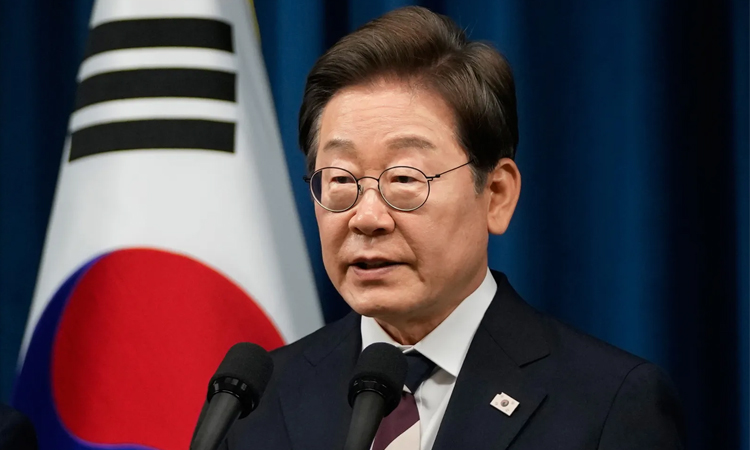
Diplomatic tensions escalated this weekend between South Korea and Israel after President Lee Jae Myung criticized alleged Israeli human rights abuses, prompting a sharp rebuke from Israeli officials who accused him of amplifying misinformation.
The dispute began Friday when President Lee commented on a social media video purportedly showing Israeli soldiers mistreating a Palestinian. “I need to look into whether this is true, and if so, what measures have been taken,” Lee wrote on X, the platform formerly known as Twitter.
The video in question appears to show a different angle of an incident captured by AFPTV in the West Bank two years ago, when Israeli soldiers were filmed using a foot to push what appeared to be a dead adult man off a roof. That 2024 footage had previously drawn international attention, with the White House describing it as “deeply disturbing” and demanding an explanation amid intensified Israeli operations in the occupied West Bank.
Israel’s foreign ministry responded forcefully on Saturday, stating the incident had already been “investigated and addressed.” The ministry further accused President Lee of deliberately reviving an old story while citing “a fake account that falsely presented it as a current event.”
“This account is notorious for spreading anti-Israeli disinformation and falsehoods about Israel,” the Israeli statement added, escalating the diplomatic confrontation.
South Korea’s foreign ministry attempted to mediate the growing tension, clarifying that Lee’s comments were intended as a broader statement supporting “universal human rights rather than an opinion on any specific issue.” The president’s original post had drawn parallels between alleged Israeli actions and historical atrocities against both Jews and Koreans.
However, President Lee doubled down on Saturday with another pointed social media message directed at Israel. “It’s disappointing that you don’t even once reflect on the criticisms from people around the world who are suffering and struggling due to relentless anti-human rights and anti-international law actions,” he wrote. “When I am in pain, others feel that pain just as deeply.”
This unusual public disagreement marks a notable shift in South Korea’s typically careful diplomatic approach to Middle Eastern conflicts. As a close ally of the United States, which remains Israel’s strongest international supporter, South Korea has historically maintained a balanced stance without explicitly backing any particular side in the Israeli-Palestinian conflict.
Regional analysts note that President Lee, who took office with a strong human rights platform, appears to be signaling a more assertive foreign policy approach on humanitarian issues. This stance could potentially complicate South Korea’s relationships with both Israel and the United States at a time when international alliances are increasingly strained over responses to conflicts in Gaza and the broader Middle East.
The diplomatic spat occurs against the backdrop of ongoing international scrutiny of Israel’s military operations and human rights record. Several international organizations and United Nations bodies have raised concerns about civilian casualties and potential violations of international humanitarian law during recent conflicts.
Neither country has indicated whether the dispute will affect bilateral relations beyond the current war of words. South Korea and Israel maintain significant economic and defense ties, with cooperation in areas ranging from technology development to military equipment.
As the situation develops, observers will be watching closely to see whether this exchange represents a momentary diplomatic flare-up or signals a more fundamental shift in South Korea’s approach to Middle East diplomacy under President Lee’s administration.
Fact Checker
Verify the accuracy of this article using The Disinformation Commission analysis and real-time sources.

11 Comments
This dispute highlights the challenges of navigating sensitive geopolitical issues related to human rights. I’m curious to learn more about the context and specifics of the incident captured in the video. Do you think there are opportunities for constructive engagement between the countries to address these concerns?
Valid point. Constructive dialogue and a willingness to investigate claims objectively seem crucial in this type of diplomatic situation. Maintaining open lines of communication could help find a path forward.
Disputes over human rights allegations can be challenging, but open dialogue and a commitment to international norms seem essential. I wonder if there are opportunities for third-party monitoring or investigation to help provide more transparency and build trust between the parties involved.
This is a complex issue with significant geopolitical implications. I’m curious to hear more perspectives on how to balance national security, human rights, and diplomatic relations in cases like this. Responsible reporting and fact-finding will be important going forward.
Well said. Maintaining open channels of communication and a focus on facts and mutual understanding will be critical as these nations navigate this sensitive situation.
This dispute highlights the complexities of addressing human rights concerns in a diplomatic context. I’m curious to learn more about the specific claims and evidence on both sides. Constructive engagement and a focus on facts could help find a path forward that respects the interests of all parties.
Agreed. Maintaining open lines of communication and a willingness to investigate claims objectively seem crucial in this type of sensitive situation. Finding common ground and a mutually acceptable resolution will be important.
Disputes over human rights allegations can be challenging, but open dialogue and a commitment to international norms seem essential. I wonder if there are opportunities for third-party monitoring or investigation to help provide more transparency and build trust between the parties involved.
The reaction from Israel’s foreign ministry seems quite strong. I wonder if there are opportunities for third-party mediation or independent investigation to help bring more clarity to this incident and the broader human rights concerns. Effective conflict resolution often requires nuanced approaches.
Interesting to see the diplomatic tensions between South Korea and Israel over this video incident. It’s important to carefully verify claims and incidents like this before drawing conclusions. What do you think is the best way to address human rights concerns while maintaining diplomatic relations?
Agreed, these types of situations require nuance and open dialogue. Transparency and a commitment to international norms are key for all parties involved.