


Listen to the article
Editor Warns of Social Media’s Impact on Information Quality Amid Global Instability
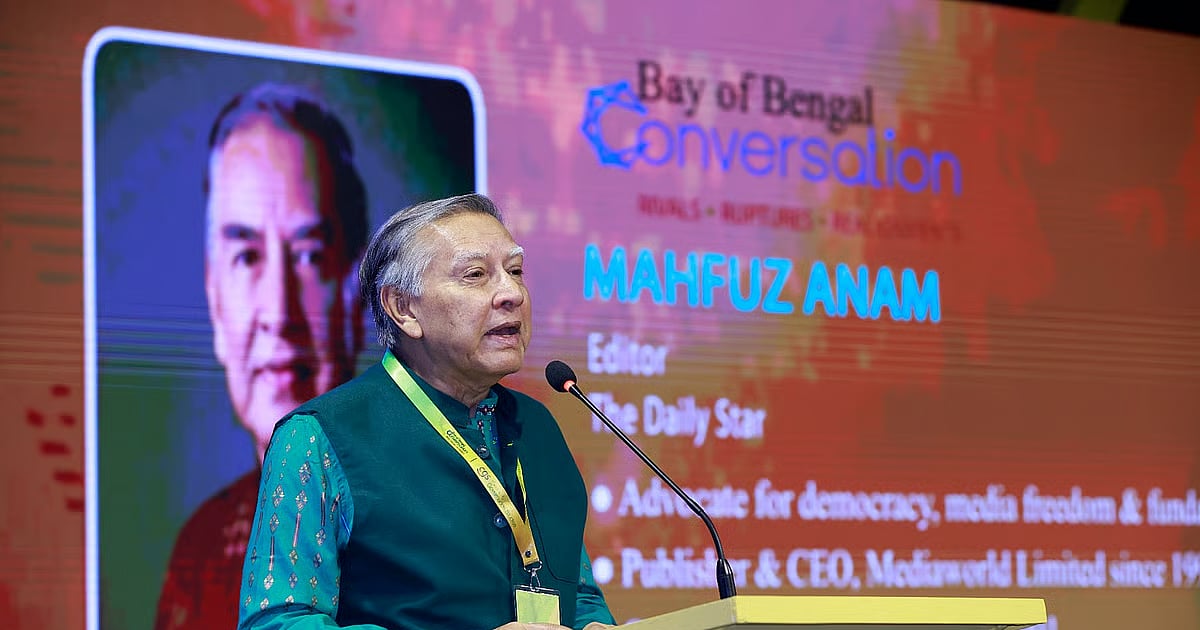
In a wide-ranging discussion on global security challenges and information integrity, The Daily Star editor Mahfuz Anam offered a sobering assessment of how social media’s democratization of information flows has created new vulnerabilities, particularly for developing nations like Bangladesh.
Addressing two critical topics—”War, Fragile States and the End of Global Stability” and “Artificial Intelligence and the Threat of Disinformation”—Anam acknowledged the positive aspects of social media’s rise while highlighting its darker implications.
“It is true that social media has democratised information flow; now every individual can express their opinion,” Anam noted. “But the negative side is that, in most cases, these are not information-based, not knowledge-driven, and not even rational.”
The veteran journalist’s comments come at a time when misinformation and disinformation have become increasingly prevalent across digital platforms, complicating public discourse and policy responses to complex issues ranging from climate change to geopolitical conflicts.
For developing nations like Bangladesh, these information challenges arrive alongside growing geopolitical instability. Anam emphasized that global stability, particularly economic stability, is not merely desirable but essential for smaller countries navigating an increasingly turbulent international landscape.
“For small countries like ours, global stability is extremely important—particularly in the economic sphere,” he explained.
Bangladesh, with its export-oriented economy and significant dependence on global trade networks, remains vulnerable to international disruptions. The country’s garment industry, which accounts for over 80% of export earnings and employs approximately 4 million people, is particularly sensitive to global economic fluctuations.
Anam’s observations reflect growing concerns about the fragility of the post-Cold War international order. Recent years have seen a resurgence in great power competition, regional conflicts, and economic nationalism that threaten the rules-based system that smaller nations have relied upon for development.
In what may be his most pointed assessment, Anam highlighted what he sees as Bangladesh’s primary strategic asset in navigating these troubled waters.
“We cannot compete with the world in terms of wealth or military strength; our only competitive advantage is knowledge and skills,” he stated. This perspective underscores the critical importance of education, workforce development, and technological adaptation for Bangladesh’s continued economic growth.
The country has made significant strides in human development over recent decades, with improvements in literacy rates, technological adoption, and specialized training programs. These advances have helped diversify the economy beyond traditional agriculture and basic manufacturing.
However, Anam expressed concern about emerging threats to this knowledge-based development strategy, warning that “in this era of populism, we are rapidly heading toward a frightening reality.” His remarks point to the global rise of populist movements that often reject expert knowledge and promote simplistic solutions to complex problems.
For Bangladesh, a nation of approximately 170 million people facing significant climate vulnerability and development challenges, the stakes of this information crisis could not be higher. The country’s ability to make evidence-based policy decisions on issues ranging from climate adaptation to economic diversification depends on quality information and public discourse.
Media analysts note that Anam’s comments reflect growing concern among journalists and policy experts worldwide about the deterioration of shared factual foundations for public debate. This trend has coincided with declining trust in traditional information gatekeepers, including mainstream media outlets and academic institutions.
As Bangladesh continues its development journey amid these global challenges, Anam’s assessment suggests that strengthening critical thinking, information literacy, and evidence-based policymaking may be as important to national security as more traditional concerns about economic growth and political stability.
Fact Checker
Verify the accuracy of this article using The Disinformation Commission analysis and real-time sources.

28 Comments
If AISC keeps dropping, this becomes investable for me.
Good point. Watching costs and grades closely.
Good point. Watching costs and grades closely.
Silver leverage is strong here; beta cuts both ways though.
Production mix shifting toward Social Media might help margins if metals stay firm.
Production mix shifting toward Social Media might help margins if metals stay firm.
Good point. Watching costs and grades closely.
Good point. Watching costs and grades closely.
The cost guidance is better than expected. If they deliver, the stock could rerate.
Exploration results look promising, but permitting will be the key risk.
Good point. Watching costs and grades closely.
I like the balance sheet here—less leverage than peers.
Good point. Watching costs and grades closely.
Nice to see insider buying—usually a good signal in this space.
Good point. Watching costs and grades closely.
I like the balance sheet here—less leverage than peers.
I like the balance sheet here—less leverage than peers.
Good point. Watching costs and grades closely.
I like the balance sheet here—less leverage than peers.
Good point. Watching costs and grades closely.
Good point. Watching costs and grades closely.
Interesting update on Social Media Falsehoods Drive Online Engagement, Says Mahfuz Anam. Curious how the grades will trend next quarter.
Good point. Watching costs and grades closely.
I like the balance sheet here—less leverage than peers.
Good point. Watching costs and grades closely.
Silver leverage is strong here; beta cuts both ways though.
Good point. Watching costs and grades closely.
Good point. Watching costs and grades closely.