


Listen to the article
Photojournalist Held at Gunpoint Amid Wildfire Disinformation Crisis in Oregon
A photojournalist found himself staring down the barrel of an assault rifle last Thursday while on assignment near fire-threatened Estacada, Oregon, highlighting the dangerous real-world consequences of rampant social media misinformation about the region’s devastating wildfires.
Nathan Howard, working for a picture agency southeast of Estacada, was first confronted by an angry man on a rural roadside who accused him of looting. Despite Howard’s attempts to identify himself as a journalist, the situation quickly escalated.
“It was like his eyes were popping out of his head,” Howard recalled of the man’s agitated state. Though allowed to leave initially, Howard was pursued as he drove north, only to be intercepted by a second truck that blocked the highway. The driver emerged with a loaded assault rifle, pointing it directly at Howard through his windshield.
“He was saying, ‘you’re a looter, you have to get out of here,'” Howard recounted, “and I was like, ‘you’re blocking the road, I can’t move,’ and that conversation went on for three solid minutes.”
The confrontation underscores how social media disinformation about the fires’ causes has transformed into physical danger. Unfounded rumors claiming political activists – either far-right Proud Boys or leftist antifa groups – deliberately started the blazes have spread rapidly across Facebook and other platforms, despite repeated denials from authorities.
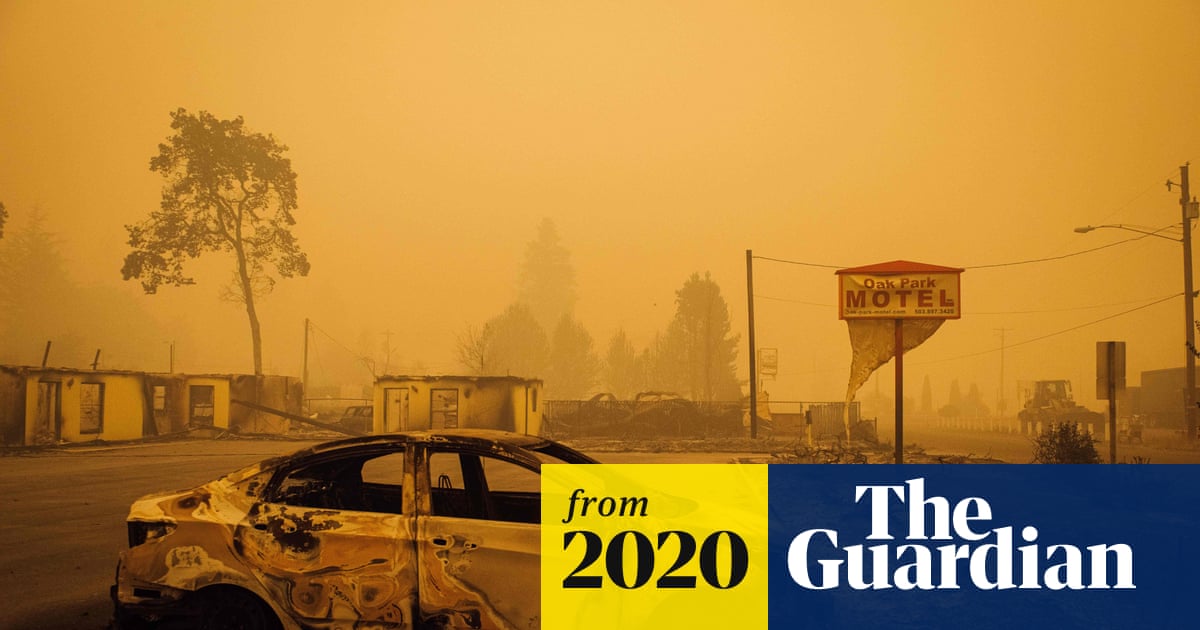
Officials have emphasized that most fires across Oregon and the western United States originated from power lines and other accidental ignitions, exacerbated by dry, hot, and windy conditions in drought-stricken landscapes. While some arson arrests have occurred, investigators have found no evidence of politically motivated fire-setting.
The FBI has investigated numerous claims and declared them false, while Oregon officials have taken to Facebook to counter the narratives. Yet these efforts have struggled against the tide of misinformation in a state already divided after months of political protests.
The problem has grown so severe that emergency responses are being hampered. Armed patrols have formed in towns where rumors of antifa arson attacks circulate, and vigilante incidents like Howard’s encounter are becoming more common.
“It has to be Facebook,” Howard said regarding the source of his assailants’ beliefs, noting his own monitoring of Estacada Facebook groups where rumors about antifa looters and arsonists continue to proliferate.
Inside Oregon-based private Facebook groups, the Guardian observed how this misinformation creates connections between local communities, protest groups, and even elected officials in rural areas. In one instance, Curry County Commissioner Christopher Paasch and Oregon State Representative David Brock Smith appeared to lend credence to unverified claims about deliberate fire-setting.
More concentrated streams of disinformation were found in groups like COPS NW, a network that has recently promoted pro-Trump, pro-police demonstrations across northwest Oregon. The group’s discussions included numerous false claims about antifa arsonists, including fabricated stories about activists being arrested for lighting fires near Salem.
The situation echoes earlier disinformation campaigns during Australia’s bushfire emergency earlier this year, when some media outlets amplified unfounded “arson emergency” claims. In Oregon, conservative talk radio host Lars Larson, whose show is nationally syndicated, has entertained conspiracy theories about the fires, suggesting they “may have been some kind of planned action” and inviting listeners to call in about their suspicions of leftist protesters’ involvement.
Howard eventually escaped his armed confrontation when a third truck appeared and its driver, after a brief conversation, drove away, prompting his captors to finally allow him passage. But the experience has left him with serious concerns about returning to areas desperately in need of accurate reporting.
“Huge parts of the state are being destroyed by fire,” Howard lamented, “and we can’t document it because that’s exactly where conspiracy theories are running wild.”
As Oregon battles both literal and metaphorical fires, the incident illustrates how online misinformation can create real-world danger zones where even documenting the truth becomes perilous.
Fact Checker
Verify the accuracy of this article using The Disinformation Commission analysis and real-time sources.

9 Comments
This is a troubling situation. Disinformation can have real-world consequences, as seen with this confrontation of the photojournalist. Social media platforms need to do more to combat the spread of false claims, especially during emergencies.
Agreed. Journalists play a vital role in reporting the facts, and they shouldn’t be at risk of violence due to rampant misinformation. Fact-checking and content moderation are crucial to prevent these kinds of dangerous incidents.
Disinformation about emergencies like wildfires can have dangerous, even life-threatening, implications. This incident with the photojournalist highlights the urgent need for social media companies to improve content moderation and fact-checking to prevent the spread of false claims.
Absolutely. Journalists must be able to report the facts without fear of confrontation or violence. Addressing the root problem of disinformation is critical to protect both the media and the public.
This is a deeply concerning situation. Journalists should never have to face the barrel of an assault rifle simply for doing their job. Social media companies need to take stronger action to curb the spread of false claims, especially during times of crisis.
The confrontation faced by the photojournalist is extremely concerning. Journalists play a vital role in providing accurate information, and they should not have to fear for their safety due to the proliferation of online misinformation. Social media platforms must do more to address this issue.
Journalists must be able to safely cover major events like wildfires without fear of being accosted. This situation shows how dangerous the spread of disinformation can become when people act on false claims. More needs to be done to address this problem.
I hope the photojournalist is okay after this harrowing experience. No one should have to face an assault rifle while simply trying to do their job. Social media platforms have a responsibility to curb the spread of misinformation, especially during crises.
This is a sobering example of how online falsehoods can have severe real-world consequences. Journalists must be able to report the facts without threat of violence. Urgent action is needed to combat the spread of disinformation, especially during emergencies.