


Listen to the article
AI Disinformation Campaigns Set to Worsen, Senate Committee Hears
Online disinformation, viral propaganda campaigns, and targeted attacks against individuals and institutions are likely to intensify before the situation improves, according to testimony at recent Senate hearings in Canberra.
The Senate select committee on information integrity on climate change and energy conducted two days of public hearings this week, gathering evidence from major technology platforms like Meta and TikTok, industry groups including Coal Australia and the Minerals Council, as well as academics and community representatives.
The committee is investigating how online bots, trolls, disinformation campaigns, and tactics such as “astroturfing” (fake grassroots movements) are hampering global climate action and renewable energy initiatives. It is also examining connections between Australian organizations and international influence networks.
Human Rights Commissioner Lorraine Finlay told senators that cleaning up online information channels while protecting free speech rights presents a significant challenge.
“Algorithms that prioritize engagement over accuracy push extreme or sensational content to the top of public debate,” Dr. Finlay said. “Foreign interference, bots, trolls, and emerging technologies like deepfakes further complicate the landscape, creating new risks for democratic participation and public trust.”
She warned that overly broad regulatory approaches could have a chilling effect on legitimate public debate about critical national issues.
This strikes at the core problem: bad actors often invoke free speech rights while deliberately spreading false information, knowing their behavior erodes social cohesion. The difficulty lies in definitively proving bad faith and determining who should make such judgments.
Technology’s Role in Spreading Misinformation
Testimony indicated that Australians should prepare for a deterioration in online information quality in coming years. The problem extends beyond climate change and will require a society-wide response.
Senators heard that rapid technological advancement has transformed the internet into a battleground for information control. The combination of artificial intelligence, social media, and data surveillance has made it significantly easier for propaganda and foreign actors to contaminate information channels.
Representatives from Meta told the committee they had removed hundreds of millions of bots from their platforms and actively work to dismantle “coordinated inauthentic behavior.” However, they stated that Meta does not censor politicians’ speech, arguing that traditional media outlets provide sufficient scrutiny of political figures.
Labor senator Michelle Ananda-Rajah expressed frustration with this position, pointing out that some influential political leaders use viral algorithms to spread harmful and false messages. Meta acknowledged awareness of Brandolini’s law—which states that debunking misinformation requires far more energy than creating it—but maintained that censoring politicians is not their responsibility unless violence is being incited.
Political Campaigning and Opacity in Funding
The committee also examined modern lobbying techniques, particularly the increasing trend of industry groups paying third parties to run political campaigns on their behalf. This practice raises questions about transparency and voter awareness regarding who is truly behind various political messaging.
Coal Australia, a relatively new lobby group representing coal miners including Peabody, Whitehaven, Yancoal, and New Hope Group, defended sending nearly $4 million to “Australians for Prosperity” last financial year. This third-party organization attacked Labor, Greens, and independent candidates during the 2025 federal election.
Stuart Bocking, Coal Australia’s chief executive and former 2GB radio host, denied this constituted “astroturfing,” claiming it had simply become standard practice for lobby groups to outsource campaign logistics.
“It’s just become a technique that’s used by different groups to be able to handle the logistics… the inordinate effort that’s required. We don’t have the capacity as Coal Australia to run election campaigns,” he said.
This phenomenon isn’t unique to Australia, with similar surges in third-party political spending observed in New Zealand recently.
According to the Australian Electoral Commission, Australians for Prosperity received $3.89 million in total receipts in 2024-25, with approximately 95 percent ($3.68 million) coming directly from Coal Australia. The organization maintains strong Liberal Party connections, with former federal Liberal MP Jason Falinski serving as its spokesperson during the 2025 election campaign and its current spokesperson being Caroline Di Russo, president of the Western Australian Liberal party.
Global Networks of Influence
Jeremy Walker from the University of Technology Sydney informed senators about the history of Australian think tanks and their decades-long association with the Atlas Network, a global organization partnering with over 500 free-market think tanks worldwide, including 10 in Australia and New Zealand.
Dr. Walker explained how fossil fuel companies have funded certain think tanks globally for decades to push climate denial, anti-Indigenous rights, and anti-renewable energy messaging, obscuring the origins of both ideas and money.
“For nearly four decades Australians have been daily exposed to professionally-produced disinformation campaigns secretly funded by fossil fuel interests,” he stated.
Nationals senator Matt Canavan claimed he had never heard of the Atlas Network, despite being a regular speaker at events held by CPAC Australia (part of the Atlas ecosystem) and a frequent guest on podcasts and at public events hosted by Atlas Network partners including the Institute of Public Affairs, the Centre for Independent Studies, and the Australian Taxpayers’ Alliance.
Dr. Walker noted that the network’s relative anonymity is deliberate, allowing it to exert influence while avoiding scrutiny.
Coinciding with Angus Taylor’s recent rise to Liberal Party leadership, several former think tank staff from the Atlas Network ecosystem have secured important shadow cabinet positions, including new shadow treasurer Tim Wilson (former Institute of Public Affairs), shadow defence minister James Patterson (former Institute of Public Affairs), and shadow small business minister Jacinta Nampijinpa Price (former Centre for Independent Studies).
Scientific Communication Challenges
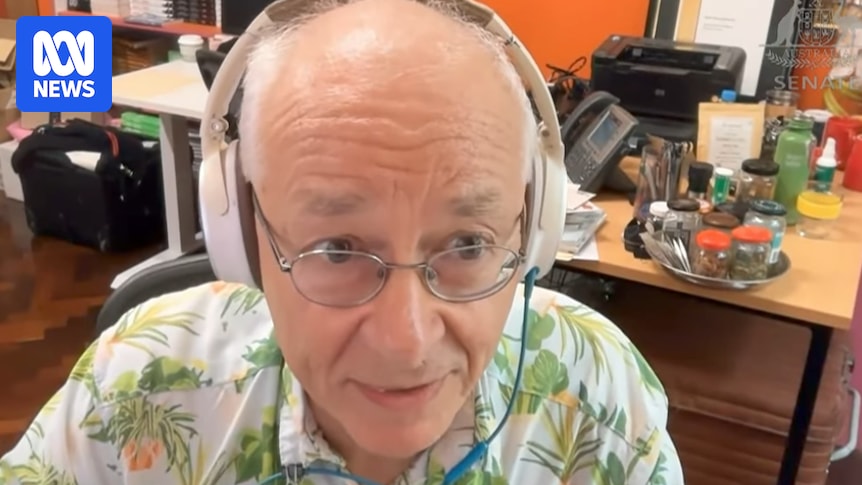
Science communicator Karl Kruszelnicki (Dr. Karl) illustrated the difficulty of establishing basic factual ground in climate discussions through an exchange with One Nation senator Malcolm Roberts:
Dr. Karl: “Do you agree that the climate records show that the last 10 years have been the hottest on record worldwide?”
Senator Roberts: “The last 10 years in Australia have been cooler than the 1880s and 1890s in Australia.”
Dr. Karl: “Worldwide. Do you agree that the last 10 years have been the hottest years on record worldwide?”
Roberts: “No I don’t.”
Dr. Karl: “I feel like I’m talking to a school child who says seven times two is not 14, but instead seven times two is a bicycle divided by the square root of a banana.”
Dr. Karl told the committee he has been developing an AI chatbot to help scientists rapidly combat climate denialist talking points, noting that personally debunking common myths is too time-consuming.
“People would typically say ‘Oh yeah, but the climate has always changed,’ and following the ‘bulldust asymmetry factor’ to set them straight on that takes around 12 minutes, and I just did not have those periods of 12 minutes. So the obvious way out was an AI.”
He emphasized that preventing AI chatbots from spreading incorrect scientific information requires training them exclusively on legitimate scientific papers rather than broader internet content, noting he has collected 40,000 scientific papers on climate change over four decades for this purpose.
The Senate committee is scheduled to present its final report on March 24.
Fact Checker
Verify the accuracy of this article using The Disinformation Commission analysis and real-time sources.

10 Comments
This is a complex issue with valid concerns on both sides. I’m curious to learn more about the specific tactics and connections being examined. How can we balance free speech with the need to address online disinformation?
Agreed, it’s a delicate balance. Protecting free expression while mitigating the harms of coordinated disinformation campaigns is a major challenge for policymakers.
The intensification of AI-powered disinformation is concerning, especially around critical issues like climate change. I appreciate the committee’s efforts to investigate these tactics and their sources.
Yes, the use of bots, trolls, and astroturfing to sow doubt and division is deeply troubling. Transparent and fact-based public discourse is essential.
The connections between Australian organizations and international influence networks are concerning. I hope the committee can shed light on these opaque influence operations.
Yes, understanding the global nature of these disinformation campaigns is key. Tracing the sources and motivations will be important for crafting effective responses.
This seems like an important inquiry into the complex interplay between free speech, online influence, and the impacts on environmental policy. I’ll be interested to see what recommendations come out of the hearings.
Agreed, it’s crucial that policymakers find the right approach to address coordinated disinformation while upholding democratic principles. Robust public debate is vital.
As someone invested in the mining and energy sectors, I’m skeptical of claims of widespread disinformation. However, I’m open-minded and will be following the committee’s findings with interest.
I appreciate your willingness to consider the evidence objectively. An open and constructive dialogue is essential for addressing these complex issues.