


Listen to the article
The rise of misinformation and digital scams in India has reached alarming proportions, threatening public trust, social harmony, and journalistic integrity, according to experts at a recent literary festival.
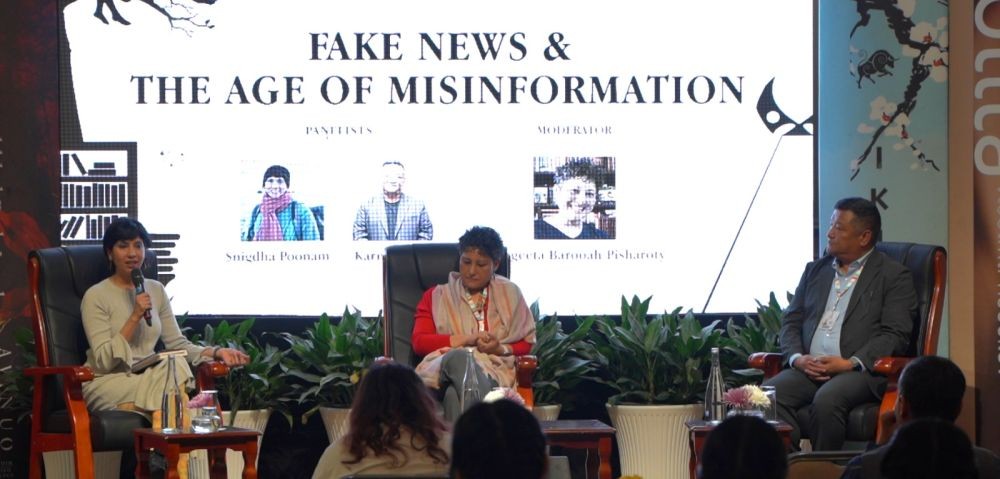
Speaking at The White Owl Literature Festival and Book Fair in Chümoukedima on February 6, media professionals highlighted how sophisticated fake news operations and elaborate digital scams are eroding public confidence in information sources and financial systems alike.
Karma Paljor, Editor-in-Chief and co-founder of EastMojo, emphasized that today’s misinformation landscape extends far beyond simple social media forwards. “Fake news now ranges from harmless rumours to organised factories producing fabricated content targeting communities,” Paljor said, noting how professional-looking false content increasingly mimics credible journalism.
Drawing from his extensive media experience, Paljor recalled the 2011 Sikkim earthquake coverage where a major national channel broadcast foreign footage falsely presented as local disaster scenes—an early example of verification failures that have since become more common.
The Manipur crisis provided another troubling case study, with Paljor describing how violent, unverified videos circulated widely during the conflict. Despite facing online backlash, EastMojo chose not to publish such unverified content, prioritizing public safety over viral metrics—a standard increasingly abandoned by some mainstream outlets.
Artificial intelligence has further complicated the information landscape. Paljor cited a widely circulated AI-generated video purportedly showing a tiger cub near Gangtok that spread rapidly before being debunked. Such incidents demonstrate how even sophisticated audiences can be misled by increasingly realistic fabrications.
The journalist was particularly critical of mainstream television channels, which he accused of spreading disinformation during national security events. He advised audiences to approach sensational content skeptically, rely on independent digital platforms with established verification protocols, and cross-check information before sharing.
Addressing journalistic practices, Paljor stressed the importance of ground-level verification, including dispatching reporters to locations or contacting trusted local sources before publishing stories. The rush to break news first, he warned, frequently results in misleading reporting that damages public trust.
The financial impact of digital misinformation was highlighted by author-journalist Snigdha Poonam, who described how sophisticated scams are depleting both bank accounts and societal trust. “Nearly every smartphone user has encountered scam calls or messages promising lottery wins, investment returns, or impersonating authorities,” Poonam said.
Drawing from her research, Poonam revealed that fraudsters routinely impersonate legitimate institutions including the Reserve Bank of India, tax authorities, and investigative agencies. Their operations span regions including Assam, West Bengal, and Mewat, with scammers creating elaborate fake websites to lend credibility to their schemes.
“Even educated, urban citizens fall prey to such scams,” she noted, recounting how during the COVID-19 pandemic, she received a WhatsApp message falsely claiming she had won Rs 25 lakh, illegitimately endorsed with images of Prime Minister Narendra Modi and other public figures. Fraudsters interviewed for her research admitted earning crores through similar schemes.
Poonam also exposed the socioeconomic dimensions of digital fraud, explaining that scam networks often operate from underdeveloped areas and justify their activities as a way to “level the playing field” against more privileged populations. These operations frequently exploit existing fault lines of caste, gender, religion, and economic disparity.
Sangeeta Barooah Pisharoty, president of the Press Club of India, who moderated the discussion, characterized scams as “a barometer of societal breakdown” and emphasized that addressing structural inequalities is essential to curbing digital fraud. She warned that widespread misinformation, combined with weak journalistic accountability, poses a direct threat to democratic functioning.
The experts concluded by calling on media organizations to prioritize public education about digital risks rather than simply reporting on scams after they occur. With data breaches increasingly common and public awareness lagging, independent media has a crucial role in combating both misinformation and digital fraud in India.
“Journalists have a duty to verify, educate, and protect public trust,” Paljor concluded, highlighting the need for responsible reporting in an age of information chaos.
Fact Checker
Verify the accuracy of this article using The Disinformation Commission analysis and real-time sources.

9 Comments
This is a concerning trend. Fake news and scams can have serious consequences for public trust and social stability. Maintaining journalistic integrity and verifying information sources is crucial in this digital age.
The examples provided highlight how even major media outlets can fall victim to misinformation. Improved verification processes and media literacy are needed to combat these sophisticated disinformation tactics.
Agreed. Fact-checking and transparency from media organizations will be key to rebuilding trust with the public.
Misinformation erodes the credibility of legitimate journalism. Journalists and editors must be vigilant in verifying sources and fact-checking to maintain their role as reliable information providers.
Absolutely. The public relies on the media to cut through the noise and provide accurate, trustworthy reporting.
Digital scams targeting vulnerable communities are especially worrying. Stricter regulations and consumer education may help mitigate the risks of these financial crimes.
This is a complex issue without easy solutions. Addressing the root causes of misinformation, from social media algorithms to financial incentives, will require a multi-faceted approach.
Maintaining public trust is essential for a healthy society and functioning democracy. Tackling misinformation and scams should be a top priority for policymakers and tech companies.
The rise of fake news is a global problem, but the impacts can be especially severe in emerging markets like India. Strengthening digital literacy and media regulations is crucial.