


Listen to the article
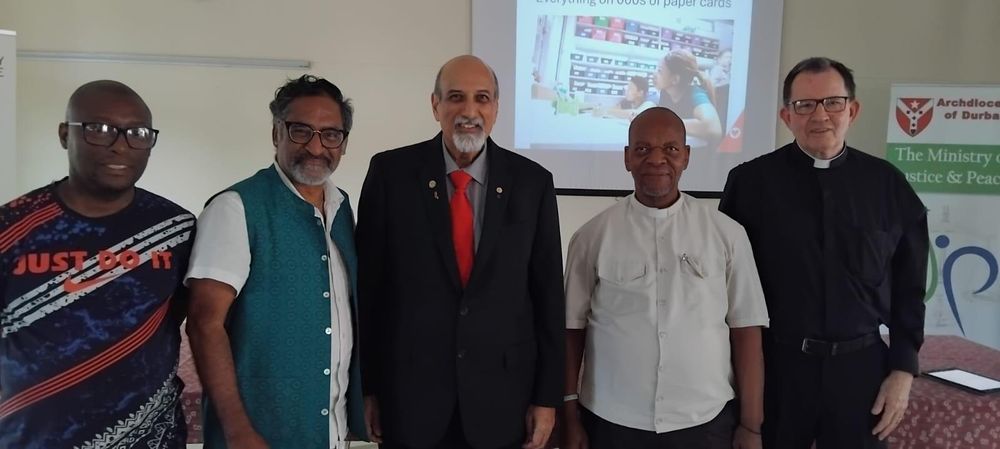
In a powerful address on Saturday, Professor Salim Abdool Karim warned that institutional disinformation has emerged as a significant threat in the post-Covid world. Speaking at the annual Archdiocese of Durban Justice and Peace lecture, Karim highlighted the growing challenge of deliberate misinformation campaigns that undermine public trust.
The lecture honored both Archbishop Denis Hurley and Archbishop Abel Gabuza, who died during the early stages of the Covid-19 pandemic. Gabuza had continued Hurley’s legacy as a Catholic bishop championing justice and peace initiatives in South Africa.
Karim’s presentation focused on strategies to counter disinformation and uphold truth in public discourse. He drew parallels between South African state capture mechanisms and former US President Donald Trump’s policies, arguing that both employed misinformation tactics to obscure facts and manipulate public perception.
“To accumulate wealth and power, you have to hide the truth in captured states – the truth is more than inconvenient. Information is power, disinformation is an abuse of power,” Karim stated. He noted that Trump’s administration had systematically undermined government scientists, scientific agencies, and research budgets as part of a broader attack on fact-based governance.
Drawing from his book “Standing up for Science,” Karim outlined several approaches to combat disinformation. These include recognizing the nature and scope of the problem, supporting scientists as trusted voices for truth, consistently fact-checking government communications, backing independent media organizations, rebuilding public trust in science, improving scientific communication, and enhancing public scientific literacy.
Karim shared insights from his extensive Covid-19 research and his experience briefing governments worldwide during the pandemic. “While sharing information on Covid, we came across the war on disinformation, where truth became the casualty,” he explained. “Social media has transformed the way we access information. Speculation in social media masqueraded as fact. You did not know the person behind it. This kind of information not only misinformed but also caused polarization in society and drove a wedge among us.”
He emphasized that social media platforms lack the editorial oversight and fact-checking standards of traditional media. This absence of quality control creates an environment where misinformation can flourish unchecked. The consequences extend beyond social division to financial harm, with Karim noting that South Africans lose billions to scammers who exploit disinformation on social media to access victims’ bank accounts.
“We need to foster a society that is aware of these scammers,” Karim stressed.
Dr. Raymond Perrier, director of the Denis Hurley Centre, also addressed the audience, focusing on local manifestations of disinformation. He expressed particular concern about false narratives targeting undocumented migrants seeking healthcare services. According to Perrier, organized groups have been physically preventing migrants from accessing hospitals and clinics, fueled by deliberately spread misinformation.
Perrier also highlighted disinformation campaigns targeting homeless people in Durban. “A group created this perception that people from other African countries were some kind of demons and undermined our institutions,” he said. “Part of our role at the Denis Hurley Centre is to be a voice for the voiceless. We sent a strong statement decrying what was happening. We need to speak out when we see injustice.”
The lecture underscored how disinformation has evolved from a communications issue into a social justice concern, with vulnerable populations often bearing the brunt of false narratives. Both speakers emphasized that combating disinformation requires not only better information literacy but also active advocacy for those targeted by harmful falsehoods.
The event highlighted the growing recognition among academic, religious, and civil society organizations that disinformation represents a fundamental threat to democratic institutions and social cohesion in South Africa and globally.
Fact Checker
Verify the accuracy of this article using The Disinformation Commission analysis and real-time sources.

19 Comments
Karim’s lecture underscores the need for robust strategies to counter the rising tide of disinformation. Empowering citizens with critical thinking skills is key to safeguarding truth and transparency.
I appreciate Karim’s call to action on tackling disinformation. His insights on the parallels between South African state capture and Trump’s tactics are a sobering reminder of the global scale of this challenge.
Absolutely. Disinformation is a threat that transcends borders and political affiliations. Karim’s lecture highlights the urgent need for coordinated, international efforts to address this problem.
Karim’s presentation on the disinformation crisis is timely and relevant. His emphasis on the connection between information and power is a critical lesson for policymakers and the public alike.
Karim’s insights on the growing challenge of disinformation are both alarming and necessary. Restoring public trust in institutions and upholding truth must be a top priority in the post-COVID world.
I commend Karim for his courage in addressing the disinformation threat. His parallels between South African state capture and Trump’s tactics are a sobering reminder of the global nature of this problem.
Agreed. Disinformation is a pervasive issue that requires a coordinated, multi-stakeholder response. Karim’s lecture highlights the importance of empowering citizens with critical thinking skills to combat this challenge.
Kudos to Karim for his courageous stance in highlighting the dangers of disinformation. Restoring public trust in institutions is vital for a healthy democracy in the post-COVID era.
Professor Karim’s address on disinformation challenges in the post-COVID world is timely and important. His analysis of the parallels between South African state capture and Trump’s tactics is eye-opening and deserves careful consideration.
Interesting to see the connections Karim draws between South African state capture and Trump’s policies. Combating institutional disinformation requires a multi-pronged approach focused on facts and public empowerment.
Karim’s lecture is a powerful call to action on the disinformation crisis. His insights on the link between information and power are crucial for understanding the threat and developing effective countermeasures.
Absolutely. Disinformation undermines the foundations of democracy and public trust. Karim’s emphasis on the need for transparency and accountability in institutions is a vital message for leaders and policymakers.
Karim’s emphasis on the link between information and power is crucial. Disinformation is a tool of manipulation, and we must be vigilant in upholding truth, especially in the digital age.
Karim’s lecture is a timely reminder that disinformation is a serious threat to democracy and public trust. I appreciate his call to counter misinformation campaigns and restore integrity in institutions.
Agreed. Disinformation erodes the foundation of informed decision-making. Leaders must champion transparency and accountability to address this growing challenge.
Tackling disinformation is critical in the post-COVID world. Karim’s insights on parallels between South African state capture and Trump’s tactics are eye-opening. Upholding truth in public discourse is the key challenge.
Karim’s lecture highlights the urgent need to address the growing threat of disinformation. His insights on the connection between information and power, and the tactics used to obscure the truth, are crucial for safeguarding democracy.
I agree. Karim’s call to action on countering disinformation and upholding truth in public discourse is a vital message for all citizens. Empowering people with critical thinking skills is key to combating this challenge.
Professor Karim’s presentation on the disinformation crisis is a sobering reminder of the challenges we face in the post-COVID world. His analysis of the parallels between South African state capture and Trump’s tactics is a must-read for anyone concerned about the integrity of our institutions and public discourse.