


Listen to the article
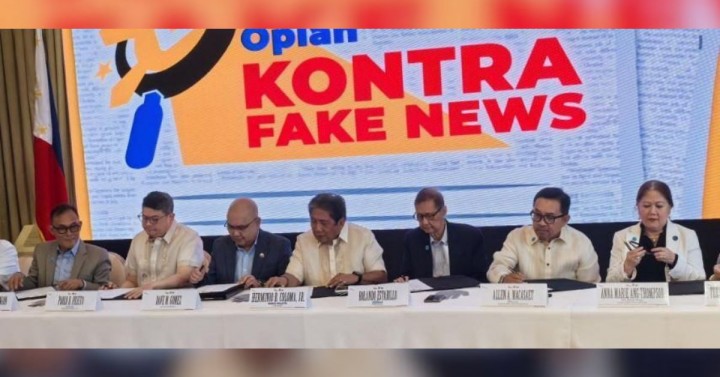
Nine of the Philippines’ most influential newspaper publishers joined forces with the Presidential Communications Office (PCO) on Wednesday in a landmark agreement aimed at combating the rising tide of misinformation threatening the country’s information ecosystem.
The formal signing of a memorandum of understanding at Malacañang Palace’s Kalayaan Hall marks a significant collaboration between government communicators and traditional media outlets at a time when digital falsehoods have become increasingly sophisticated and widespread.
Publishers from Business Mirror, BusinessWorld, The Daily Tribune, Malaya Business Insight, Manila Bulletin, Manila Standard, The Manila Times, Philippine Daily Inquirer, and The Philippine Star participated in the launch of “Oplan Kontra Fake News,” a comprehensive initiative designed to strengthen institutional responses to disinformation.
PCO Secretary Dave Gomez emphasized the existential threat that fake news poses to democratic institutions and public welfare during the ceremony.
“A healthy democracy depends on an informed public anchored on verified and accurate information,” Gomez said, highlighting how the partnership aims to enhance the distribution of factual information while rebuilding public trust in reliable news sources.
As part of the initiative, the PCO has established an Anti-Fake News Desk where citizens can report suspicious content for evaluation. Officials will also coordinate with major digital platforms like Meta and Google to address coordinated disinformation campaigns that often spread rapidly through social media algorithms.
Gomez was careful to frame the effort as a defense of citizens’ right to truthful information rather than a restriction on free expression. “This is not a war on words,” he stated, “but a defense of the people’s right to truthful information while upholding press freedom.”
The agreement comes amid growing concern about the impact of artificial intelligence tools that have made fabricated content increasingly difficult to distinguish from legitimate news, creating what media executives describe as an unprecedented challenge to public discourse.
Former PCO Secretary Herminio “Sonny” Coloma Jr., now publisher of Manila Bulletin, expressed solidarity with the initiative, stressing that protecting the integrity of public information requires collaboration between government communicators, established media organizations, and citizens themselves.
“The battle against disinformation cannot be fought by any single institution alone,” Coloma said. “This partnership acknowledges the complementary roles we all play in safeguarding fact-based public discourse.”
Anna Marie Ang-Thompson, chief executive officer of The Manila Times, described how traditional newspapers now function as both storytellers and shields against the flood of misleading digital content circulating online.
“Trust remains the foundation of journalism,” she noted. “This cooperation strengthens our collective ability to serve the public with information they can rely on.”
Philippine Daily Inquirer’s President and CEO Paolo Prieto highlighted recent survey data showing that while many Filipinos recognize fake news as a major problem, they often struggle to distinguish it from accurate information—a vulnerability that has been exploited by various interests.
“The sophisticated propaganda amplified by social media and increasingly by artificial intelligence tools poses serious risks to our democratic processes,” Prieto said.
T. Anthony Cabangon, publisher of Business Mirror, emphasized the real-world consequences of unchecked misinformation, noting that “fake news can damage lives, reputations, businesses and institutions” in ways that extend far beyond political discourse.
The initiative represents one of the most coordinated efforts to date between Philippine government communicators and legacy media to address what has become a global challenge to information integrity and public trust in institutions.
Fact Checker
Verify the accuracy of this article using The Disinformation Commission analysis and real-time sources.

6 Comments
This is an encouraging development in the fight against disinformation. A strong collaboration between the government and traditional media outlets is crucial to combat the spread of fake news and protect democratic institutions. I’m curious to see how ‘Oplan Kontra Fake News’ will be implemented and what tangible results it produces.
This is a significant step in the right direction, but tackling the complex challenge of disinformation will require a multifaceted approach. I hope the PCO and participating newspapers are able to develop innovative and scalable solutions that empower the public to critically evaluate online content.
While I applaud the intent behind this initiative, I have some concerns about the potential for government overreach or censorship. Striking the right balance between combating disinformation and preserving press freedom will be critical. Transparency and independent oversight should be key components of this campaign.
Misinformation can have serious consequences for public welfare, so I’m glad to see the Philippines taking proactive steps to address this issue. The partnership between the PCO and leading newspapers seems like a sensible approach to leverage their combined reach and credibility.
Agreed. Fact-checking and promoting verified information are essential to maintaining a healthy information ecosystem. I hope this initiative leads to more transparency and accountability around online content.
It’s good to see the government and media working together to combat the spread of fake news. However, the success of this campaign will depend on its ability to reach and resonate with the public, especially on digital platforms where misinformation often proliferates. Effective communication and public engagement will be key.