


Listen to the article
Far-Right German Rappers Spread Extremist Content Through Social Media Loopholes
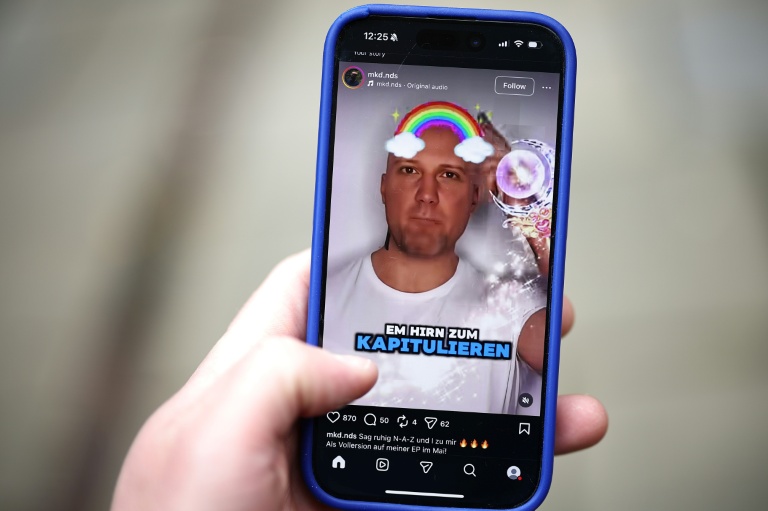
Far-right German-language rappers are circumventing hate speech regulations to distribute extremist rhetoric and disinformation across popular social media platforms, particularly TikTok, an AFP investigation has revealed.
In one particularly troubling example, a rapper known as MaKss Damage, whose real name is Julian Fritsch, posted a video on TikTok drawing parallels between the Gaza conflict and Nazi Germany. The video featured his face morphing into an antisemitic demonic silhouette while he rapped, “Back then it was Germany, today it’s Palestine,” displaying a Germanic triangle tattoo commonly associated with far-right movements.
The lyrics contained thinly veiled references to Adolf Hitler, describing him as an “old painter” whose warnings people now supposedly understand. Fritsch also promoted an unfounded antisemitic conspiracy theory about the September 11 attacks, suggesting the Jewish owner of the World Trade Center had foreknowledge of the tragedy.
After AFP contacted TikTok about these violations, the platform removed all of Fritsch’s accounts but declined to answer specific questions regarding their hate speech policy enforcement measures.
Germany’s federal domestic intelligence agency has officially classified Fritsch as a right-wing extremist, and he has been identified as a supporter of the far-right party The Third Way.
This investigation comes amid a concerning political climate in Germany, where the far-right Alternative for Germany (AfD) party has experienced surging support as anti-immigration sentiment intensifies. Official government data published in May documented a significant increase in politically motivated crimes, including antisemitic offenses.
Fritsch represents just one figure in a growing movement of far-right German-language performers promoting extremist ideologies across streaming platforms and social media. According to Thorsten Hindrichs, a musicologist at the University of Mainz, this online neo-Nazi movement, which includes Holocaust deniers, has become “significantly more radical in recent years.”
The Saxony state domestic intelligence agency has confirmed this trend, noting an expansion of extremist activities in the region. Many of the clips reviewed by AFP remained accessible despite apparently violating platform policies against hate speech.
Experts have identified a curious pattern in how these far-right figures approach the Middle East conflict. Bernhard Weidinger, an Austrian specialist in right-wing extremism at the Documentation Centre of Austrian Resistance in Vienna, explained this contradiction: while they rail against “Islamisation” domestically, portraying Islam as incompatible with Western values, they simultaneously express sympathy toward Palestinians, believing they share a common enemy in “Jews and Americans.”
Another prominent figure in this scene, rapper E.Mar, who describes himself as a “patriot,” has amassed over 96,000 monthly listeners on Spotify with songs criticizing Germany’s immigration policies. His content, featuring him masked and dressed in German flag apparel, has garnered hundreds of thousands of views on TikTok. In one track available across major streaming services, he rapped about being “ready for war,” claiming that “current politics makes you feel foreign in your own country.”
When contacted, Spotify stated it removes content promoting violent extremism but may retain material that “does not explicitly incite violence or hatred against protected groups.” Earlier this year, major platforms removed Kanye West’s “Heil Hitler” song glorifying the Nazi dictator, though copies remain accessible online.
German researchers have noted that neo-Nazi networks particularly favor TikTok for its live video capabilities, which allow real-time interaction with viewers. Markus Boesch, a researcher at the University of Muenster, warned these discussions create a “more private, intimate situation” that “might turn into some form of extremist recruitment,” often directing users to less regulated platforms like Telegram or Discord.
These extremist communities demonstrate remarkable adaptability, according to Tom Divon, a social media researcher at the Hebrew University of Jerusalem, who describes them as “not massive, but nimble,” frequently migrating between accounts to evade detection. Ciaran O’Connor, a senior analyst at the Institute for Strategic Dialogue, noted that while these users anticipate being blocked for policy violations, they can “often return to the platform with ease.”
The investigation also uncovered commenters using coded emoji communication to signify far-right allegiance while avoiding potential bans, such as blue hearts indicating AfD support and lightning bolt symbols referencing the Nazi SS.
Fact Checker
Verify the accuracy of this article using The Disinformation Commission analysis and real-time sources.

7 Comments
It’s troubling to see how these far-right extremists are exploiting loopholes in social media platforms to spread their toxic ideology. Stronger moderation and enforcement is clearly needed.
Comparing the Gaza conflict to Nazi Germany is a blatant antisemitic dog whistle. This rapper is clearly peddling dangerous conspiracy theories and propaganda, which is deeply concerning.
Agreed. Promoting Holocaust denial and 9/11 conspiracy theories is unacceptable. TikTok should be more proactive in identifying and removing this type of hateful content.
This is a worrying trend. Social media companies need to crack down on the proliferation of hate speech and disinformation, especially when it comes from influential figures like these rappers.
Absolutely. Allowing this kind of content to spread unchecked is extremely dangerous and can radicalize vulnerable audiences. Platforms must take a firmer stance against extremism.
Disturbing to see these neo-Nazi rappers spreading hate and misinformation on social media platforms. TikTok needs to do more to enforce its policies and curb the spread of extremist content.
Rappers spreading hateful, antisemitic rhetoric on TikTok? That’s a recipe for disaster. Social media platforms need to do more to prevent the normalization of such dangerous ideologies.