


Listen to the article
Misinformation on Social Media Impacts California Wildfire Recovery Efforts
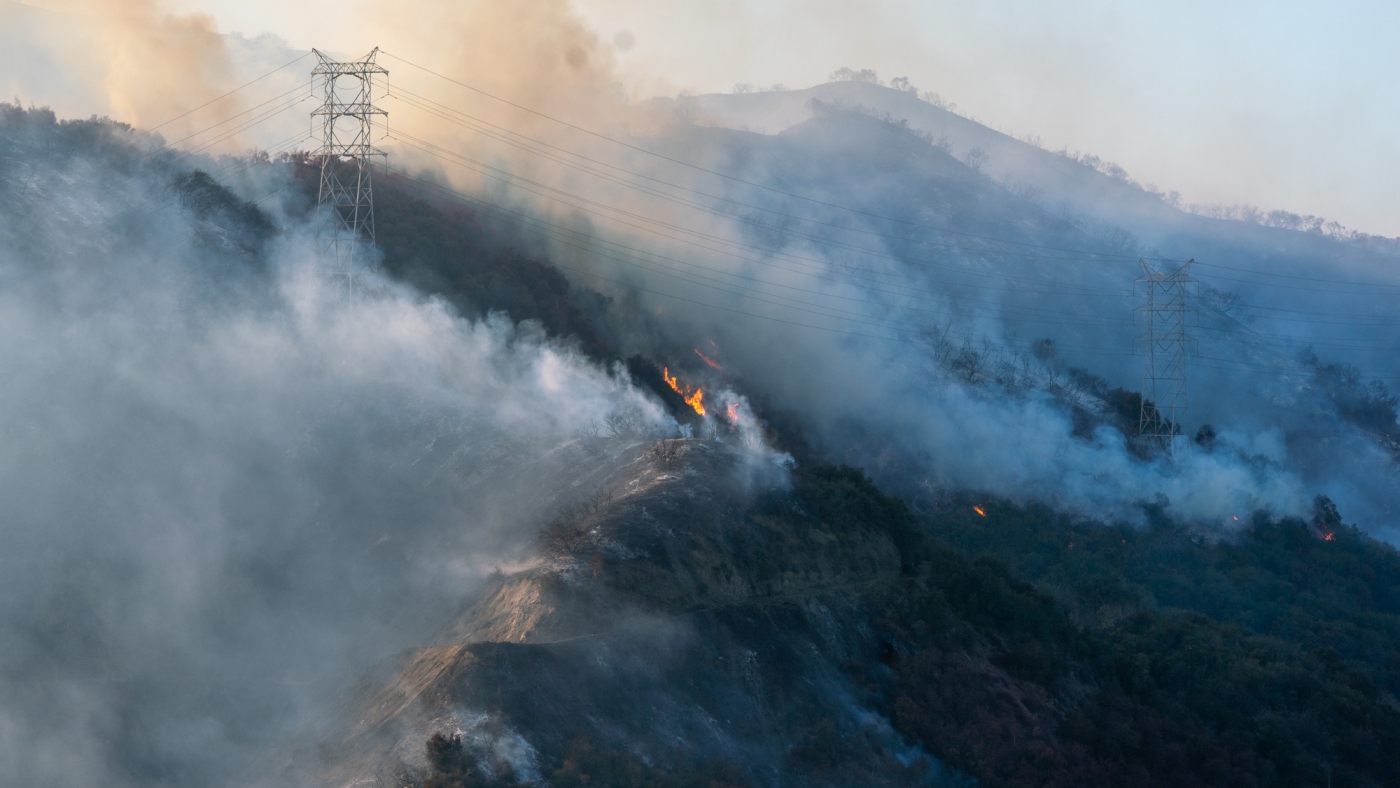
When Chad Comey’s five-story condo building burned down in the Palisades Fire early last year, all that remained was the parking garage, a brick and stucco wall, and a few charred trees. Comey’s street is now lined with empty lots stretching up into the green hills.
Comey, a musician and caretaker for his two disabled parents, has moved five times in the past year, searching for wheelchair-accessible housing while trying not to overstay their welcome with friends and family.
“I think we have a right to be angry,” Comey says. “I am housed, but I am homeless.”
The 32-year-old has relied on traditional news sources like the Los Angeles Times and LAist for information about the fires and their aftermath. However, many others turn to social media platforms, where misinformation has spread rapidly, influencing public perception and even affecting policy decisions.
According to Pew Research, more than half of Americans get at least some of their news from social media. In the aftermath of the Los Angeles fires that killed 31 people and burned an area roughly three times the size of Manhattan, this reliance on social media has had tangible consequences.
“In today’s day and age on social media, one kernel of truth can be spun off into reels and rage bait,” Comey notes. “There’s a lot of that.”
Max Boykoff, an environmental studies professor at the University of Colorado Boulder who studies media and climate change, explains that these false narratives “are tactics to muddy the waters of public discussions,” distracting from how best to respond to disasters.
Senate Bill 549: A Casualty of Misinformation
One clear example of misinformation’s impact involves Senate Bill 549 (SB 549), says Julia Stein, deputy director for the Emmett Institute on Climate Change and the Environment at UCLA School of Law.
The bill, introduced last February, had two main purposes: helping local governments finance transit-oriented development and low-income housing, and creating a central hub to manage LA’s post-fire recovery. This hub was recommended by an independent panel of experts and local leaders to serve as a “single point of accountability” for residents who lost their homes.
However, last summer, incorrect narratives about the bill spread quickly on social media. A key false claim was that SB 549 would result in an influx of new, high-density affordable housing in fire-affected areas.
Spencer Pratt, a podcaster and former reality TV star who lost his home in the Palisades Fire, posted a TikTok video to his more than 2 million followers claiming that the bill would grant “LA County authority to purchase fire destroyed lots for minimal cost and convert them into low income housing” and “force low-income housing mandates.” The video received over 286,000 views, and similar messages spread through other influencers.
Stein explains that these claims were false: “You have injected this narrative that what this bill is trying to do is build dense, affordable housing and big apartment buildings in the Palisades. Even though the bill wouldn’t have done those things.”
The bill was designed to finance transit-oriented development only for areas within half a mile of “major transit stops” as defined by California law—rail stations, bus rapid transit stations, or ferry terminals. The Palisades neighborhood, located near the ocean in the Santa Monica mountains, does not qualify as being near such transit stops.
Just one day after Pratt posted his TikTok video, the bill’s author, California state Sen. Ben Allen, paused the legislation. Allen’s office received hundreds of calls and emails—far more than the few dozen calls typically received for hot-topic bills.
“I’m all for community engagement and public participation,” Stein says, “but, in this case, folks were reacting to information that was factually incorrect.”
Allen told NPR, “The absence of good journalism, along with misreads of the bill, allowed false narratives to spin around on the internet, which then impacted AI-generated descriptions of the bill, which people unfortunately turn to for information now. It hampered our ability to have a productive conversation on the matter.” He added, “I have no plans to move SB 549 forward.”
The delay in creating the centralized recovery authority has left many fire victims without clear guidance. “Right now,” Stein says, “folks don’t know where to turn.”
Rebuilding Trust in Official Information
Jake Levine, whose mother lost her home in the Palisades Fire, acknowledges the widespread mistrust of state and local agencies among many fire survivors. Levine, a former climate and energy director at the National Security Council who is now running for Congress in a district that includes the Palisades, suggests this mistrust may be partially justified.
A recent Los Angeles Times investigation found that the Los Angeles Fire Department deleted and revised drafts of a key report after the fires, changing words like “failures” to “primary challenges.”
“I think one of the reasons why people are looking for information from all sorts of sources is because the normal institutional sources that we rely on have allowed there to be a bit of a vacuum in terms of official and reliable information,” Levine says.
He hopes that in the future, more government agencies can share information directly with residents about issues like air quality after fires, so people don’t have to rely on potentially inaccurate information from commercial apps or social media.
Boykoff emphasizes the need for robust fact-checking by news organizations, especially as more people use AI for information without verifying original sources. “In that new environment, there is much higher potential for mis and disinformation,” he notes.
As climate change increases the frequency and intensity of disasters, addressing misinformation becomes even more crucial for effective disaster response and recovery.
Fact Checker
Verify the accuracy of this article using The Disinformation Commission analysis and real-time sources.

15 Comments
This is a sobering reminder of the real-world consequences of misinformation on social media. Reliable, fact-based reporting is crucial for keeping communities informed and safe during crises. Platforms need to do more to stem the tide of false narratives.
Agreed. Fact-checking and content moderation should be a top priority for social media companies, especially when it comes to breaking news and emergency situations. Responsible reporting is essential for supporting recovery efforts and maintaining public trust.
Wildfires are devastating enough without the added burden of misinformation. Local news outlets and authorities should be the primary sources for information during emergencies. Social media can be a powerful tool, but it requires vigilance to separate fact from fiction.
Misinformation can be incredibly damaging during times of crisis. It’s essential that people turn to credible local news sources and official channels for the most accurate and up-to-date information. Social media platforms have a duty to combat the spread of false narratives.
Tragic to hear about the spread of misinformation during such a devastating time. Social media can be a double-edged sword – it allows for rapid information sharing, but also the proliferation of false narratives. Reliable local news sources will be crucial for accurate updates on the recovery efforts.
Agreed. Fact-checking and responsible reporting are essential, especially when communities are grappling with natural disasters and their aftermath. Misinformation can hamper relief efforts and spread unnecessary fear.
This highlights the importance of media literacy and critical thinking when consuming news on social platforms. Verifying information from credible sources should be a priority, rather than relying on unsubstantiated social media posts. Transparency and accountability are key to rebuilding trust.
The spread of misinformation on social media can have real-world consequences, as seen in the aftermath of the Los Angeles fires. Fact-based journalism and transparent communication from authorities are crucial for keeping communities informed and safe. Platforms must do more to address this problem.
The spread of misinformation during crises is a concerning trend. Robust fact-checking and reliable local reporting can help counter the rapid dissemination of false narratives on social media. It’s crucial that recovery efforts are guided by accurate, up-to-date information.
Absolutely. Social media platforms have a responsibility to curb the spread of misinformation, especially around high-stakes events like natural disasters. Partnerships with journalists and fact-checkers could be one way to address this challenge.
This highlights the urgent need for improved media literacy and critical thinking skills. Social media has become a breeding ground for misinformation, especially during times of crisis. Fact-based reporting from local news sources is crucial for keeping communities informed and safe.
Tragic to see the devastating impact of misinformation on social media during such a challenging time. Reliable, fact-based reporting from local news outlets should be the go-to source for information. Platforms need to do more to combat the spread of false narratives.
Agree completely. Curbing the rapid dissemination of misinformation should be a top priority for social media companies. Fact-checking and partnerships with journalists are essential for ensuring accurate, responsible reporting during emergencies.
The spread of misinformation on social media during natural disasters is a serious concern. Reliable local news outlets should be the primary source of information for affected communities. Platforms need to strengthen their efforts to identify and remove false content.
Absolutely. Fact-checking and verification should be the top priority for social media companies when dealing with breaking news and emergency situations. Responsible reporting and transparency are key to maintaining public trust and supporting recovery efforts.