


Listen to the article
Coordinated Disinformation Campaign Targets Armenia-France Relations Ahead of Elections
A sophisticated disinformation operation falsely claiming collaboration between Armenian and French officials to manipulate elections has been detected circulating on social media platforms, according to media monitoring specialists.
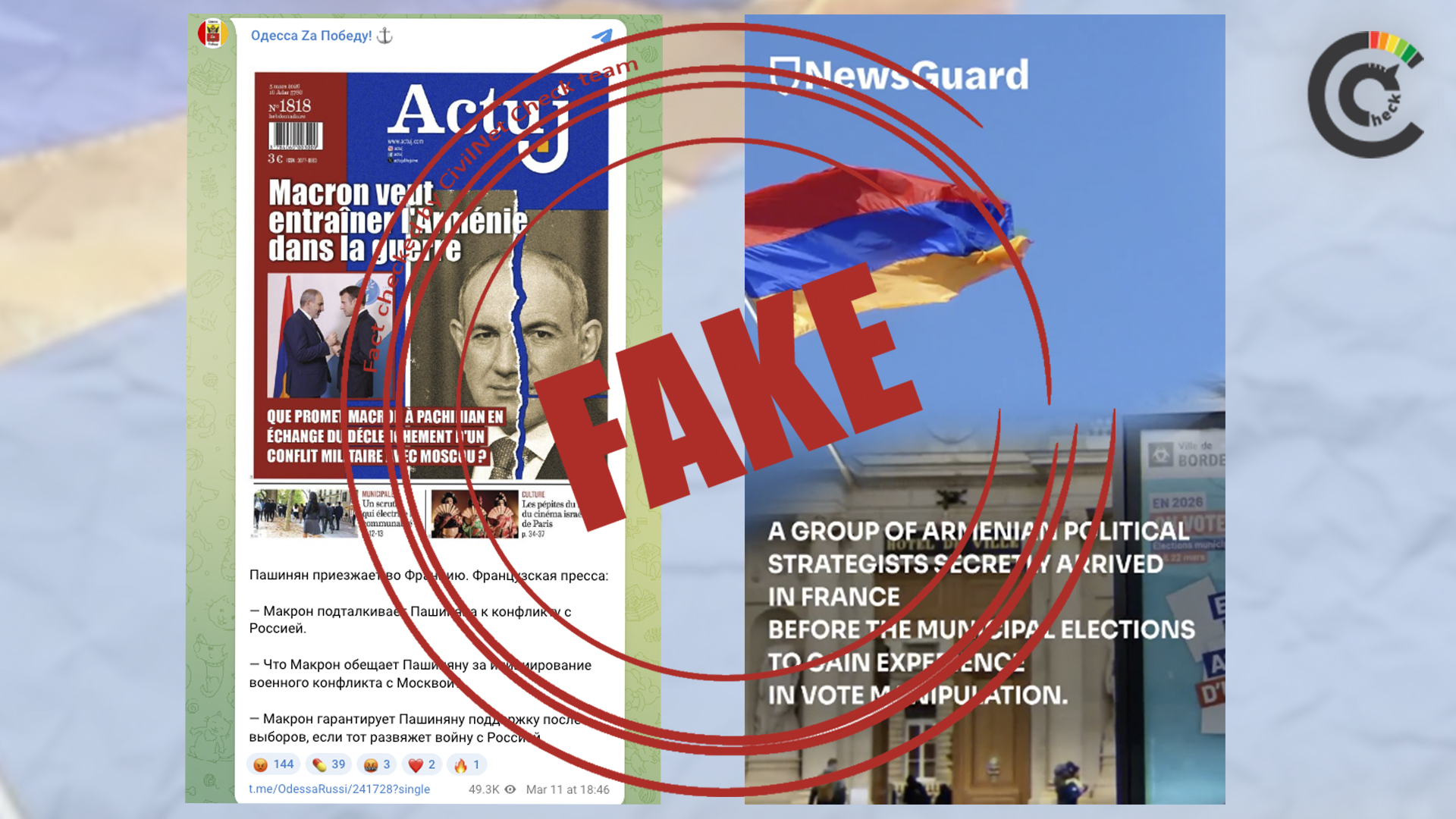
The fabricated video, which began spreading on X (formerly Twitter) on March 10, alleges that “a group of Armenian political strategists secretly arrived in France before the municipal elections to gain experience in vote manipulation” as part of a supposed “secret agreement” between French President Emmanuel Macron and Armenian Prime Minister Nikol Pashinyan.
The false narrative suggests Armenian experts would learn election manipulation techniques during France’s March 14 municipal elections and later apply them in Armenia’s upcoming June parliamentary elections. The video further claims this strategy was previously used to secure Maia Sandu’s victory in Moldova’s 2020 elections.
Digital forensics experts who examined the content found it displays hallmarks of Russia-associated disinformation networks, particularly the “Matryoshka” and “Doppelgänger” strategies, which conduct coordinated campaigns across social media platforms using bot networks and impersonation tactics.
The video deceptively features the NewsGuard logo to create a false impression of credibility. NewsGuard, an American organization that evaluates the reliability of online news sources, has not published any such report. This tactic follows a pattern seen in previous disinformation campaigns that misappropriated logos from CNN, Reuters, Bloomberg, and Euronews to lend legitimacy to false claims.
Analysis of the accounts spreading the content revealed they were either newly created in February-March 2026 or dormant accounts that suddenly resumed activity. Most had minimal prior engagement, primarily focused on non-political content before abruptly sharing the coordinated messaging about Armenia and France. The original publisher had been inactive since 2013 before suddenly posting in March 2026, suggesting a compromised account.
This campaign represents the latest in a series of targeted disinformation efforts aimed at undermining Armenia’s diplomatic relationships, particularly its growing partnership with France, which has strengthened its commitments to Armenia since the 2020 Nagorno-Karabakh conflict.
Previous disinformation operations included false claims that French company Orano was secretly transporting nuclear waste into Armenian territory, a story fabricated on a website designed to imitate a legitimate French media outlet.
More recently, Russian-language Telegram channels with tens of thousands of followers have circulated fake images purporting to be front pages of respected French publications like Liberation and Le Parisien. These fabrications feature doctored headlines claiming “Macron guarantees support for Pashinyan after the elections if he declares war on Russia.” Fact-checkers comparing these images with actual publications confirmed they were completely fabricated.
The timing of this disinformation surge coincides with France’s approaching municipal elections, where similar tactics are being deployed. False claims about French police concealing crime statistics and intelligence agencies requesting election postponements have spread across social media, often tagging legitimate outlets like RTL France and Le Monde to manufacture credibility.
Several accounts involved in the Armenia-France disinformation also amplified election-related content targeting Paris candidate Pierre-Yves Bournazel through a fake campaign website and videos falsely claiming he proposed converting the Centre Pompidou into a migrant reception center with President Macron’s backing.
Media analysts note that such coordinated campaigns typically intensify before elections, exploiting heightened public attention to influence voter behavior and perceptions. The pattern has been observed in both Armenia and France during recent electoral cycles.
Security experts warn that these operations aim to sow distrust in democratic institutions, undermine international partnerships, and manipulate public opinion during sensitive political moments. The campaigns demonstrate increasing sophistication in their ability to mimic legitimate news sources and coordinate distribution across multiple platforms simultaneously.
Fact Checker
Verify the accuracy of this article using The Disinformation Commission analysis and real-time sources.

10 Comments
It’s concerning to see this kind of coordinated cross-border disinformation operation. I wonder what the motivations and potential impacts could be, beyond just sowing general chaos and discord.
Good question. Destabilizing relations between Armenia and France, or discrediting the integrity of upcoming elections, could be part of the underlying objectives here. Vigilance and transparency will be key.
This disinformation campaign seems to be leveraging the ‘Matryoshka’ and ‘Doppelgänger’ strategies, which are concerning. I wonder what other tactics may be employed to amplify these false claims.
Good point. Tracking the evolution of these tactics and the networks behind them will be important for anticipating and mitigating future influence operations. Maintaining transparency and public awareness is key.
This is a concerning case of coordinated disinformation targeting Armenia and France. It’s critical that we stay vigilant against such attempts to undermine democratic processes through fabricated claims and misleading narratives.
Agreed. Digital forensics examining the hallmarks of Russia-associated tactics like ‘Matryoshka’ and ‘Doppelgänger’ strategies underscores the need for robust media literacy and fact-checking efforts.
Spreading false videos and headlines to sow discord ahead of elections is a dangerous tactic. I hope authorities in Armenia and France are aware of this disinformation campaign and taking appropriate measures to counter it.
Absolutely. Maintaining public trust in the electoral process is critical for healthy democracy. Disinformation undermines that, so a firm, fact-based response is essential.
Fabricating claims about ‘secret agreements’ and ‘vote manipulation’ tactics being shared between countries is a classic disinformation tactic. I hope fact-checkers and media can effectively debunk these false narratives.
Agreed. Exposing the origins and techniques used in this coordinated campaign is vital. Rigorous analysis of the digital forensic evidence will be crucial for countering the spread of these falsehoods.