


Listen to the article
Syrian journalism students sharpen fact-checking skills in EU-backed workshop
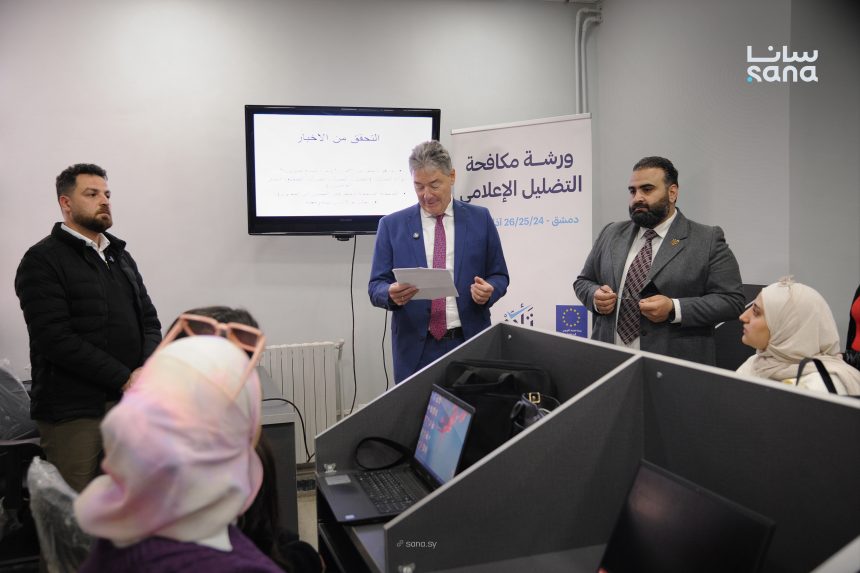
A specialized training workshop aimed at equipping young journalists with crucial fact-checking skills kicked off Tuesday at Damascus University’s Faculty of Media. The three-day initiative, titled “Empowering Young Journalists to Combat Media Disinformation,” represents a collaborative effort between the university, the European Union Mission to Syria, and the Verify-Sy platform.
The workshop specifically targets fourth-year media students who are preparing to enter a job market increasingly complicated by the proliferation of misinformation. Participants are receiving practical training in verification techniques, digital content analysis, and hands-on exercises designed to strengthen their critical assessment abilities.
Dr. Khaled Zaarour, dean of the Faculty of Media, emphasized that the initiative responds directly to a growing challenge facing journalism students and professionals alike. “In today’s information landscape, verification skills have become essential rather than optional,” Zaarour noted. “We’re seeing an unprecedented spread of inaccurate information, making critical thinking and source evaluation fundamental components of media literacy.”
The European Union’s involvement underscores the international recognition of disinformation as a cross-border concern. Michael Ohnmacht, chargé d’affaires for the EU Mission in Syria, highlighted a particularly insidious aspect of modern misinformation during the workshop.
“What makes misleading information especially dangerous is that it’s often built on partial truths presented without proper context,” Ohnmacht explained. “This problem has been magnified exponentially in the age of social media, where information travels faster than our ability to verify it.”
Ohnmacht also reaffirmed the EU’s commitment to supporting initiatives that enhance access to reliable information, particularly those that empower young people with the critical skills needed to navigate today’s complex media environment.
The workshop comes at a critical time for Syria, where information integrity faces unique challenges after years of conflict that have fragmented the media landscape. Syrian journalism students must navigate this environment while also keeping pace with the rapid evolution of digital misinformation tactics occurring globally.
Participants expressed enthusiasm about applying their new skills in real-world settings. Several students noted that the workshop had already enhanced their ability to critically assess information and distinguish between credible reporting and potentially misleading content.
“Before this training, I might recognize something seemed suspicious but wouldn’t know exactly how to verify it systematically,” one participant shared. “Now I have specific tools and methodologies to apply.”
The training is being facilitated by Verify-Sy, an independent non-profit platform established in 2016 and officially licensed in Syria in 2026. The organization has built a reputation for its focus on fact-checking and media analysis, having conducted multiple training programs for working journalists and media students throughout the region.
Media literacy initiatives like this workshop represent an increasingly important component of journalism education worldwide. As digital platforms continue to transform how information is created and consumed, the skills to identify, analyze and counter misinformation have become essential professional competencies for journalists.
The collaboration between academic institutions, international organizations, and specialized platforms also reflects a growing recognition that combating disinformation requires multi-stakeholder approaches rather than isolated efforts.
As the workshop continues through the week, participants will progress from theoretical foundations to increasingly complex verification scenarios, ultimately developing practical portfolios demonstrating their newly acquired skills – capabilities that will serve not only their professional development but also the broader Syrian public’s right to accurate information.
Fact Checker
Verify the accuracy of this article using The Disinformation Commission analysis and real-time sources.

15 Comments
It’s encouraging to see the EU collaborating with Syrian universities to address the growing challenge of misinformation. Empowering young journalists with the right skills can make a real difference in combating the spread of false narratives.
Practical, hands-on training in areas like digital content analysis is exactly what’s needed. Equipping the next generation of media professionals with these critical capabilities is an important step forward.
It’s encouraging to see the EU collaborating with Syrian universities to combat disinformation. Empowering young journalists with fact-checking skills and critical thinking abilities is a worthwhile investment in the future of quality reporting.
In an era of rampant misinformation, the ability to verify sources and analyze digital content is essential for journalists. This training program should give Syrian media students a valuable edge as they enter the profession.
Providing practical training in verification techniques and digital content analysis is a smart way to prepare the next generation of Syrian journalists. Developing these essential skills will serve them well in their future careers.
Strengthening the capacity of Syrian media students to identify and counter false narratives is a crucial step in maintaining the integrity of journalism. This EU-backed workshop seems like a promising initiative to achieve that goal.
It’s great to see the EU supporting efforts to combat disinformation in the Syrian media landscape. Equipping young journalists with the tools to identify and counter false narratives is crucial for maintaining public trust.
This training seems like a positive step towards building a more resilient and responsible media ecosystem in Syria. The hands-on nature of the workshop should help translate these skills into real-world application.
Fact-checking skills are crucial for journalists today, with the rise of misinformation. This EU-backed workshop sounds like a great initiative to equip Syrian media students with the tools to combat disinformation effectively.
Verification techniques and critical assessment abilities are vital in the modern information landscape. This training should give these students a strong foundation to navigate the complexities of today’s media environment.
This initiative seems timely and necessary, given the prevalence of misinformation, especially in conflict zones like Syria. Strengthening fact-checking and critical thinking skills among aspiring journalists is a smart investment in the future of quality reporting.
The dean’s comments underscore how verification has become an essential skill, not just an optional one. This workshop should give participants a valuable edge as they enter the job market.
In an age of information overload, the ability to critically assess sources and identify misinformation is invaluable. This workshop should equip Syrian media students with the tools they need to navigate the complexities of today’s media landscape.
Combating the spread of disinformation is a global challenge, and it’s heartening to see the EU supporting efforts to equip Syrian media students with the necessary skills. This workshop could have a significant impact on the future of quality journalism in the region.
Fact-checking and critical analysis are fundamental skills for journalists today. This EU-backed initiative to strengthen these capabilities among Syrian media students is a constructive approach to addressing the spread of misinformation.