


Listen to the article
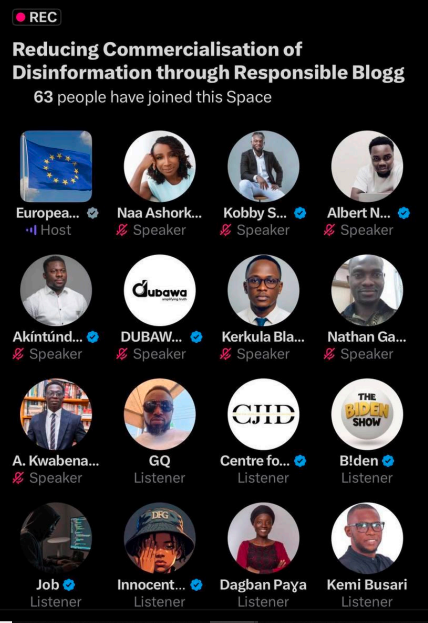
A tense but necessary conversation about truth, profit, and responsibility unfolded across West Africa’s digital space on Friday evening as media practitioners, bloggers, and policy actors gathered for a regional webinar organized by the Centre for Journalism Innovation and Development (CJID), DUBAWA, and the European Union (EU).
With over 900 attendees, the virtual forum, themed “Reducing Commercialisation of Disinformation through Responsible Blogging and Content Creation,” addressed growing concerns about digital falsehoods as threats to democracy, public safety, and national security.
Even before the event began, controversy erupted over the inclusion of Ghanaian blogger Nat Hyde, known as “Bongo Ideas,” whose provocative online style has frequently drawn accusations of sensationalism. Petitions circulated on social media urged organizers to remove Hyde, whom critics described as a habitual spreader of disinformation.
Rather than backing down, organizers proceeded with their original lineup, aiming to facilitate a necessary dialogue among diverse voices. Deputy EU Ambassador Jonas Claes acknowledged the controversy head-on, emphasizing that the forum was not intended to reward or showcase individual bloggers.
“We adhere to an open debate culture involving differing, dissenting, sometimes even uncomfortable opinions. I learn the most from those,” Claes stated. He framed the passionate public response as evidence of Ghana’s democratic maturity and of the real-world consequences of monetized disinformation.
Broadcaster and journalist Naa Ashorkor moderated the discussion, reminding participants that the ethical tension between speed and responsibility predates social media. From her journalism training, she noted that sensational headlines might drive quick sales but can permanently damage lives.
Maxine Danso, International Expansion Lead at CJID, provided context by defining the commercialization of disinformation as the deliberate production of misleading or false content designed primarily to generate engagement and revenue. She explained that modern digital platforms reward virality over accuracy, creating an economic incentive structure where outrage and fabrication often outperform careful reporting.
Danso outlined various tactics from clickbait headlines and sensational distortions to misinformation, malicious release of private information, and the growing use of artificial intelligence to create deepfakes. These approaches, she noted, follow recognizable patterns that researchers use to identify intentional harm.
Legal practitioner and DUBAWA researcher Austin Brako-Powers highlighted international risk assessments that now rank disinformation among the most serious global threats. He argued that when falsehoods are amplified for profit, citizens lose the ability to distinguish fact from fiction—a condition that undermines democratic processes.
The conversation gained particular poignancy when bloggers shared their personal experiences working in West Africa’s fast-paced digital ecosystem, where many creators operate without newsrooms, editors, or legal teams.
Liberian blogger Kerkula Blama admitted that the pressure to be first has often led him to share information without adequate verification. “Picking and sharing, picking and sharing,” he described, recalling an incident where prematurely reporting a prominent figure’s death nearly resulted in his arrest. This close call forced him to prioritize fact-checking over speed.
Ghanaian content creator Philomena Antonio shared a similar learning experience. After publishing inaccurate information from what she believed was a reliable source, she deleted the post and publicly corrected herself, choosing transparency to preserve her credibility.
Digital strategist Kobby Spiky Nkrumah reinforced these concerns, noting that hasty posts have triggered legal threats and demands for retractions—stark reminders that online publishing carries real-world consequences.
The most anticipated contribution came from Hyde himself, who addressed his critics directly. He acknowledged his controversial reputation but challenged how the term “disinformation” is applied. For Hyde, intent is the crucial factor; false information becomes disinformation only when deliberately crafted to deceive.
“I don’t think I’ve ever put out something that I know in my heart of hearts is false,” he maintained. While he has sometimes complied with retraction requests, Hyde said he resists constant apologies, believing excessive backtracking could damage his brand.
As the discussion concluded, participants focused on solutions. Panelists agreed that while disinformation must be curtailed, enforcement should not rely solely on punitive measures that might suppress free expression. Instead, they advocated for stronger fact-checking practices, transparent corrections, and platform systems that discourage engagement-driven falsehoods.
The forum ended with bloggers and organizers pledging to promote responsible content creation by verifying information before publication, avoiding sensationalist headlines, promptly retracting inaccurate posts, and issuing public apologies when errors occur.
The event forms part of the “See the Pattern” Campaign, launched in January 2026 by the EU and DUBAWA to strengthen information integrity across Ghana and the broader West African region, where independent creators now shape public discourse as significantly as traditional media outlets.
Fact Checker
Verify the accuracy of this article using The Disinformation Commission analysis and real-time sources.

9 Comments
Intriguing topic. Addressing the monetization of disinformation is a complex challenge, but promoting responsible blogging and content creation seems like a step in the right direction. I’m curious to hear more about the perspectives shared during the webinar.
This is a timely and critical issue, especially in the context of social media and the attention economy. I’m curious to learn more about the specific strategies and recommendations that emerged from the webinar for combating the commercialization of digital falsehoods.
The virtual forum’s theme of ‘Reducing Commercialisation of Disinformation through Responsible Blogging and Content Creation’ strikes me as a pragmatic and multi-faceted approach. I look forward to seeing what concrete actions or policy proposals result from this dialogue.
Agreed. Practical solutions that empower content creators and platforms to prioritize accuracy and integrity will be key. Curious to see if any industry self-regulation or collaborative initiatives emerge from this process.
Monetized disinformation is a growing problem that undermines trust in media and democratic discourse. I’m glad to see the EU and local organizations taking steps to address this challenge through multi-stakeholder engagement.
The inclusion of controversial figures like Bongo Ideas raises some concerns, but I appreciate the organizers’ aim to facilitate a necessary dialogue. Engaging diverse voices, even those with differing views, could lead to meaningful progress on this issue.
I agree. Avoiding echo chambers and creating space for nuanced discussions, even with provocative figures, is important. Hopefully the event generated more light than heat on this sensitive topic.
The webinar’s focus on responsible blogging and content creation is an important step, but the challenge extends beyond individual actors. Systemic changes to the incentive structures and business models driving the spread of digital falsehoods will also be necessary.
Addressing the monetization of disinformation is crucial for protecting democracy and public discourse. I commend the organizers for tackling this complex issue through multi-stakeholder engagement, despite the controversy around certain participants.