


Listen to the article
EU Backs Nigerian Editors’ Initiative to Combat Misinformation Through Fact-Checking Desks
The spread of misinformation and fake news has emerged as a critical threat to Nigeria’s media landscape and national stability, prompting a coordinated response from the country’s top editors with support from the European Union.
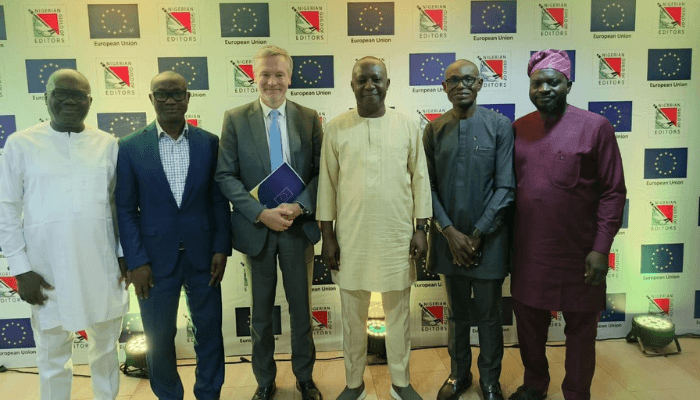
Following a recent EU-facilitated workshop in Lagos, editors from print, online, and electronic media outlets across Nigeria have committed to establishing dedicated fact-checking desks in their newsrooms to combat the rising tide of false information. The initiative comes as media professionals acknowledge their crucial gatekeeping role in maintaining information integrity.
At the one-day workshop, which drew approximately 40 members of the Nigerian Guild of Editors, EU Ambassador to Nigeria and ECOWAS Gautier Mignot emphasized media literacy as an essential defense against misinformation. “Anything that compromises the integrity of information reduces people’s capacity to take informed and right decisions in matters that affect them,” Mignot stated.
The ambassador highlighted how technological advancements have created a double-edged sword for journalism. While modern tools have accelerated communication, they have simultaneously made it easier to produce and distribute deceptive content that increasingly resembles authentic material. “The implications are far reaching because misleading information erodes not only the credibility of the message, but also that of the messenger and the institution,” he warned.
Nigeria’s struggle with misinformation mirrors a global challenge but carries unique risks in a diverse nation with complex political, ethnic, and religious dynamics. Social media platforms have accelerated the spread of false narratives, often with harmful consequences for social cohesion and democratic processes.
Eze Anaba, President of the Nigerian Guild of Editors, reinforced these concerns during the workshop. “The deliberate spread of false information, whether through disinformation, misinformation, or fabricated news, not only undermines public trust but also threatens social cohesion, democratic governance, and national security,” he observed.
Media experts have long noted that despite editors’ critical role as information gatekeepers, many lack specialized training in digital verification techniques and fact-checking methodologies. The workshop aimed to address this gap by enhancing editors’ capabilities to identify false information and promote accurate reporting.
The initiative represents a significant shift in Nigeria’s media ecosystem, where traditional verification processes are being adapted to counter sophisticated forms of misinformation. By establishing dedicated fact-checking desks, newsrooms will create specialized units focused solely on verifying information before publication.
Media analysts suggest this development could help restore public trust in mainstream journalism at a time when confidence in traditional news sources has been eroded by the proliferation of unverified information online. The EU’s support for this initiative aligns with broader international efforts to strengthen media literacy and combat fake news globally.
The workshop also emphasized the importance of instilling rigorous verification practices as standard procedure in Nigerian newsrooms. By systematically authenticating content before publication, editors hope to safeguard the credibility of their outlets while providing the public with reliable information.
As Nigerian media organizations begin implementing these fact-checking desks, the initiative could serve as a model for similar efforts across West Africa, where many countries face comparable challenges with misinformation undermining democratic institutions and social stability.
Fact Checker
Verify the accuracy of this article using The Disinformation Commission analysis and real-time sources.

11 Comments
Misinformation is a global scourge, so it’s encouraging to see international cooperation to address it. Strengthening media fact-checking capabilities is a prudent step.
The rise of fake news is a global challenge, but it’s good to see collaborative efforts like this to combat it. Strengthening media literacy will be key, along with robust fact-checking processes.
Absolutely. Empowering the public to critically evaluate information sources is vital. Kudos to the EU for supporting this important initiative.
Glad to see the EU and Nigerian media leaders taking action against misinformation. Fact-checking desks in newsrooms are a crucial step to upholding integrity of information and enabling informed decisions.
Combating misinformation is a complex issue, but this seems like a pragmatic approach. Fact-checking desks can help Nigerian media uphold their gatekeeping role.
This collaboration between EU and Nigerian editors demonstrates the global nature of the disinformation challenge. I’m curious to see how effective the fact-checking desks will be in practice.
Establishing dedicated fact-checking units in Nigerian media is a proactive move. Misinformation can undermine democratic processes, so this is a timely and necessary response.
While technology has enabled faster spread of information, it has also enabled the spread of falsehoods. I’m glad to see efforts to shore up media integrity and build public trust.
Agreed. Maintaining high journalistic standards in the digital age is crucial. This initiative could serve as a model for other countries grappling with misinformation.
The EU’s support for this Nigerian editors’ initiative is commendable. Robust fact-checking processes are vital to counter the erosion of trust in media and democratic institutions.
Agreed. Preserving the integrity of information is critical, especially in an age of rapid digital spread. This collaborative effort could yield valuable lessons.