


Listen to the article
Social Media Awash with Disinformation as Election Day Approaches
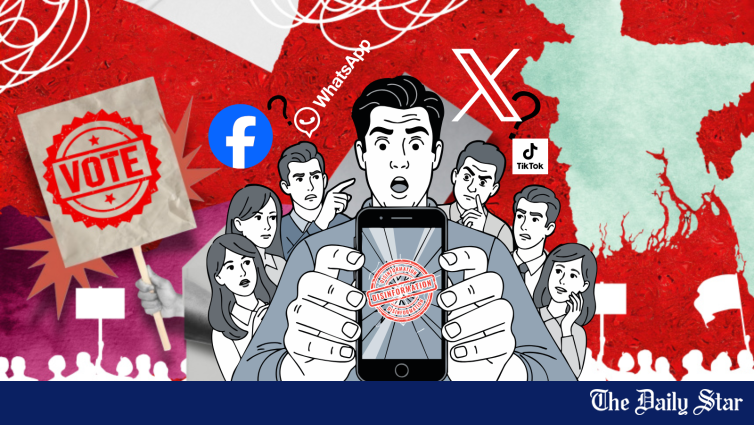
Just a day before the election, Facebook has transformed into a battleground for political disinformation, with manipulated content circulating widely and potentially influencing voters across the country.
False statements attributed to political leaders, doctored images, and AI-generated visuals are being deployed to create fabricated scenarios and provoke partisan outrage. Experts warn these tactics could significantly impact public opinion as voters head to the polls in tomorrow’s February election.
“The main intention behind disinformation campaigns is to manipulate voting choice,” said Dr. Din M Sumon Rahman, Head of Media Studies and Journalism at the University of Liberal Arts Bangladesh (ULAB). “Disinformation neatly feeds the confirmation bias of a decided voter’s choice.”
According to Dr. Rahman, who also serves as founding editor of fact-checking organization FactWatch, undecided voters are particularly vulnerable. “Voters who don’t know whom to vote for, don’t have a strong opinion, are provided with disinformation that influences them to vote for a certain political party. In this process, they use religion, violence and many other aspects for provocation.”
A month-long investigation by The Daily Star documented 220 cases of disinformation circulated between mid-December 2025 and mid-January 2026. The findings reveal a disturbing pattern of coordinated disinformation campaigns along party lines.
Entities supporting Jamaat topped the list with 96 documented instances of disinformation, followed by Awami League-aligned groups with 78, and BNP-aligned actors with 38. These 220 posts collectively generated over 2 million engagements within just 24 hours of publication, demonstrating the rapid spread of false information.
Jamaat-aligned entities dominated engagement metrics, accounting for more than 1.8 million interactions (90.68%), while AL and BNP-aligned actors trailed far behind with 5.13% and 3.57% respectively.
Targeting Political Rivals
The data reveals disinformation is being used as a deliberate tactical weapon against political opponents. Jamaat-aligned entities directed 78% of their disinformation at the BNP, their former ally but now main political rival. These posts aggressively framed BNP leadership as extortionists and criminals while attempting to position Jamaat as a morally superior alternative.
One example includes Uttorbongo Television’s release of an AI video featuring a staged interview with an elephant handler who falsely claimed the BNP was the “real extortionist.”
BNP-aligned actors responded in kind, targeting Jamaat with 80% of their disinformation campaign. These posts frequently questioned Jamaat’s Islamic credentials and portrayed the party as a threat to Hindu communities.
Meanwhile, pro-Awami League entities focused their efforts on undermining the interim government and student coordinators. One widely shared claim falsely alleged that Chief Adviser Dr. Muhammad Yunus was plotting a civil war.
Defamation as a Primary Weapon
Defamation emerged as the dominant tactic across political divides. Of the 220 pieces of documented disinformation, 155 were categorized as defamatory. Nearly 90% of all defamatory content spread by Jamaat-aligned entities targeted the BNP, while almost all defamatory content from BNP-aligned actors focused on Jamaat.
On December 21, 2025, a high-engagement post falsely alleged that BNP Secretary General Mirza Fakhrul Islam Alamgir and his brother ran a multimillion-taka scheme to smuggle Awami League leaders across the border, providing no evidence to support the claim.
Jamaat-aligned actors also promoted conspiracy narratives suggesting the BNP would compromise national interests for Indian favor, including a fabricated story claiming Tarique Rahman had agreed not to purchase weapons without India’s permission.
Tactics and Media Formats
Nearly 59% of the analyzed posts contained manipulative content that twisted truth into false narratives. Of the 62 manipulative posts pushed by Jamaat-aligned entities, 48 targeted the BNP, while pro-BNP actors produced 18 such posts, almost all aimed at Jamaat.
Beyond fabrication, political actors also employed decontextualization, manipulating authentic information to construct misleading narratives. Among the content analyzed, 27 posts fell into this category, where real statements or events were reframed to serve partisan agendas.
Videos remain the dominant vehicle for disinformation, though photocards are growing in popularity. Of the 220 items analyzed, 104 were videos and 44 were photocards. Approximately one-third of posts relied on forged documents or fabricated quotes, with 75 such instances identified.
Deepfakes and other AI-generated content formed the second most common category, totaling 58 documented cases. Pro-Jamaat entities produced the highest number in this category with 27 instances, followed by pro-BNP actors with 17, and pro-Awami League entities with 14.
With election day imminent, this surge in disinformation highlights growing concerns about social media’s role in democratic processes and the increasing sophistication of digital manipulation tactics in political campaigns.
Fact Checker
Verify the accuracy of this article using The Disinformation Commission analysis and real-time sources.

10 Comments
I’m curious to hear more about the specific tactics and motivations behind these disinformation campaigns. What are the underlying goals, and how can they be most effectively countered?
Disinformation thrives on confirmation bias and partisan outrage. Voters must make the effort to seek out objective, fact-based information from trusted sources before casting their ballots.
Absolutely. An informed and engaged citizenry is crucial for the health of our democracy. We all have a role to play in combating the corrosive effects of online misinformation.
This is a complex issue with no easy fixes. While social media companies have a responsibility to curb the spread of disinformation, individual users also need to be more discerning and critical consumers of online content.
This is deeply concerning. Disinformation on social media can have serious consequences for the democratic process. Voters need accurate, reliable information to make informed decisions.
Agreed. Manipulated content and fabricated scenarios undermine public trust and threaten the integrity of elections. Platforms must do more to combat the spread of misinformation.
The rise of AI-generated visuals to spread disinformation is especially troubling. It’s becoming increasingly difficult for the average user to discern what’s real and what’s not online.
Fact-checking organizations play a vital role in debunking these kinds of deceptive tactics. But the scale of the problem may require more comprehensive, coordinated solutions.
As a voter, I’m deeply concerned about the potential impact of disinformation on my decision-making process. I will be sure to cross-reference any political claims I see online with reputable, fact-based sources.
This is a sobering reminder of the challenges we face in the digital age. Maintaining the integrity of our democratic institutions requires constant vigilance and a commitment to truth and transparency.