


Listen to the article
Global News Shaped by Trade Wars, AI Expansion, and Ongoing Conflicts in 2025
News coverage in 2025 reflected a world in transition, with major stories dominated by US trade policies, the expanding influence of artificial intelligence, and persistent global conflicts. As President Donald Trump’s second term took hold, his administration implemented sweeping tariffs and deep spending cuts that created widespread economic uncertainty worldwide.
The rapid growth of AI technology and data centers emerged as a central global narrative, highlighting technology’s increasing impact on economies, employment, and energy consumption. Meanwhile, conflicts in Ukraine, Gaza, Sudan, and Syria continued to demand media attention, with journalists using sophisticated data analysis and visualization techniques to convey the human toll of ongoing violence.
Climate disasters also featured prominently in reporting, from California wildfires to Amazon droughts, while social media platforms faced scrutiny for their role in amplifying extremism and misinformation.
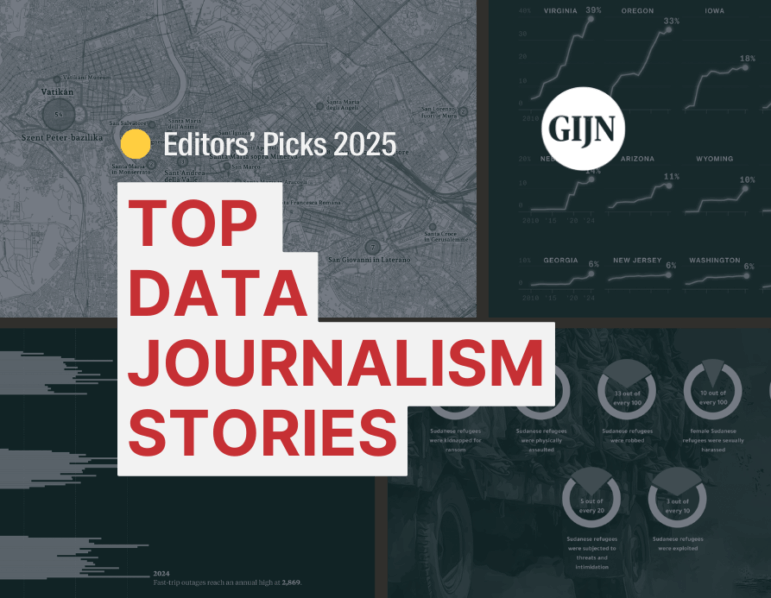
Data journalism played an especially crucial role in 2025’s coverage, with news organizations leveraging advanced visualization, mapping, and open-source intelligence to make complex stories accessible to global audiences.
Conflict Reporting Dominated Headlines
Approximately 14% of major data journalism stories focused on conflicts, with the Russia-Ukraine war, Gaza, and Sudan producing some of the year’s most in-depth investigations. These reports combined open-source intelligence, mapping, social media analysis, and on-the-ground reporting to document the human costs of war.
In Ukraine, where Russian forces made incremental advances despite international resistance, Ukrainian news outlet Texty examined how large language models from various countries interpreted the conflict. Their research revealed significant biases among AI systems, with Canadian LLMs showing the most pro-Ukrainian stance while Chinese models demonstrated stronger pro-Russian perspectives.
The Gaza conflict, which reached a fragile ceasefire in October after claiming more than 70,000 lives and injuring 170,000, sparked detailed investigations into Israeli military tactics. Forensic Architecture and the World Peace Foundation documented systematic attacks on aid convoys and food infrastructure, using open-source data and spatial analysis to reveal patterns suggesting intentional targeting of civilians seeking humanitarian assistance.
Sudan’s devastating civil war between government forces and the Rapid Support Forces developed into a catastrophic humanitarian crisis. Arab Reporters for Investigative Journalism exposed how smugglers and criminal gangs exploited refugees fleeing the violence, particularly those crossing into Egypt. Their investigation, based on interviews with survivors and surveys of over 300 refugees, revealed widespread sexual violence and mapped the main smuggling routes used to traffic vulnerable people.
Following Bashar al-Assad’s flight from Syria in late 2024, The New York Times produced a remarkable 3D model of the notorious Sednaya prison, providing an interactive look at the facility where the regime had tortured thousands of dissidents. This investigation helped document potential war crimes and told the stories of prisoners held there.
Climate Crisis Intensifies
Extreme weather and natural disasters in 2025 underscored the accelerating climate crisis. From Hurricane Melissa striking Jamaica to typhoons in Hong Kong and flooding in Pakistan and India, climate events dominated headlines globally.
High Country News and Type Investigations conducted a groundbreaking analysis of California wildfire prevention measures after a catastrophic blaze sparked by a damaged transmission tower. Their research revealed that rural communities, which often border forests and face higher fire risk, experienced 600% more power outages due to wildfire prevention systems than urban areas.
In Brazil, InfoAmazonia reported that nearly 60% of municipalities in the Amazon experienced drought throughout 2024, combining data analysis with on-the-ground reporting from communities along the Solimões River. Their investigation included detailed graphs showing monthly variations in drought conditions and measurements of political commitment to environmental protection.
AI Transforms Society and Infrastructure
Artificial intelligence dominated technology headlines in 2025, with data journalism teams tracking its impact on employment, energy consumption, and various industries from finance to creative sectors.
Bloomberg’s analysis of energy-hungry AI data centers revealed their growing strain on power grids and consumer electricity prices. By tracking wholesale electricity prices at 25,000 “grid nodes,” they found that areas near significant data center activity saw price increases as high as 267% in a single month. With data centers projected to account for 9% of all US power demand by 2035, the investigation highlighted the real-world costs of AI infrastructure expansion.
Africa Uncensored investigated how companies recruit thousands of AI “tutors” tasked with training artificial intelligence systems. Their reporting uncovered how these mass hirings often served as “labor hedging” – a tactic to impress investors and technology clients by projecting workforce readiness. By tracking job postings across 62 countries, they visualized how the AI arms race exploits a largely Global South workforce.
Social Media and Disinformation Spread
In 2025, social media platforms faced increasing scrutiny for their role in amplifying extremism and spreading misinformation.
Sky News tested whether X’s algorithm favors right-wing political content by creating test accounts mimicking British users with different political leanings. Their experiment collected 90,000 posts and found that more than 60% of political content shown to new users came from right-wing accounts. Even neutral users saw twice as much right-wing content as left-wing, with over half of all political posts originating from accounts classified as extreme.
ARIJ and Code for Africa collaborated to investigate social media disinformation about climate change, uncovering coordinated efforts to spread conspiracy theories through networks of automated accounts with ties to oil interests in Gulf states.
Global Trade and Other Key Topics
Economic policies under President Trump, including high tariffs and spending cuts, had far-reaching effects in 2025. The Financial Times produced compelling visualizations of China’s record trade surplus, which exceeded $1 trillion, highlighting why Trump’s aggressive tariff strategy targeted the US’s biggest rival. Their data showed China’s dominance in global manufacturing and its strategic trading relationships.
Other significant stories included Reuters’ investigation into Iran’s “ghost fleet” of oil tankers evading international sanctions. Using mapping, satellite imagery, and leaked documents, they revealed how Iran maintained a multibillion-dollar global oil trade despite Western sanctions through tactics like ship-to-ship transfers, forged documents, and falsified tracking signals.
Meanwhile, El Comercio explored violence against women and teenage pregnancy in Peru’s Condorcanqui province, showing how Awajún Indigenous women are working to protect girls and educate communities. Their interactive visualizations presented data on sexual violence cases, with particular attention to those involving minors.
As Cardinal Robert Francis Prevost became the first US-born pontiff in May, adopting the name Leo XIV, Hungarian outlet Átlátszó produced a detailed illustrated piece on the papal conclave, including maps of papal tombs and a 3D model of the Sistine Chapel.
In a year defined by uncertainty and transformation, data journalism proved essential for making sense of complex global issues, offering audiences deeper understanding through rigorous analysis and innovative storytelling techniques.
Fact Checker
Verify the accuracy of this article using The Disinformation Commission analysis and real-time sources.

6 Comments
Fascinating to see the role data journalism played in reporting on major global events in 2025. The use of advanced visualization and data analysis techniques must have really helped convey the nuances and human impact of complex issues like trade wars, AI, and ongoing conflicts.
The summary highlights the significant influence of geopolitical tensions and technological advancements on global news coverage. I wonder how data journalists adapted their storytelling approaches to make these high-stakes, fast-moving issues more understandable for audiences.
I’m interested to see how the news media navigated the challenge of reporting on the spread of misinformation and extremism across social media platforms in 2025. Maintaining journalistic integrity and public trust must have been a key priority.
It’s encouraging to see data journalism playing such a central role in 2025’s news reporting. The ability to leverage data and visualization to convey nuanced, fact-based narratives will be crucial in an era of growing misinformation and polarization.
The continued prominence of climate disasters in news coverage is concerning but not surprising. I’m curious to learn more about how journalists leveraged data and visuals to communicate the urgency and scale of these environmental crises.
Yes, data journalism will likely play an increasingly vital role in covering the multifaceted impacts of climate change in the years ahead. The ability to translate complex data into compelling, accessible stories will be crucial.