


Listen to the article
Alberta faces unprecedented wave of misinformation as referendum looms
A series of contentious referendum questions slated for October 19, 2026 has triggered an alarming surge of misinformation and disinformation across Alberta’s social media landscape. Voters will decide on issues including immigration restrictions, abolishing the Canadian Senate, provincial appointment of federal judges, and most controversially, separation from Canada.
Experts warn that Alberta is particularly vulnerable to manipulation. Jean-Christophe Boucher, a University of Calgary professor, described the province as “excessively vulnerable to American interference,” while former RCMP intelligence director Patrick Lennox bluntly stated that “Alberta is not ready at all” to counter the sophisticated misinformation campaigns already underway.
The referendum questions threaten to create unprecedented divisions within Alberta’s communities and families while attracting malicious actors both foreign and domestic who seek to destabilize Canada’s social fabric.
University of Alberta researcher Timothy Caulfield, a leading voice on misinformation threats, noted earlier this year that while misinformation exists across the political spectrum, “a growing body of evidence tells us in this cultural moment, we’re seeing more misinformation come from populist parties.” He warned that misinformation about immigration, crime, the economy, and climate change significantly influenced voter decisions in the United States, with Canada likely to experience similar effects.
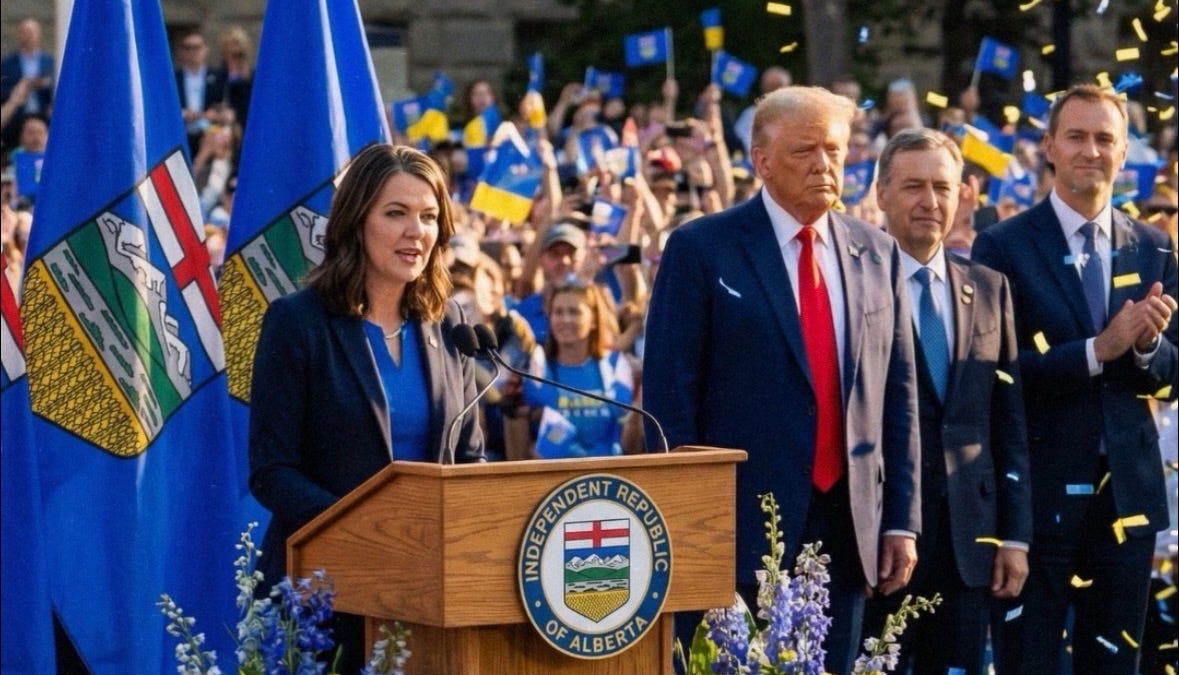
Social media platforms have become the primary battleground, with anonymous accounts flooding feeds with AI-generated videos, images, and charts promoting Alberta separatism. Many of these accounts push racist narratives targeting immigrants and employ slogans like “Make Alberta Great Again,” directly inspired by Donald Trump’s political movement. One popular separatist Instagram account recently shared an AI-generated image showing Premier Danielle Smith and President Trump celebrating the creation of an “Alberta Republic.”
Despite polls showing only 17 percent of Albertans support separation, the referendum could normalize separatist views and far-right politics in provincial and national discourse. Security experts believe Alberta separatist groups are likely being used as conduits by those close to the Trump administration seeking to influence and destabilize Canada.
The threat of AI-generated content is particularly concerning. Peter Loewen of Cornell University testified to a Canadian parliamentary committee last October that AI brings “the cost of communication down to zero,” rendering traditional spending limits on political messaging ineffective. He warned that autonomous AI agents could soon create and distribute political content without human intervention.
Despite these warnings, there appears to be little urgency among federal and provincial elected officials to address these threats. The failed Online News Act has further complicated matters, with Meta’s retaliatory banning of news links on Facebook and Instagram creating an information vacuum filled by unverified content.
Justice Marie-Josée Hogue, who led a public inquiry into foreign interference, wrote in 2025 that misinformation and disinformation pose “the single biggest risk to our democracy” and “an existential threat.”
Some municipal officials, including Edmonton City Councillor Michael Janz, have recognized the problem, referring to the volume of online misinformation as “manufactured rage-baiting.” The City of Edmonton’s 2025 Corporate Strategic Risks analysis identified misinformation and the adverse impact of artificial intelligence as “risks that can shift public opinion and erode trust in authority.”
Potential solutions include creating a “public health system for Canada’s democracy,” as proposed by John Beebe of Toronto Metropolitan University, who advocates for the establishment of a Canadian Democracy Endowment to fund civic infrastructure and coordinate national responses to democratic threats.
Education is another crucial component, with experts pointing to Finland’s approach of teaching critical thinking and fact-checking skills across all school subjects. For adults, improving media literacy and making trustworthy information more accessible are essential steps.
UBC professor Heidi Tworek suggests a broader approach that focuses on the health of the entire information ecosystem rather than just policing bad content. This could include investing in public journalism, supporting digital literacy, and improving government communications.
As Alberta approaches this crucial referendum, combating misinformation will require a coordinated response from all levels of government, civil society organizations, and individual citizens committed to preserving democratic values in an increasingly complex information landscape.
Fact Checker
Verify the accuracy of this article using The Disinformation Commission analysis and real-time sources.

20 Comments
This is a concerning issue that requires concerted efforts to address. Misinformation and disinformation can have severe impacts on democratic processes and social cohesion. I hope Alberta and the Canadian government can develop effective strategies to counter these threats.
You’re right, misinformation campaigns can be very damaging. Robust fact-checking and public education will be crucial to combating this problem.
Separating from Canada would be a major decision with far-reaching consequences. I hope Albertans can make an informed choice based on facts, not manipulated information. Maintaining national unity is important, but local concerns must also be addressed.
Agreed, this is a complex issue that deserves serious and objective consideration. Transparency and open dialogue will be key to navigating this challenging situation.
Dividing families and communities along political lines is a worrying prospect. Maintaining social cohesion should be a key consideration as Alberta navigates this challenging situation. Open dialogue and compromise will be essential.
Well said. Polarization and division can have lasting negative impacts on a society. Fostering mutual understanding and finding common ground should be the goal.
Addressing the vulnerability of Alberta to foreign interference is a complex challenge. I hope the government can work with international partners to develop strategies that enhance digital resilience and safeguard democratic institutions.
As a Canadian citizen, I’m concerned about the potential for these referendum questions to destabilize the country. I hope the government and civil society can work together to promote truth, transparency, and national unity.
I share your concerns. Maintaining a strong, unified Canada should be the ultimate goal, while also addressing regional grievances through legitimate democratic channels.
This is an important issue that goes beyond Alberta. Misinformation undermines trust in institutions and the democratic process across Canada. A coordinated, nationwide response is needed to address this threat effectively.
I agree, a national strategy is essential. Sharing best practices and resources between provinces will help build a more resilient, well-informed citizenry.
The proposed referendum questions cover highly contentious topics that could have far-reaching consequences. I encourage all Albertans to approach these issues with an open mind, critical thinking, and a commitment to facts and evidence.
Absolutely. Rational, fact-based deliberation is essential when considering such consequential decisions. Emotion and partisanship should not cloud our judgment on these matters.
Misinformation and disinformation are serious threats to democracy. I hope the government and tech companies can collaborate to develop effective ways to combat the spread of false narratives online.
Misinformation and disinformation are global problems that require global solutions. I hope Canada can collaborate with international partners to develop effective counter-narratives and strengthen digital literacy worldwide.
The threat of foreign interference in Canada’s democratic processes is alarming. Strengthening cybersecurity and developing robust counter-disinformation strategies must be a top priority for all levels of government.
The vulnerability of Alberta to foreign interference is concerning. Strengthening digital literacy and resilience against disinformation should be a top priority. Protecting the integrity of the democratic process is fundamental.
The proposed referendum questions cover complex, high-stakes issues. It’s critical that Albertans have access to reliable, unbiased information to make informed decisions. Fact-checking and media literacy initiatives should be a priority.
Protecting the integrity of the democratic process is of utmost importance. I encourage all Albertans to seek out reliable, non-partisan information and to engage in constructive dialogue on these important issues.
Well said. An informed and engaged citizenry is the best defense against the corrosive effects of misinformation and disinformation.