


Listen to the article
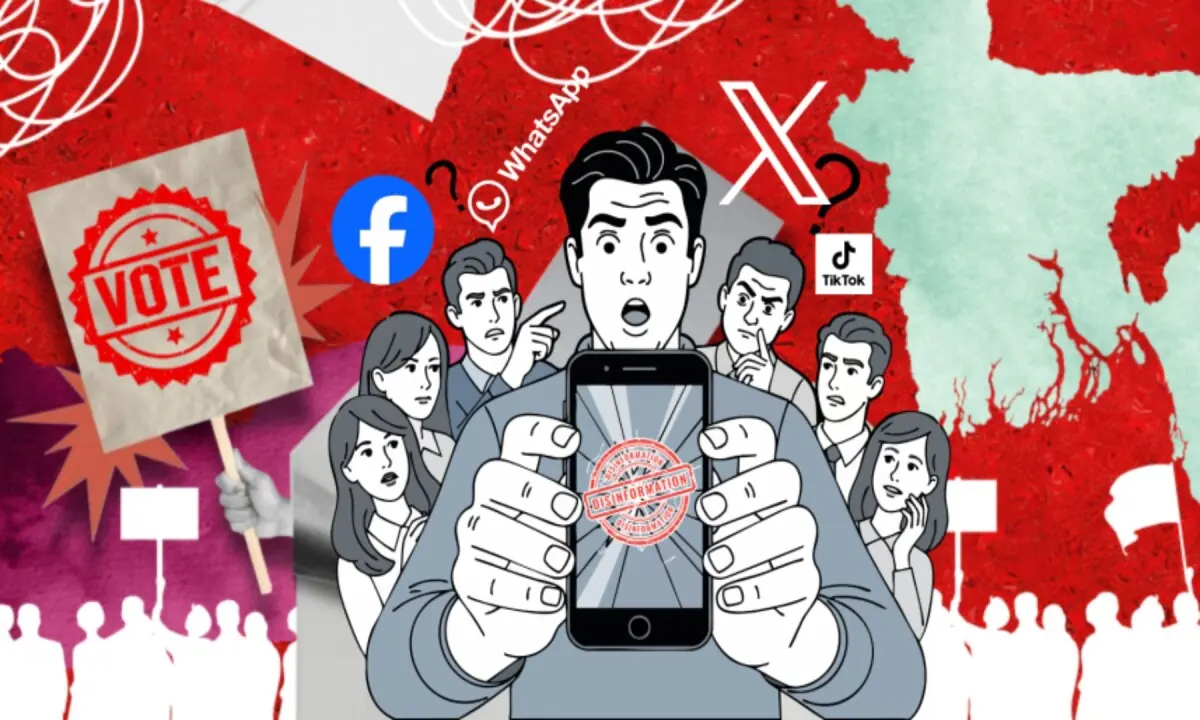
In a concerning development ahead of Bangladesh’s General Elections set for February 12, Facebook has become a hotbed of disinformation, with political actors flooding the platform with false content designed to influence voters.
An investigation by The Daily Star has documented 220 cases of political disinformation circulating on the platform from mid-December 2025 to mid-January 2026. These posts collectively garnered over 2 million engagements within 24 hours of publication, highlighting the rapid spread of misleading information among voters.
The investigation revealed that entities appearing to support Jamaat-i-Islami were responsible for nearly half of the documented disinformation cases (96 instances). Awami League-aligned groups followed with 78 instances, while Bangladesh Nationalist Party (BNP)-aligned actors accounted for 38 cases.
Dr. Din M Sumon Rahman, Head of Media Studies and Journalism at the University of Liberal Arts Bangladesh, explained the strategic purpose behind these campaigns: “The main intention behind a disinformation campaign is to manipulate voting choice. Disinformation neatly feeds the confirmation bias of a decided voter’s choice.”
According to Rahman, who also serves as founding editor of fact-checking organization FactWatch, undecided voters represent the primary targets. “Voters who don’t know whom to vote for, don’t have a strong opinion, are provided with disinformation that influences them to vote for a certain political party. In this process, they use religion, violence and many other aspects for provocation.”
The data demonstrates that disinformation is being deployed as a deliberate tactic aimed at political rivals rather than random misinformation. Jamaat-aligned entities directed 78 percent of their disinformation at the BNP, their former ally and current political rival. These posts typically portrayed BNP leadership as criminals and extortionists while positioning Jamaat as morally superior.
BNP-aligned actors responded in kind, with 80 percent of their disinformation targeting Jamaat, frequently questioning the party’s Islamic credentials and portraying them as a threat to Hindu communities. Meanwhile, pro-Awami League entities primarily targeted the interim government and student coordinators, including spreading claims that Chief Adviser Dr. Muhammad Yunus was plotting civil war.
The investigation identified defamation as the dominant tactic across political divides, with 155 of the 220 documented cases falling into this category. Nearly 90 percent of defamatory content from Jamaat-aligned entities targeted the BNP, while almost all defamatory content from BNP-aligned actors focused on Jamaat.
Beyond outright fabrication, approximately 59 percent of the analyzed posts contained manipulative content that distorted truth into false narratives. For example, BNP-aligned political analyst Maruf Mallick was documented misrepresenting findings from the Commission of Inquiry on Enforced Disappearances to allege a “secret understanding” between the Awami League and Jamaat-Shibir.
The investigation also found 27 instances of decontextualization, where authentic information was manipulated to construct misleading narratives. In one example, a video falsely claimed to show a BNP leader harassing a freedom fighter, when it appeared to show someone merely asking another person to change seats.
Regarding the mediums used, videos remain the primary vehicle for disinformation (104 instances), though photocards are growing in popularity (44 instances). Approximately one-third of the disinformation posts relied on forged documents or fabricated quotes. Notably, deepfakes and other AI-generated content formed the second most common category with 58 documented cases.
The engagement data reveals Jamaat-aligned entities dominated with more than 1.8 million interactions (90.68 percent of total engagement), while Awami League and BNP-aligned actors trailed significantly with 5.13 percent and 3.57 percent, respectively.
As Bangladesh approaches its election day, experts warn these tactics may fuel partisan hostility and significantly impact public opinion, particularly among undecided voters who are vulnerable to such manipulation.
Fact Checker
Verify the accuracy of this article using The Disinformation Commission analysis and real-time sources.

12 Comments
This is a troubling trend – political actors weaponizing social media to spread false narratives and sway voters. Voters need access to reliable, fact-based information to make informed decisions at the ballot box. Stronger safeguards against disinformation are urgently needed.
Agreed. Disinformation undermines public trust and the integrity of elections. Social media platforms have a responsibility to enforce stricter content moderation policies and partner with fact-checkers to combat the spread of misleading propaganda.
It’s troubling to see how quickly disinformation can spread and gain traction on social media. The speed and scale of these campaigns highlights the need for more robust content moderation and fact-checking processes. Voters must be empowered to identify and resist manipulation.
Agreed. The viral nature of social media makes it an especially dangerous vector for the spread of false information. Platforms need to invest heavily in proactive detection and removal of disinformation, as well as public education initiatives.
The fact that political entities from different parties are all engaging in disinformation campaigns is deeply concerning. This bipartisan approach to spreading false narratives demonstrates the cynical nature of these tactics. Voters deserve better from their elected leaders.
You make an excellent point. When disinformation becomes a common political strategy, it erodes public trust in the entire system. Ethical, evidence-based campaigning should be the norm, not the exception.
This is a sobering reminder of the challenges democracies face in the digital age. Disinformation campaigns that hijack social media to influence elections are a serious threat to the integrity of the political process. Urgent action is needed to combat this problem.
Well said. Protecting the democratic process from manipulation by bad actors should be a top priority for policymakers and tech companies. Robust policies, effective enforcement, and public awareness are all crucial components of the solution.
The scale of the problem is alarming – over 2 million engagements on disinformation posts within 24 hours. This highlights how quickly false narratives can take hold and influence public opinion. Robust media literacy education is crucial to help voters identify and resist manipulation.
Absolutely. Building public resilience against disinformation should be a priority. Educating citizens on how to critically evaluate online content and sources is key to strengthening democratic processes.
Concerning to see such a flood of disinformation ahead of a critical election. Social media platforms need to be more proactive in monitoring and removing false content that could sway voters. Careful fact-checking and transparency are crucial for preserving democratic integrity.
You’re right, disinformation can have serious consequences for the democratic process. Platforms must work harder to curb the spread of misleading propaganda, especially from political actors trying to manipulate public opinion.