


Listen to the article
Power Struggle in Beijing: Inside the Alleged Arrest of China’s Top Military Figure
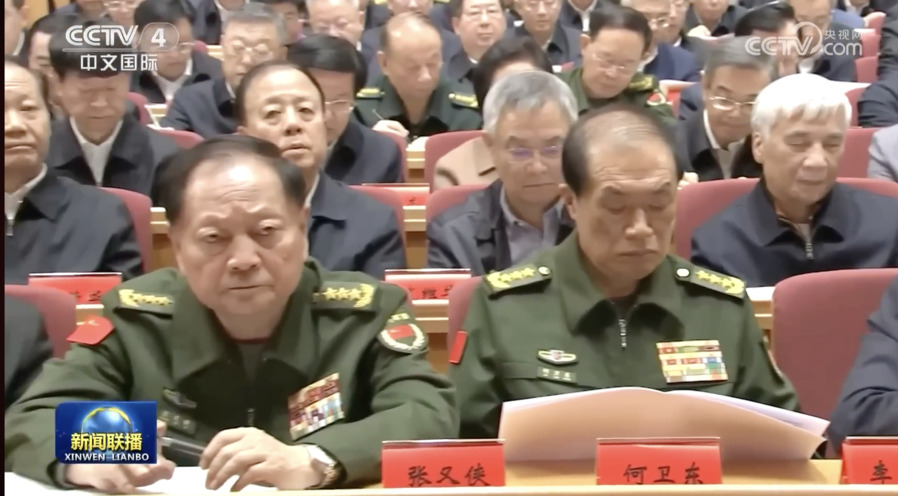
Speculation has intensified around an apparent power struggle within China’s highest military ranks, following the circulation of a dramatic account claiming to detail the arrest of Zhang Youxia, vice chairman of the Central Military Commission.
The controversial document, which appeared on overseas platforms just days before a scheduled review by China’s rubber-stamp legislature, purports to provide an insider’s view of Zhang’s detention amid a months-long power contest with Chinese leader Xi Jinping.
The account’s author identifies himself as “a pro-American figure within the CCP’s decision-making apparatus” with access to Beijing’s heavily secured Zhongnanhai compound, where China’s top leadership operates. While promising to reveal “the entire process of Zhang Youxia’s downfall,” the narrative contains remarkably specific details that have raised questions about its authenticity.
Military and security analysts familiar with Chinese politics note the suspiciously cinematic quality of the account. One passage describes Zhang’s arrest in minute detail: “At 5 p.m. on January 19, Zhang Youxia’s black Audi A8L departed his residence in the Xishan military compound…” continuing to document his expression, exact dialogue, and even the sound of handcuffs clicking shut during the detention.
The document similarly details a simultaneous raid on Zhang’s residence with implausible precision, including specific timestamps, dialogue from family members, and descriptions of the search process. Perhaps most tellingly, it claims to know Xi Jinping’s private reactions, stating he “watched the recording three times at Zhongnanhai and said: ‘Clean and efficient.'”
Beyond its questionable narrative style, the document methodically outlines three serious accusations against Zhang: nuclear espionage, military insubordination, and corruption.
The espionage allegations claim Zhang was implicated by Gu Jun, head of China National Nuclear Corporation, who supposedly confessed under interrogation to facilitating the transfer of sensitive nuclear missile parameters to American interests. The account describes Xi responding to this revelation by slamming his hand on a table and shouting, “This is treason!”
Regarding insubordination, the document alleges Zhang had privately expressed opposition to Xi’s Taiwan policy, reportedly stating that “Taiwan cannot be taken by a quick strike” and warning about catastrophic consequences should the U.S. military intervene. This purportedly led to the formation of a circle of dissenting officers within military leadership.
The corruption charges paint Zhang as having profited enormously from China’s military procurement system, allegedly taking bribes during his tenure running the General Armaments Department and helping advance the career of former defense minister Li Shangfu in exchange for payments. The document claims Zhang laundered money through Hong Kong and Singapore shell companies and purchased luxury properties internationally, with total illicit gains exceeding 10 billion yuan.
Political observers have noted the document’s contradictory nature – while superficially criticizing Xi Jinping’s leadership as dictatorial, it devotes most of its content to establishing Zhang’s alleged crimes. This has led some commentators to suggest the document represents a strategic information operation from Xi’s camp, designed to legitimize action against Zhang while appearing to come from a critical source.
“On the surface, it criticizes Xi Jinping’s dictatorship, but its real purpose is to establish serious criminal allegations against Zhang Youxia,” noted one online commentator. Others identified this as a classic example of “export for domestic consumption,” where propaganda is first planted in foreign media before being referenced back in China as independent reporting.
The circulation of such an elaborate narrative may signal Xi’s continuing struggle to consolidate control over military leadership. Despite extensive anti-corruption campaigns that have removed numerous high-ranking officials, Xi appears to face significant resistance from within the military establishment regarding actions against Zhang and former Joint Staff Department chief Liu Zhenli.
The current situation underscores the opaque and faction-ridden nature of China’s highest political and military circles, where power struggles often play out through carefully orchestrated information campaigns rather than transparent processes.
Fact Checker
Verify the accuracy of this article using The Disinformation Commission analysis and real-time sources.

26 Comments
Production mix shifting toward Propaganda might help margins if metals stay firm.
Good point. Watching costs and grades closely.
Uranium names keep pushing higher—supply still tight into 2026.
Uranium names keep pushing higher—supply still tight into 2026.
Good point. Watching costs and grades closely.
Uranium names keep pushing higher—supply still tight into 2026.
Good point. Watching costs and grades closely.
Good point. Watching costs and grades closely.
Nice to see insider buying—usually a good signal in this space.
Good point. Watching costs and grades closely.
Good point. Watching costs and grades closely.
Silver leverage is strong here; beta cuts both ways though.
Good point. Watching costs and grades closely.
Good point. Watching costs and grades closely.
If AISC keeps dropping, this becomes investable for me.
Silver leverage is strong here; beta cuts both ways though.
If AISC keeps dropping, this becomes investable for me.
Uranium names keep pushing higher—supply still tight into 2026.
Good point. Watching costs and grades closely.
Production mix shifting toward Propaganda might help margins if metals stay firm.
Good point. Watching costs and grades closely.
Good point. Watching costs and grades closely.
Uranium names keep pushing higher—supply still tight into 2026.
Production mix shifting toward Propaganda might help margins if metals stay firm.
Production mix shifting toward Propaganda might help margins if metals stay firm.
Good point. Watching costs and grades closely.