


Listen to the article
The Treasonous Voice: How “Lord Haw-Haw” Became Nazi Germany’s English-Language Propagandist
His voice was impossible to forget: a nasal, haughty sneer with an exaggerated mimicked poshness of the British upper class, warped by a malevolent glee. The British press dubbed him “Lord Haw-Haw,” the host of a pro-Nazi, English-language radio program called “Germany Calling” that became the mocking soundtrack to the Blitz.
But despite being part of the Nazi propaganda machine, broadcasting from a radio station in Germany, Lord Haw-Haw was not German.
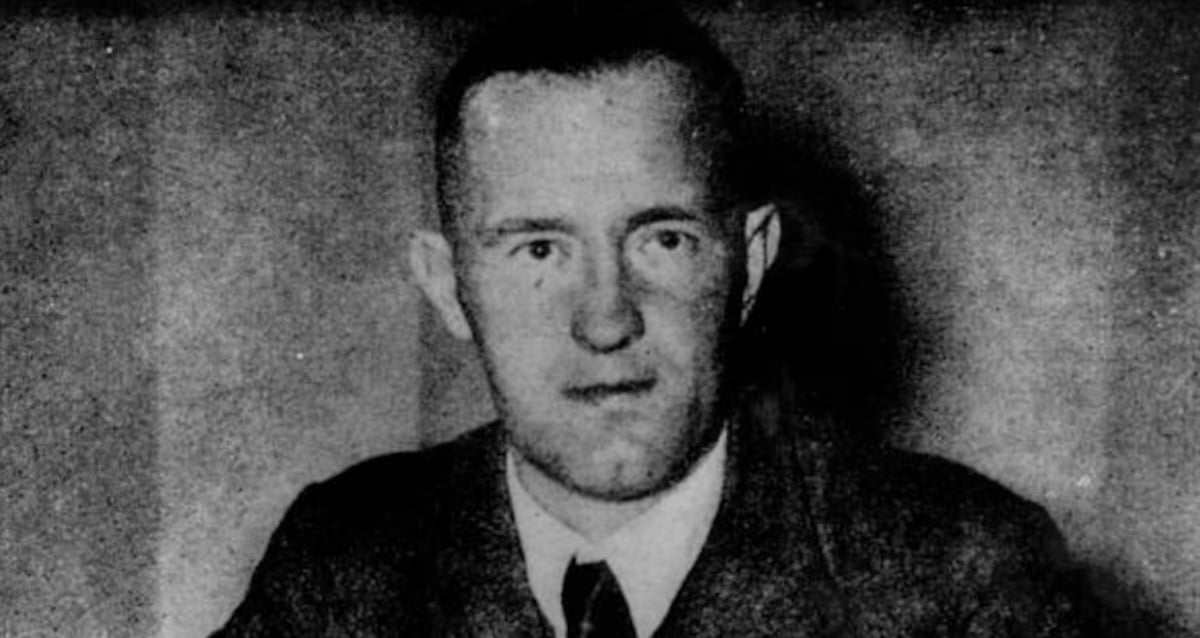
His real name was William Joyce, an American-born fascist who had spent much of his early life in Ireland and England before fleeing Britain to embrace the Nazi regime during World War II. From his position at the Reichssender Hamburg microphone, Joyce spewed disinformation intended to break the spirits of the British people.
He promised imminent destruction and scoffed at the courage of Allied soldiers on the battlefield. But as the tide of war turned and Allied armies closed in on the shattered remains of the Third Reich, it was not Lord Haw-Haw who would have the last laugh.
Born on April 24, 1906, in Brooklyn, New York, to Michael Francis Joyce, a naturalized U.S. citizen of Irish origin, and Gertrude Emily Brooke from an Anglo-Irish family, William Joyce spent his early childhood in America before his family returned to Ireland.
During World War I, Joyce’s father supported the Allied cause, and during the Irish War of Independence, he aligned with the British establishment. Eventually fearing retribution from Irish nationalists, the Joyce family fled to England, where William continued his education at the University of London, studying English Language and Literature and History at Birkbeck College.
Joyce’s interest in politics took a radical turn when he developed extreme fascist views. He joined the British Fascists in 1923, an early fascist organization modeled after Benito Mussolini’s movement in Italy.
A pivotal moment came in 1924 when Joyce was caught in a violent confrontation at a London rally. He received a deep slash to his face, leaving a permanent scar. Joyce claimed his attacker was a Jewish communist, which apparently cemented his deep antisemitism.
However, historian Colin Holmes, author of “Searching for Lord Haw-Haw,” noted that Joyce’s first wife Hazel Kathleen Barr had said Joyce was actually “knifed by an Irish woman,” and that he later changed the details to solidify his standing within the fascist movement.
In the early 1930s, Joyce encountered Sir Oswald Mosley, the leader of the British Union of Fascists (BUF). Captivated by Mosley’s vision, Joyce joined his organization and, thanks to his intelligence and charisma, quickly rose through the ranks, eventually becoming the BUF’s Director of Propaganda.
However, his relationship with Mosley deteriorated over time. Joyce’s fervent antisemitism went beyond what even Mosley—certainly an antisemite himself—was promoting. While Mosley focused primarily on economic prosperity through corporatism, Joyce advocated for a more blatant hatred of Jews. Joyce also lacked loyalty to Mosley, reportedly calling him “hopeless” and “the worst leader of what should have been the best cause in the world.”
Eventually, Mosley dismissed Joyce from the organization, prompting Joyce to establish his own National Socialist League, explicitly modeled on Hitler’s Nazi Party. But this group saw significant infighting over how to best promote fascism in Britain.
By 1939, with war looming, the National Socialist League fractured beyond repair. Joyce, struggling with alcoholism but still aware of the political climate, dissolved the organization and fled to Berlin with his second wife Margaret just before Hitler’s invasion of Poland.
“To me it was clear on the morning of 25th August that the greatest struggle in history was now doomed to take place,” Joyce later wrote in his book “Twilight over England.” “…England was going to war. I felt that if, for perfect reasons of conscience, I could not fight for her, I must give her up forever.”
Upon arriving in Germany, Joyce immediately offered his services to Joseph Goebbels’ Reich Ministry of Propaganda. After a successful audition, he was given his own radio show, “Germany Calling,” becoming the main English-language broadcaster for the Nazi regime.
His broadcasts initially focused on sowing distrust between the British people and their government. He told the working class they were being oppressed by the middle class and wealthy Jewish businessmen, launched attacks on democracy, and delivered his message in a dramatic, caustic style that many found more entertaining than the BBC’s drier programming.
The nickname “Lord Haw-Haw” wasn’t originally intended for Joyce. Daily Express radio critic Jonah Barrington had used the term in 1939 to describe a broadcaster who spoke “English of the haw-haw, damit-get-out-of-my-way variety” with “gentlemanly indignation.” Barrington was likely referring to German broadcaster Wolf Mittler, but since Joyce became more prominent, the name stuck to him instead.
“I tell the Führer about Lord Haw-Haw’s success,” Goebbels wrote in his journal, “which is really astonishing.”
By 1940, Joyce had become a German citizen. Though he claimed to have 6 million regular listeners in the UK at his peak, his actual impact on British morale was minimal. Most Britons viewed him as an entertainer rather than a serious threat, though some found his occasional accurate observations unsettling.
Joyce made his final broadcast on April 30, 1945—the same day Hitler died by suicide. “And now I ask you earnestly, can Britain survive? I am profoundly convinced that without German help she cannot,” he said before signing off with “Heil Hitler and farewell.”
With the Nazi regime collapsing, Joyce and his wife attempted to flee to Sweden, planning to eventually reach neutral Ireland. Their escape failed when Joyce encountered two British officers near Germany’s border with Denmark. Though carrying false papers, his distinctive voice betrayed his identity, and he was captured on May 29, 1945.
Brought back to Britain to face trial for treason, the court faced a significant legal challenge: establishing that Joyce had ever owed allegiance to Britain, given his American birth and citizenship. The prosecution succeeded on a technicality—Joyce had acquired a British passport before leaving for Germany. Though he had obtained it by falsely claiming to be a British subject, the court ruled that by holding this document, he had accepted the protection of the British Crown and therefore owed allegiance during the period his passport remained valid.
Joyce was found guilty of high treason specifically for the propaganda he broadcast while his British passport was valid. His appeals failed, and William Joyce, the infamous Lord Haw-Haw, was hanged at Wandsworth Prison on January 3, 1946, at the age of 39.
His reported final words remained defiantly antisemitic and unapologetic, warning against “the Jews who caused this last war” and expressing pride in dying for his ideals while lamenting “the sons of Britain who have died without knowing why.”
The saga of Lord Haw-Haw remains a stark reminder of the power of propaganda and the complex question of national loyalty during wartime—a cautionary tale of how extremist ideology can lead a man to betray one country in service of another that would ultimately be defeated.
Fact Checker
Verify the accuracy of this article using The Disinformation Commission analysis and real-time sources.

9 Comments
This article provides an insightful look at the life and legacy of William Joyce, the American-born propagandist known as Lord Haw-Haw. It’s a chilling reminder of how individuals can be drawn into extremist ideologies and the damage they can inflict through the use of media and disinformation.
Absolutely. The story of Lord Haw-Haw is a cautionary tale about the dangers of unchecked nationalism and the ability of charismatic figures to wield propaganda for nefarious ends. It’s a sobering reminder of the importance of critical thinking and media literacy.
It’s remarkable how this American-born fascist managed to become the voice of Nazi Germany’s English-language propaganda. His mocking sneer and exaggerated poshness must have been deeply unsettling for British listeners at the time. An intriguing piece of history.
Agreed, the story of William Joyce’s transformation into Lord Haw-Haw is a complex and troubling one. His willingness to embrace the Nazi regime and use his voice to demoralize the British people is a sobering reminder of the power of propaganda.
This article provides a thought-provoking look at the life and legacy of William Joyce, the Nazi propagandist known as Lord Haw-Haw. It’s a sobering reminder of how individuals can be drawn into extremist ideologies and use the power of media to spread disinformation and demoralize their enemies. A cautionary tale about the dangers of unchecked nationalism and the importance of critical thinking.
The rise and fall of Lord Haw-Haw is a fascinating historical narrative. It’s remarkable how an American-born fascist managed to become the voice of Nazi Germany’s English-language propaganda, and how his mocking broadcasts became a symbol of the Blitz. A complex and troubling story.
Fascinating to learn about the story of Lord Haw-Haw and his role in the Nazi propaganda machine. It’s remarkable how an American-born fascist managed to become the voice of Germany’s English-language broadcasts, and how his mocking tone became a symbol of the Blitz. A complex and troubling figure in history.
This article provides a compelling look at the life and legacy of William Joyce, the notorious Nazi propagandist known as Lord Haw-Haw. It’s a chilling reminder of how individuals can be drawn into extremist ideologies and use the power of media to spread disinformation and demoralize their enemies. A sobering piece of history.
A fascinating look at the notorious Lord Haw-Haw and his role in Nazi propaganda. It’s chilling to think how his voice became a symbol of the Blitz and the attempt to break the British people’s spirits. Curious to learn more about his background and motivations.