


Listen to the article
WikiLeaks Pivots from Transparency Champion to Anti-Israel Platform
WikiLeaks, once celebrated as a revolutionary force for government accountability, has undergone a significant transformation that raises questions about its current mission and integrity. Founded in 2006 as a platform dedicated to exposing classified documents related to war, espionage, and corruption, the organization built its reputation on radical transparency and garnered global recognition for releasing sensitive materials about U.S. military operations in Afghanistan and Iraq.
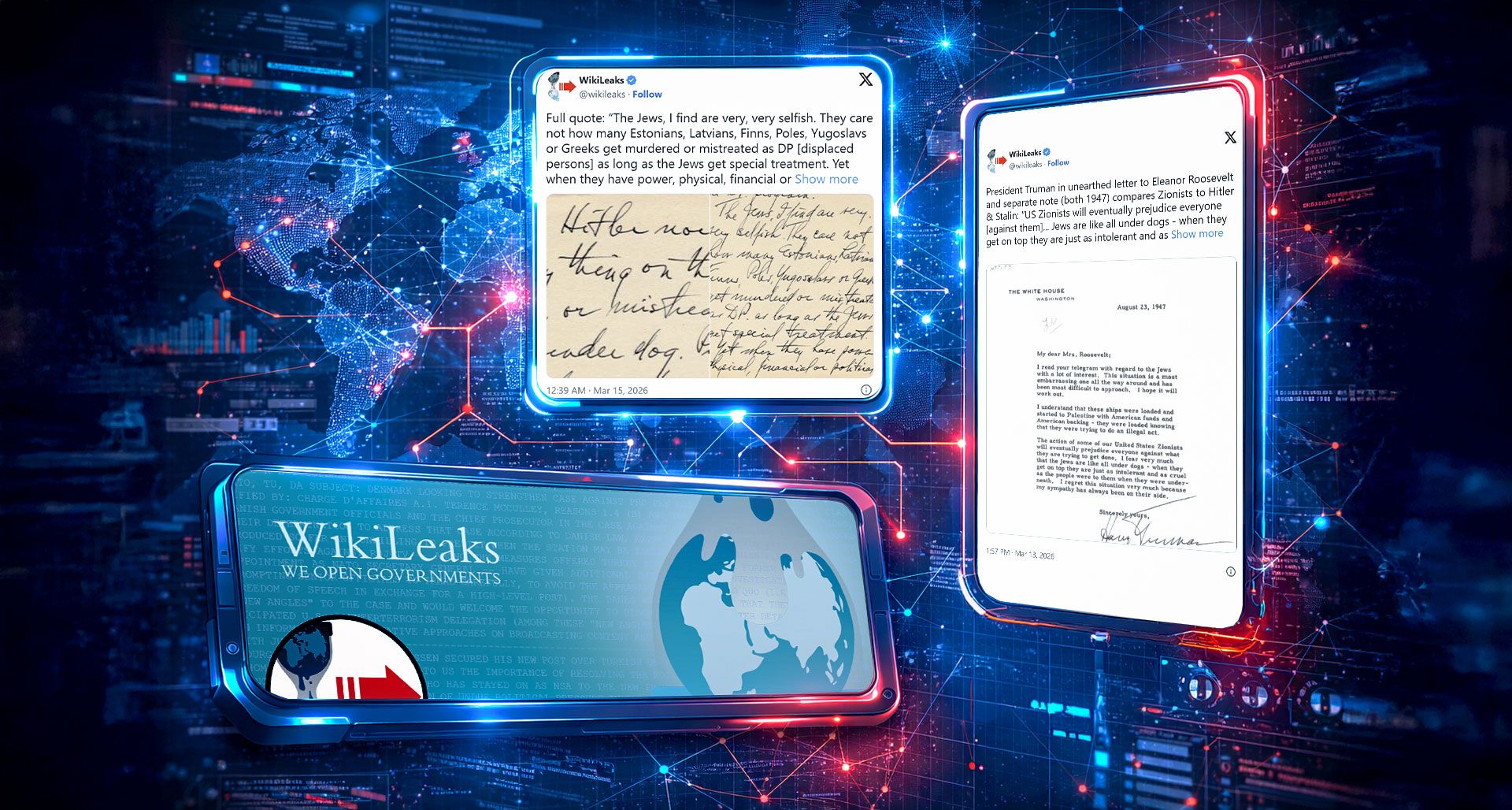
Today, however, the organization’s online presence tells a markedly different story. With over 5.6 million followers on X (formerly Twitter), WikiLeaks has increasingly become a hub for anti-Israel content that bears little resemblance to its founding purpose of publishing classified material exposing government wrongdoing.
Analysis of the organization’s recent activity reveals a troubling pattern. Since the beginning of 2026, 11 out of 15 posts on its X account have focused exclusively on Israel or Jewish people. Rather than exposing new, classified information, these posts often recycle old, already public documents while removing critical context to construct narratives that cast Israel in a negative light.
A recent example highlights this shift in focus. In March 2026, WikiLeaks posted a document from July 1947 featuring derogatory remarks about Jews by then-U.S. President Harry Truman. The organization presented this as a “leak” despite the document having been publicly available since 2003. Notably absent was any mention of Truman’s subsequent decision to recognize the State of Israel in 1948—context that would have provided a more complete historical picture.
Two months into the Israel-Hamas conflict, WikiLeaks resurfaced a document it had initially published in 2010, claiming an “Israeli intelligence chief encouraged Hamas’ takeover of the Gaza Strip.” This selective framing appeared designed to shift blame for the conflict onto Israel, without providing updates or new information that would justify republishing the material.
The organization’s influence extends beyond its immediate audience. High-profile activists like Shaun King and Susan Abulhawa frequently amplify WikiLeaks’ posts to their own substantial followings, creating an echo chamber where unverified or misleading claims gain legitimacy through repetition. In October 2025, WikiLeaks helped propagate an unsubstantiated claim that pro-Israel influencers were being paid $7,000 per post to “increase global influence,” despite the cited documents providing no evidence for such payments.
Julian Assange, WikiLeaks’ founder, has himself demonstrated a pattern of anti-Israel activism. In 2012, he launched a show on Russian state-controlled network RT, featuring Hezbollah leader Hassan Nasrallah as his first guest. During this interview, Assange allowed Nasrallah to characterize Israel as an “illegal state” without challenge. More recently, in August 2025, Assange was photographed leading a pro-Palestinian protest in Sydney that featured flags of designated terrorist organizations.
This evolution raises fundamental questions about WikiLeaks’ current purpose and credibility. An organization that once prioritized transparency and accountability now appears to selectively curate information to advance a specific geopolitical narrative. With millions of followers and influential amplifiers, misleading claims circulate widely with minimal scrutiny.
The transformation represents a significant departure from WikiLeaks’ original mission of exposing censored information in the public interest. Instead of championing transparency across the board, the organization now seems primarily focused on amplifying anti-Israel content, often recycling old material rather than providing genuine leaks or new insights.
For an organization that built its reputation on challenging power through the revelation of hidden truths, this narrowed focus not only undermines its stated principles but also raises concerns about its role in an information ecosystem already vulnerable to manipulation and bias.
Fact Checker
Verify the accuracy of this article using The Disinformation Commission analysis and real-time sources.

9 Comments
If WikiLeaks is indeed transitioning from a transparency champion to an anti-Israel platform, that’s a troubling development. Leaking sensitive information can serve an important purpose, but weaponizing it for ideological aims undermines the organization’s credibility.
I agree. WikiLeaks should remain focused on exposing wrongdoing across the board, not targeting specific countries or groups. Impartiality and commitment to truth should be their guiding principles.
Focusing more on Israel than new leaks of classified material is a significant shift for WikiLeaks. Transparency and accountability are vital, but the organization must be vigilant about avoiding the appearance of political bias or agenda-driven motives.
This is a concerning shift in WikiLeaks’ focus. While transparency in government is vital, singling out Israel raises questions about the organization’s impartiality and motives. Reliable, unbiased reporting is crucial for a healthy democracy.
The alleged change in WikiLeaks’ focus from classified document leaks to anti-Israel content is troubling. Impartial reporting of government wrongdoing is vital, but using the platform for ideological attacks undermines the organization’s credibility and purpose.
If the reports are accurate, WikiLeaks’ transition from a transparency champion to an anti-Israel platform is concerning. Whistleblowing and exposing government wrongdoing are important, but the organization must remain impartial and committed to the truth, not ideological agendas.
The pivot from classified document leaks to anti-Israel advocacy is puzzling. While freedom of speech is crucial, using a platform like WikiLeaks to push a partisan agenda raises ethical concerns. Maintaining objectivity should be the priority.
If accurate, this transition of WikiLeaks from a transparency advocate to an anti-Israel voice is worrying. Whistleblowing and exposing corruption are crucial, but the organization must maintain a balanced and objective approach, not become a mouthpiece for specific political agendas.
This news about WikiLeaks raises red flags. While the organization has done important work in the past, a shift towards anti-Israel advocacy raises questions about its integrity and commitment to its founding principles. Transparency should not become a cover for political bias.