


Listen to the article
For decades, Tehran’s infamous “Palestine Square” served as Iran’s primary anti-Israel propaganda showcase, featuring inflammatory displays targeting the Jewish state and its allies. However, since the outbreak of the Israel-Hamas war on October 7, this once-prominent propaganda hub has largely vanished from public view and media coverage.
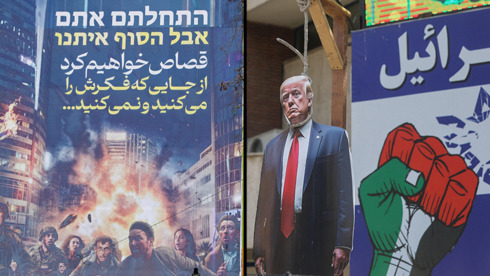
The square, located in central Tehran, was previously known for its provocative visual displays that included giant banners with threatening messages in Hebrew, mock hangings of political figures including former U.S. President Donald Trump, and a digital countdown clock allegedly tracking the time until Israel’s supposed destruction. These installations served as powerful visual backdrops for both domestic news coverage and international reporting on Iran’s stance toward Israel.
Regional experts note that the apparent downplaying of Palestine Square in recent months represents a significant shift in Iran’s public messaging strategy. While the Islamic Republic continues to voice support for Palestinian causes and maintains its hostile rhetoric toward Israel, the toning down of its most visible propaganda platform suggests potential recalculations within Tehran’s leadership circles.
“The regime has always used these public displays to signal both to domestic audiences and the international community,” explains Dr. Meira Shalev-Harari, a Middle East analyst at the Center for Strategic Studies. “The reduced visibility of Palestine Square might indicate Iran is attempting to manage escalation risks while still supporting proxy groups across the region.”
The square’s most notorious feature was perhaps its digital countdown clock, installed in 2015 following comments from Iran’s Supreme Leader Ayatollah Ali Khamenei predicting Israel would cease to exist within 25 years. The clock, which purportedly displayed the remaining time until this supposed deadline, became a symbol of Iran’s hardline stance and was frequently highlighted in official media.
Other provocative installations included life-sized effigies of political figures, particularly American and Israeli leaders, sometimes depicted in mock executions or humiliating scenarios. These displays would often coincide with significant political developments or anniversaries, serving as rallying points for state-organized demonstrations.
The square’s prominence reached its peak during the Trump administration, especially following the U.S. withdrawal from the Iran nuclear deal and the assassination of Iranian General Qassem Soleimani in January 2020. During this period, the square featured increasingly aggressive displays targeting both American and Israeli leadership.
Since October 7, however, Iran has seemingly opted for a more cautious approach in its visual propaganda. While officially continuing to support Hamas and condemning Israel’s military operations in Gaza, the regime appears to be carefully calibrating its public messaging during a period of heightened regional tensions.
Some observers suggest the reduced visibility of Palestine Square might reflect Iran’s complex position in the current conflict. While Tehran has long supported Hamas and other militant groups opposing Israel, it has thus far avoided direct military confrontation.
“Iran is walking a delicate line,” says regional analyst Fareed Mohamedi. “They want to maintain their image as the defender of Palestinian causes while avoiding actions that might trigger wider regional conflict or severe international repercussions.”
The apparent downplaying of Palestine Square comes amid other signs of Iran’s careful positioning, including statements from Iranian officials emphasizing diplomatic solutions to the Gaza conflict despite continuing rhetorical support for resistance groups.
For residents of Tehran and international observers familiar with the square’s provocative history, its reduced prominence represents a notable shift in Iran’s propaganda approach. Whether this change signals a strategic recalibration or merely a temporary adjustment remains uncertain as regional tensions continue to evolve.
Iranian authorities have not officially commented on the reduced visibility of Palestine Square in state media or its apparent diminished role in the regime’s public messaging strategy since October 7.
Fact Checker
Verify the accuracy of this article using The Disinformation Commission analysis and real-time sources.
