


Listen to the article
Voice of America Journalists Sue Agency, Claiming White House Interference
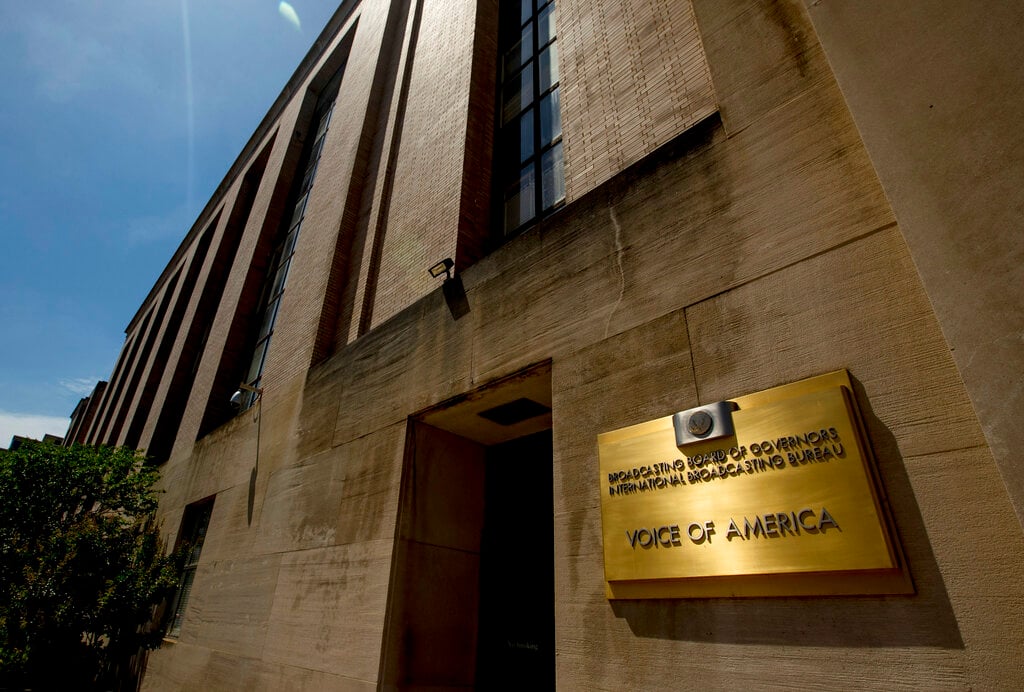
A group of Voice of America (VOA) journalists filed a lawsuit Monday against the U.S. Agency for Global Media (USAGM), alleging the agency is attempting to transform the government-funded news outlet into a propaganda vehicle for the White House.
The 37-page complaint, filed in the U.S. District Court for the District of Columbia, claims that USAGM leadership has illegally interfered with VOA’s editorial independence by censoring certain news stories and forcing the publication of partisan content as objective reporting.
Four veteran VOA journalists brought the suit: Barry Newhouse, former acting director of the VOA Central News Division; Ayesha Tanzeem, director of the South & Central Asia division; Dong Hyuk Lee, chief of the Korean Service; and Ksenia Turkova, a former contractor for the Russian Service.
According to the lawsuit, former acting CEO Kari Lake pivoted to controlling VOA’s news content after her earlier attempts to dismantle the agency were blocked by federal courts. On March 17, Senior U.S. District Judge Royce Lamberth, a Reagan appointee, ordered the reinstatement of hundreds of VOA employees who had been placed on administrative leave, ruling that Lake lacked the authority to terminate them because she had not received Senate confirmation. The government has since appealed this decision to the D.C. Circuit.
“Frustrated in that effort by the courts, the administration has now taken a different tack: to use its governmental authority to control VOA’s substantive output,” the journalists state in their complaint. They argue this approach violates both federal statutes governing VOA and the First Amendment.
The plaintiffs are seeking an injunction to protect their editorial independence and a declaration that the government’s actions violate the Constitution.
The lawsuit highlights particular concerns about coverage of Iran amid ongoing tensions. According to the journalists, Lake and current acting CEO Michael Rigas have suppressed reporting on anti-government protests in Iran and banned coverage of certain opposition elements to the Iranian regime from VOA’s Persian Service. This suppression, they argue, has undermined VOA’s credibility as “a once-respected source of independent news about Iran.”
Additionally, the journalists allege that USAGM leadership has commandeered VOA’s Mandarin Service to “republish White House talking points and label them, falsely, as ‘news,'” including forcing the publication of “images of President Trump in the style of Dear Leader Kim Jong-Il.”
The International Broadcasting Act of 1994 requires VOA to provide “accurate, objective and comprehensive” news coverage and mandates that the USAGM CEO “respect the independence and integrity” of the outlet. The lawsuit emphasizes the importance of the “statutory firewall” designed to prevent political interference in VOA’s journalism.
Clayton Weimers, executive director of Reporters Without Borders Inc., which is supporting the lawsuit, stated: “The Trump administration has made clear that if it can’t eliminate VOA, it wants to turn it into a political propaganda machine, cheerleading Trump’s agenda. That is at odds with VOA’s mission to inform millions around the world who lack regular access to authentic, trustworthy journalism.”
The journalists argue that government interference has substantially harmed VOA’s ability to “faithfully report the news,” silenced journalists and editors, and deprived audiences worldwide of critical information.
The dispute comes in the wake of a March 2025 executive order signed by President Trump, titled “Continuing the Reduction of the Federal Bureaucracy,” which required elimination of USAGM’s “non-statutory components and functions” to the “maximum extent.” Trump has previously referred to the agency as the “Voice of Radical America” and criticized its coverage of the 2020 presidential election and the January 6, 2021, Capitol attack.
This legal battle represents a significant moment in the ongoing tension between government oversight and press independence at federally funded media organizations, with potential implications for how the United States is perceived globally through its international broadcasting services.
Fact Checker
Verify the accuracy of this article using The Disinformation Commission analysis and real-time sources.

23 Comments
Exploration results look promising, but permitting will be the key risk.
If AISC keeps dropping, this becomes investable for me.
Good point. Watching costs and grades closely.
Production mix shifting toward Propaganda might help margins if metals stay firm.
If AISC keeps dropping, this becomes investable for me.
Good point. Watching costs and grades closely.
Good point. Watching costs and grades closely.
If AISC keeps dropping, this becomes investable for me.
Good point. Watching costs and grades closely.
Uranium names keep pushing higher—supply still tight into 2026.
Good point. Watching costs and grades closely.
Good point. Watching costs and grades closely.
Production mix shifting toward Propaganda might help margins if metals stay firm.
Good point. Watching costs and grades closely.
If AISC keeps dropping, this becomes investable for me.
Nice to see insider buying—usually a good signal in this space.
Good point. Watching costs and grades closely.
If AISC keeps dropping, this becomes investable for me.
The cost guidance is better than expected. If they deliver, the stock could rerate.
Good point. Watching costs and grades closely.
Exploration results look promising, but permitting will be the key risk.
Good point. Watching costs and grades closely.
Nice to see insider buying—usually a good signal in this space.