


Listen to the article
Ukrainian Athlete’s Commemorative Art Sparks Controversy Amid War
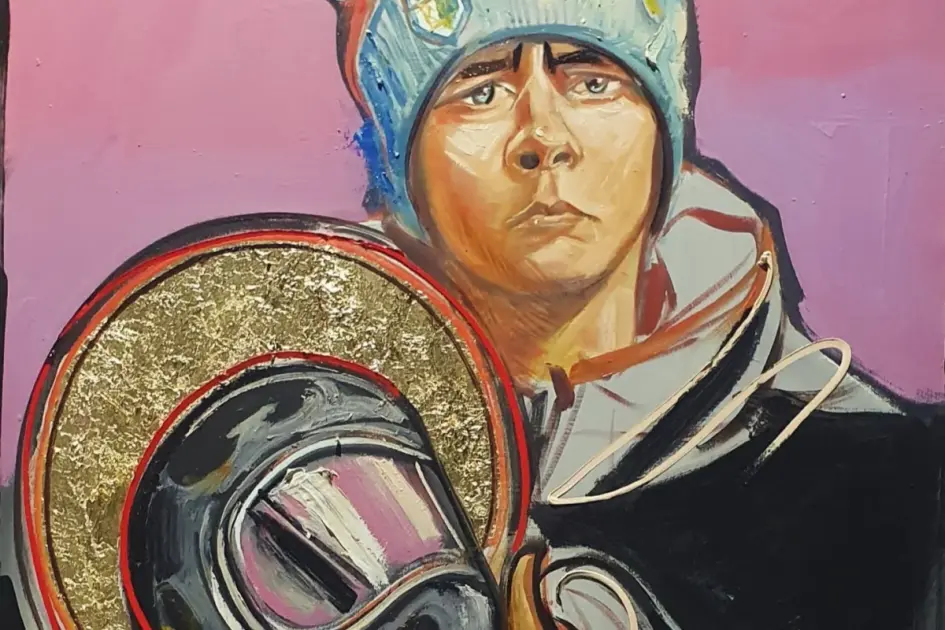
A painting by Ukrainian artist Roman Bonchuk depicting skeleton racer Vladyslav Heraskevych has become the center of controversy, with pro-Kremlin media labeling it “blasphemous” for its use of iconographic elements.
The artwork, titled “The Holy Helmet of Dignity and Freedom,” shows Heraskevych holding a helmet adorned with images of Ukrainian athletes killed since Russia’s full-scale invasion began in 2022. Bonchuk, an artist from Ivano-Frankivsk known for blending religious and political themes in his work, placed a halo around the helmet as a central visual element.
Former Ukrainian Prime Minister Nikolay Azarov, who fled Ukraine in 2014 and was later convicted of treason, criticized the artwork on social media, writing: “Blasphemy continues in Ukraine!” He further claimed that “the regime in Kyiv is proud of a helmet and the disqualification of an athlete” while “other countries are proud of their Olympic medals.”
Art experts note, however, that Bonchuk’s work is not an actual religious icon but rather a contemporary painting that employs iconographic elements as artistic metaphor. The piece was not created for worship or religious purposes, and is not displayed in a church setting.
The controversy extends beyond the artwork itself to Heraskevych’s recent Olympic disqualification. The skeleton racer had planned to compete wearing the commemorative helmet featuring images of Ukrainian athletes killed during the war – either as civilians or as military personnel defending their country. The International Olympic Committee barred him from competition, citing rules against political symbols.
Ukrainian President Volodymyr Zelensky condemned the IOC’s decision, arguing that honoring war victims did not violate Olympic principles of peace and unity. He suggested the ban represented a double standard, as Russian-associated symbols have appeared in Olympic venues without similar sanctions.
Pro-Kremlin media have seized on both the artwork and the disqualification to promote narratives that Ukraine has abandoned Christian values, lacks Olympic achievements, and uses sports controversies to distract from military failures. These portrayals align with broader Russian propaganda efforts to discredit Ukraine while deflecting attention from Russia’s own Olympic restrictions resulting from its invasion.
The Russian Federation itself faces significant Olympic limitations following decisions by sports federations and the IOC due to its violation of international law through the invasion of Ukraine – a fact frequently omitted in Russian media coverage of these controversies.
Bonchuk’s previous works include a diorama dedicated to the 2014 Euromaidan protests and a painting depicting Jesus Christ with a crown of thorns in the colors of the Ukrainian flag – pieces that similarly blend spiritual imagery with Ukrainian national themes.
The helmet controversy highlights the ongoing intersection of sports, art, politics and war as Ukraine continues to participate in international competitions despite having its sports infrastructure bombed and dozens of athletes killed since the Russian invasion began.
For Ukrainian artists like Bonchuk and athletes like Heraskevych, commemorating fallen compatriots represents not political provocation but an act of remembrance and dignity amid devastating national circumstances – a nuance that often gets lost in politicized international coverage.
Fact Checker
Verify the accuracy of this article using The Disinformation Commission analysis and real-time sources.

10 Comments
It’s interesting to see how this painting by Roman Bonchuk is stirring up controversy. The blending of religious and political themes is certainly provocative, but I think the artist is using these symbolic elements to make a meaningful statement about the experiences of Ukrainian athletes during the war.
While the former Ukrainian PM may see this artwork as an affront, I think it’s a thought-provoking exploration of how sport and national identity intersect, especially in times of conflict. The artist is using religious iconography to elevate the sacrifices of these Ukrainian athletes – a powerful creative choice.
The reaction from Azarov and others to this painting by Roman Bonchuk is quite telling. Rather than engaging with the deeper meaning and symbolism, they seem quick to dismiss it as “blasphemous.” But art has a long history of using religious imagery to make powerful political and social statements. This piece appears to be doing just that in the context of the war in Ukraine.
Interesting to see how this Ukrainian athlete’s symbolic art has sparked controversy. While some may view it as blasphemous, the artist’s use of iconographic elements seems to be a thoughtful metaphor for the sacrifices and struggles of Ukrainian athletes during the war.
The outcry from pro-Kremlin figures like Azarov over this artwork is rather predictable. They seem unwilling to engage with the nuanced symbolism and instead resort to accusations of “blasphemy.” But art often challenges us to confront difficult realities, and this piece appears to be doing just that for the Ukrainian experience of the war.
This piece by Roman Bonchuk blends religion and politics in a powerful way. The helmet adorned with images of fallen Ukrainian athletes is a poignant tribute, even if it ruffles the feathers of pro-Kremlin figures like Azarov. Art can be a powerful medium for expressing the realities of war.
I agree, the artist’s use of religious imagery to commemorate these Ukrainian athletes is a bold and compelling statement. It’s unfortunate that some choose to dismiss it as mere “blasphemy” rather than engaging with the deeper meaning and symbolism.
This is a fascinating case study in how art can become politicized, especially in the context of an ongoing conflict. While some may dismiss Bonchuk’s work as “blasphemous,” I think it’s important to engage with the deeper meaning and significance that the artist is trying to convey through this powerful visual metaphor.
This controversy over the “Holy Helmet of Dignity and Freedom” painting highlights the divisive role that art can play, especially when it touches on sensitive political and cultural issues. While some may find the religious iconography offensive, the artist’s intent seems to be a sincere tribute to the sacrifices of Ukrainian athletes. It’s a complex and thought-provoking work.
This is a fascinating case study in how art can become a battleground for competing narratives and ideologies, especially in times of war and conflict. While the pro-Kremlin figures may see this painting as an affront, I think the artist is using religious iconography in a thoughtful and compelling way to honor the sacrifices of Ukrainian athletes. It’s a complex work that deserves careful consideration.