


Listen to the article
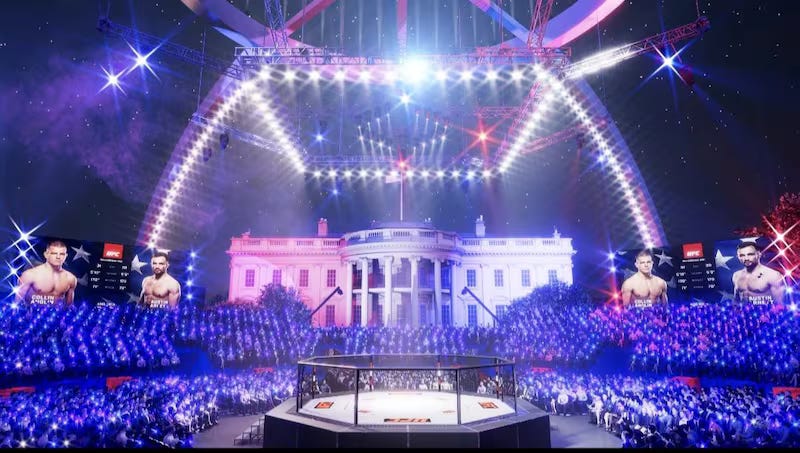
In a significant setback to highly publicized plans, the UFC’s White House event scheduled to commemorate America’s 250th anniversary has fallen dramatically short of expectations, prompting widespread disappointment among fans and industry observers alike.
When President Donald Trump first announced the event last December, he promised a spectacular showcase featuring “eight or nine championship fights – the biggest fights they’ve ever had.” UFC CEO Dana White amplified these claims, vowing to deliver “the greatest fight card ever assembled” and the “baddest card of all time.”
However, the recently unveiled fight card for “UFC Freedom 250” includes just two title bouts: a lightweight championship match between Ilia Topuria and Justin Gaethje, and an interim heavyweight title fight pitting Alex Pereira against Ciryl Gane. The remaining four primetime fights will feature several vocal Trump supporters, including Michael Chandler facing Brazilian Mauricio Ruffy, and Bo Nickal challenging Kyle Daukaus.
The announcement was met with immediate criticism. Even former UFC champion Ronda Rousey, historically loyal to White and the organization, publicly acknowledged that “UFC’s White House card sucks.” Former UFC fighter Tom Lawlor’s reaction was more blunt, tweeting: “LOL THATS IT?”
Industry analysts suggest this disappointment reflects the UFC’s evolution under Endeavor, which purchased the promotion in 2016. The organization has dramatically scaled its operations, transitioning from just 10 events in 2005 to more than four times that number today. This expansion has fundamentally changed the viewer experience, with many longtime fans lamenting that watching UFC events now feels “like an obligation” rather than a special occasion.
Financial considerations likely played a significant role in the event’s underwhelming lineup. The White House card is expected to cost approximately $60 million, with the UFC hoping to recoup half through sponsorships. This financial reality appears to have influenced decisions about which fighters to include, with former heavyweight champion Jon Jones claiming he was “lowballed” during negotiations to appear on the card.
The event’s timing is also noteworthy, coinciding with Trump’s 80th birthday on June 14, further emphasizing its political significance. Critics argue this underscores the symbiotic relationship between the UFC and Trump’s political movement, with the event representing what one journalist called “the sports arm of Trump’s MAGA regime.”
The UFC and White have maintained close ties with Trump throughout his political career. White has campaigned for Trump across three presidential runs and claims to have advised the president to embrace podcast appearances during the 2024 campaign – a strategy credited with helping Trump win over young male voters.
This White House event represents the culmination of that relationship – a high-profile political spectacle showcasing the alignment between the UFC’s brand and Trump’s political messaging. However, the underwhelming fight card suggests that even with this political significance, the UFC remains constrained by business considerations and its own packed schedule.
The organization recently signed a massive seven-year deal with Paramount valued at approximately $7.7 billion, which will move the UFC’s marquee events away from the traditional pay-per-view model. Under this agreement, the UFC must produce 43 shows in 2026 alone – a volume that makes it difficult to concentrate star power in any single event, even one with the political significance of the White House card.
For many observers, the disconnect between the promised “greatest card ever assembled” and the reality of what will take place on the South Lawn of the White House represents more than just disappointed fan expectations – it reflects broader questions about the UFC’s evolution and its increasingly prominent role in America’s political landscape.
Fact Checker
Verify the accuracy of this article using The Disinformation Commission analysis and real-time sources.

8 Comments
It’s a shame the ‘baddest card of all time’ didn’t materialize as promised. While the UFC is clearly trying to court Trump’s base, a more diverse and apolitical lineup may have resonated better. Still, I’m curious to see how the event plays out.
This event seems like a missed opportunity to truly celebrate America’s history and values. While showcasing some top fighters, the lineup falls short of the promised ‘greatest fight card ever’. A more balanced, apolitical approach may have resonated better with fans.
This event seems more focused on politics than pure sporting competition. While the UFC is entitled to its choices, a less partisan approach may have generated broader appeal. Hopefully the fights themselves can still entertain fans, regardless of the event’s subtext.
I’m curious to see if this event can still generate excitement despite the scaled-back fight card. Fans may be disappointed, but perhaps the Trump supporters on the bill can still put on a show. Either way, it’s an interesting political move by the UFC.
While the UFC has the right to organize events as they see fit, this one seems more focused on political theater than celebrating the sport. The underwhelming fight card is a letdown, though the Trump-supporting fighters may still put on a show for their base.
The Trump administration has a history of using sports and entertainment for political messaging. This UFC event appears to be another example, though the lackluster lineup suggests the propaganda effort fell flat. Hopefully the fights themselves can still provide good action for fans.
I’m a bit surprised the UFC couldn’t put together a truly stacked card for this historic occasion. The political angle seems to have taken precedence over pure sporting competition. Still, the event could be an interesting cultural moment, for better or worse.
The UFC’s decision to align this event so closely with the Trump administration is a bold, if controversial, move. While the fight card may disappoint some, the political messaging will likely resonate with the president’s core supporters.