


Listen to the article
Trump’s AI Revolution: How the Former President Uses Artificial Intelligence to Shape Political Narratives
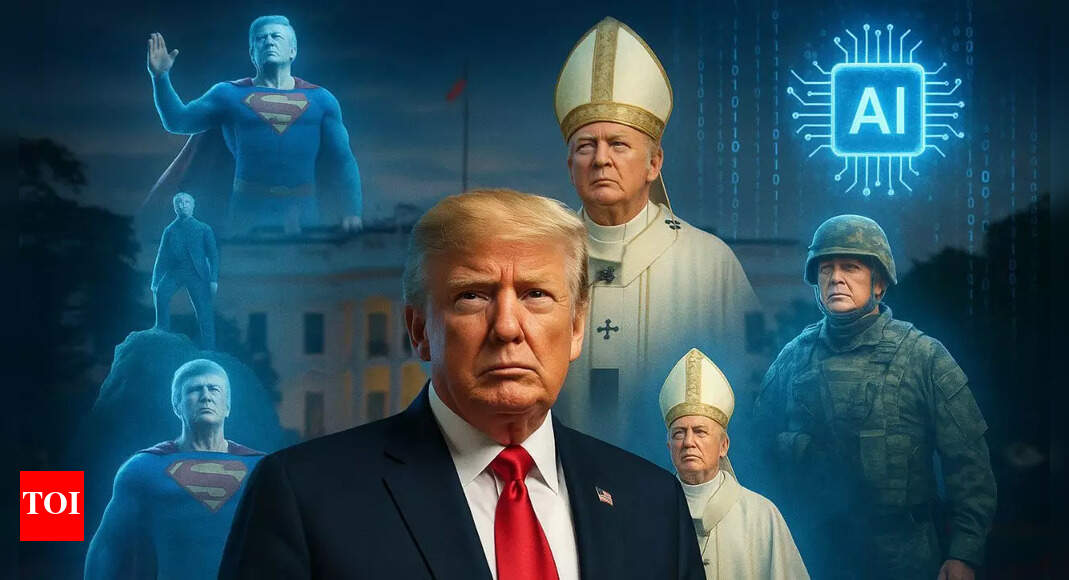
Donald Trump has transformed from showman to digital provocateur in his latest political incarnation, leveraging artificial intelligence to wage an unprecedented campaign of spectacle and influence. According to a comprehensive report by The New York Times, Trump has shared dozens of AI-generated images and videos on his Truth Social platform, ranging from the bizarre to the politically charged.
The content spans a remarkable spectrum: Trump depicted as the pope, standing triumphantly atop a mountain after “conquering Canada,” or more provocatively, images showing Barack Obama being arrested by FBI agents in the Oval Office. This isn’t random social media activity but represents a calculated evolution in political communication—blending spectacle, meme culture, and misinformation in ways that define a new chapter in political messaging.
Trump’s foray into AI imagery began with crude memes during his 2024 presidential campaign when generative tools were first becoming mainstream. The early content was obviously artificial—distorted faces, clumsy backgrounds, and cartoonish qualities. By 2025, however, as AI technology advanced, Trump’s digital arsenal grew more sophisticated and persuasive.
Many posts now merge absurdity with strategic messaging. One AI-generated video showed Trump flying a fighter jet while dumping excrement on protesters. Another depicted him conducting an orchestra after jokingly “appointing” himself head of the Kennedy Center for the Performing Arts. The imagery typically falls into recurring categories: self-flattery portraying Trump as heroic or superhuman, mockery of political opponents like Barack Obama and Kamala Harris, and propaganda contrasting an idealized “Future Under Trump” against dystopian alternatives.
“It’s designed to go viral, it’s clearly fake, it’s got this absurdist kind of tone to it,” Henry Ajder, who runs an AI consultancy, told The Times. “But there’s often still some kind of messaging in there.”
The implications extend far beyond entertainment. For the first time, a U.S. president is amplifying synthetic media as an official communication strategy. While misinformation has long plagued American politics, Trump’s embrace of AI technology pushes the phenomenon into uncharted territory. His AI-generated content often reaches millions of followers within hours, eroding the boundary between parody and propaganda.
The White House has openly defended the practice. “No leader has used social media to communicate directly with the American people more creatively and effectively than President Trump,” said Liz Huston, the White House’s assistant press secretary, in a written statement. This official endorsement effectively transforms AI-generated content from fringe experimentation into state-sanctioned communication.
Trump’s AI evolution parallels the rapid advancement of the technology itself. What began as simple still images has evolved into hyper-realistic videos and AI-cloned audio. One viral example involved actor Robert De Niro, digitally altering his lip movements to synchronize with fabricated audio mimicking his voice. Other creations combine multiple technologies—image generators, lip-sync software, and voice synthesis—to produce seamless, Hollywood-quality illusions.
These posts serve distinct rhetorical functions: mocking media narratives, reinforcing Trump’s image as a rebellious outsider, or energizing his base with humorous defiance. Adrian Shahbaz from Freedom House noted that the mechanics of social media make AI propaganda especially potent: “The more ridiculous the photo or video, the more likely it is to dominate our news feeds. A controversial post gets shared by people who enjoyed it and people outraged by it. That’s twice the shares.”
Trump’s embrace of AI imagery intensified after facing backlash during his 2024 campaign. When criticized for claiming—without evidence—that Haitian immigrants in Michigan were eating pets, his response came in meme form: AI-generated images of Trump cuddling cats and dogs under the slogan “Cats for Trump.” The point wasn’t to rebut criticism but to drown it in absurdity, transforming scandal into spectacle.
Unlike traditional propaganda, which attempts to appear credible, Trump’s content deliberately leans into obvious fabrication. The entertainment value makes it shareable, while irony provides a shield against accountability. As podcaster Brenden Dilley, who leads a pro-Trump digital collective, once wrote: “The truth no longer matters, all you have to do is go viral.”
Researchers worry that Trump’s behavior may inspire imitators globally. “Even anodyne uses of AI by a sitting president normalize the tools for political messaging,” said Ajder. The danger lies not in any single fake but in the erosion of trust itself. As AI continues to improve, distinguishing between satire and deception will become increasingly difficult.
Trump has effectively redefined political propaganda for the AI era. His posts serve a consistent goal: to dominate attention and control narratives. For supporters, they represent creativity and populist authenticity; for critics, they signal a dangerous collapse of truth in democratic discourse. What both sides acknowledge is that the age of AI politics has arrived—with Trump as its enthusiastic pioneer.
Fact Checker
Verify the accuracy of this article using The Disinformation Commission analysis and real-time sources.

7 Comments
Interesting to see how Trump is leveraging AI to spread political narratives. While the technology has potential, I’m concerned about the use of AI to create misleading or manipulative content. We’ll have to watch this space closely going forward.
This is certainly a controversial and provocative use of AI technology. I’m curious to hear more about the potential implications, both positive and negative, as this space continues to evolve.
I share your concerns about the potential for misuse. The blending of AI, spectacle, and political messaging is a concerning trend that deserves close scrutiny.
The use of AI to create politically charged content is a concerning development. While the technology has many beneficial applications, we must ensure appropriate guardrails are in place to prevent it from being misused for disinformation or manipulation.
As an investor, I’m closely watching how this AI-powered political messaging could impact markets and public sentiment. It’s a complex issue without easy answers, but one that merits careful analysis.
Agreed. The potential market impacts of this kind of political AI are an important consideration. Investors will need to stay vigilant.
Trump’s foray into AI-generated political imagery is a fascinating development. While the technology holds promise, I worry about the risks of misinformation and manipulation. We’ll need robust safeguards to ensure it’s not exploited for nefarious purposes.