


Listen to the article
In a rare glimpse inside Iran following recent U.S. and Israeli military strikes, CNN’s reporting has sparked controversy among Trump administration officials and conservative commentators who accused the network of spreading propaganda.
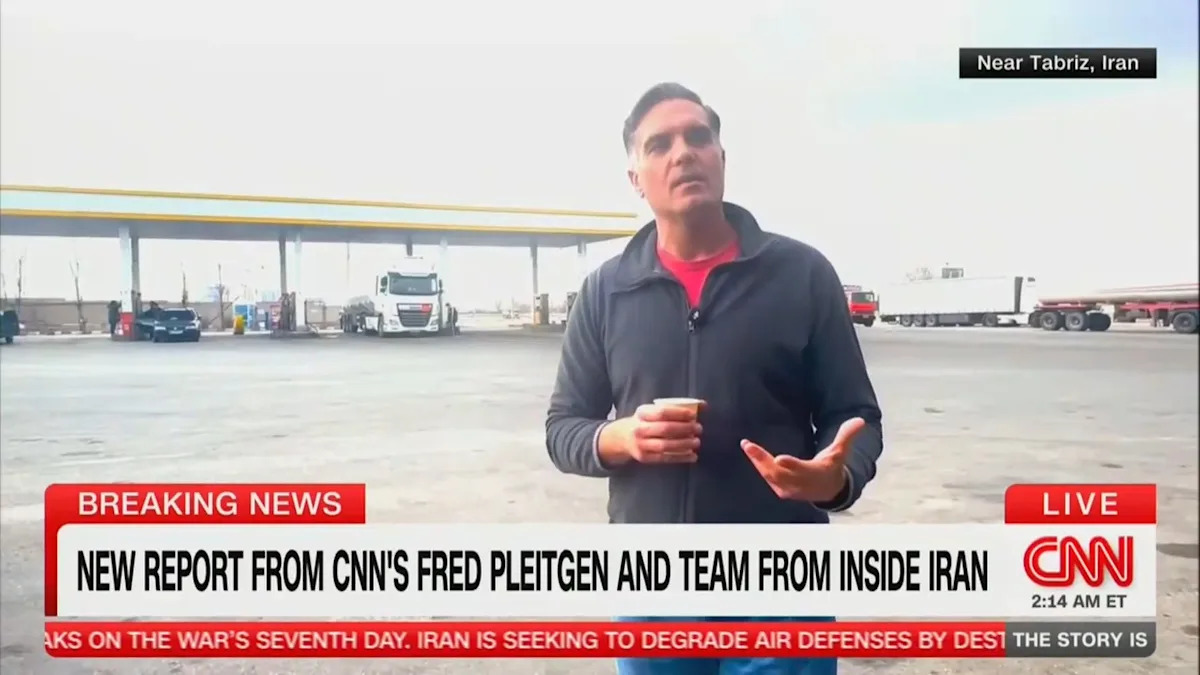
CNN senior international correspondent Frederik Pleitgen broadcast from inside Iran Thursday night on “Anderson Cooper 360°,” offering viewers a look at everyday life in the country after strikes ordered by President Donald Trump. Pleitgen’s report, filmed during a coffee stop, noted that despite visible damage from military operations, he observed functioning infrastructure and no signs of societal collapse.
“All the shops are open and really well-stocked, even with fresh things like fruits and vegetables,” Pleitgen reported. At a gas station, he added there were “no long lines” and fuel appeared to be “readily available,” concluding: “You just don’t see any sort of degree of panic anywhere.”
The footage quickly ignited criticism from Dylan Johnson, recently appointed Assistant Secretary of State for Global Public Affairs and former deputy communications director for Trump’s 2024 campaign. Johnson shared a 30-second clip of the report on X (formerly Twitter), writing: “CNN appears to now be doing straight up pro-Iran regime propaganda because someone gave this guy a coffee…”
Pleitgen responded directly to the accusation, noting that he had purchased the coffee himself rather than receiving it as a gift, but the exchange had already triggered a wave of commentary from conservative influencers who questioned the legitimacy of CNN’s reporting from inside Iran.
The controversy highlights the ongoing tensions between media outlets and government officials regarding coverage of geopolitical hotspots, particularly in countries with adversarial relationships with the United States. Iran has been under various U.S. sanctions for decades, with relations deteriorating further in recent years following the U.S. withdrawal from the nuclear deal during the previous Trump administration.
A State Department spokesperson later addressed the situation, telling NPR’s diplomatic correspondent Michele Keleman: “We encourage media outlets to verify information with official U.S. government sources before publication.” This statement suggests concern about potential misinformation or incomplete perspectives in reporting from countries with strict media controls.
CNN noted that Pleitgen crossed into Iran on Thursday morning, making the network the only U.S. television outlet reporting from inside the country after the February 28 strikes. The network also disclosed that it operates in Iran only with “government permission,” a standard requirement for foreign journalists in the country but one that critics argue can lead to limitations on reporting freedom.
The dispute underscores the complex challenges faced by journalists reporting from authoritarian states where press freedoms are limited. Western media outlets must balance providing on-the-ground coverage with transparency about the conditions under which they operate. Critics often question whether journalists can provide accurate reporting when operating under government oversight, while supporters argue that firsthand accounts, even with limitations, provide valuable context that remote analysis cannot.
This incident also reflects broader tensions in American politics regarding media coverage of foreign policy issues, particularly involving countries designated as adversaries. Conservative commentators have frequently accused mainstream media outlets of being insufficiently critical of authoritarian regimes, while journalists defend their work as providing necessary context and nuance to complex international situations.
As military tensions between the U.S. and Iran continue to simmer, the debate over how media outlets should cover these developments – and from where – remains contentious, with implications for public understanding of international conflicts and American foreign policy.
Fact Checker
Verify the accuracy of this article using The Disinformation Commission analysis and real-time sources.

14 Comments
While I appreciate getting a first-hand account from Iran, I’m curious to hear more analysis from experts on the ground to put this in proper context. Claims of propaganda shouldn’t be made lightly.
This seems like a complex issue where reasonable people may disagree. I’d encourage readers to seek out a range of credible sources and form their own conclusions, rather than blindly accepting any single narrative.
Agreed. Critical thinking and an open, impartial mindset are essential when navigating sensitive geopolitical topics with competing viewpoints.
This report raises some interesting questions about the situation in Iran. I’d be interested to see further coverage from multiple credible sources to better understand the realities on the ground.
Agreed. Nuanced, well-rounded reporting is essential when dealing with complex geopolitical issues like this.
Accusations of propaganda are serious and shouldn’t be made lightly. I’d encourage readers to approach this story with an open mind, and seek out balanced, fact-based reporting from a variety of credible sources.
Interesting report from Iran, though I’d want to see more context and analysis before drawing firm conclusions. It’s critical to scrutinize claims from all sides, given the political tensions at play.
I agree, an on-the-ground perspective is valuable, but assessing the full situation requires digging deeper. Reliable information is crucial when tensions are high.
Accusations of propaganda are serious, and should be backed by solid evidence. It’s important to approach this story with an open mind and seek out objective analysis from a range of reliable sources.
This seems like a complex issue where both sides may have valid concerns. It’s important to seek objective, fact-based reporting to understand the nuances, rather than jumping to accusations.
Absolutely. Maintaining a balanced, impartial view is key when there are competing narratives around sensitive geopolitical events.
While the on-the-ground reporting provides an interesting perspective, I share the concerns about potential propaganda. Rigorous, fact-based analysis from experts is needed to truly understand the situation.
This seems like a contentious issue where both sides have something to gain by shaping the narrative. I’d encourage readers to think critically and not take any single report or claim at face value.
Absolutely. Maintaining a healthy skepticism and cross-checking information from multiple credible sources is key when dealing with sensitive geopolitical topics.