


Listen to the article
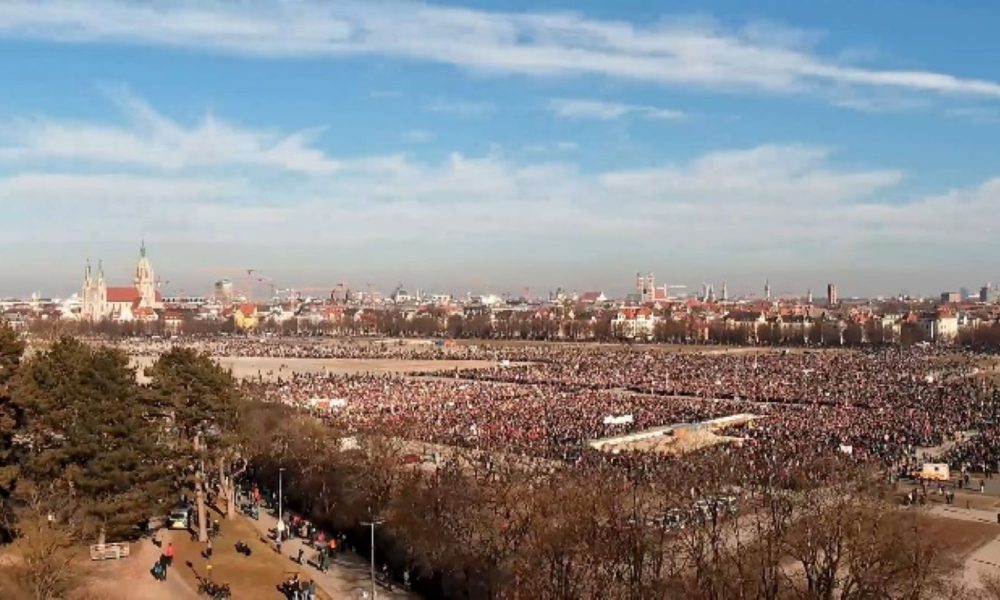
In a controversial display of political theater, a rally promoting Reza Pahlavi, son of Iran’s last shah, has raised serious questions about attendance claims and political legitimacy. The February 14th event, held alongside the Munich Security Conference, garnered attention when organizers announced an attendance of 250,000 people—a figure now facing intense scrutiny from political observers and media analysts.
Ali Bagheri, president of the International Freedom of Speech Alliance (IFSA), has challenged these numbers based on practical considerations and years of experience organizing similar events. According to Bagheri, the logistical requirements for gathering a quarter-million participants would be staggering and virtually impossible to coordinate without months of visible planning.
“Mobilizing even several tens of thousands of people in a European city is a complex operation,” notes Bagheri. “Gathering a quarter of a million people within a limited timeframe represents an entirely different magnitude.”
For context, the largest recent Iranian demonstration in Europe—a broadly supported Berlin rally following Mahsa Amini’s death in 2022—drew approximately 80,000 participants according to media estimates. That event enjoyed cross-spectrum political backing, unlike the Munich rally which specifically promoted Pahlavi, a polarizing figure whom critics associate with Iran’s former autocratic regime.
The scale of 250,000 attendees would surpass three times the capacity of Munich’s Allianz Arena and equate to relocating the entire population of a mid-sized European city like Ghent or Charleroi to a single location. Such an undertaking would require extraordinary infrastructure and planning.
Transportation logistics alone cast doubt on the claims. Moving 250,000 people would necessitate approximately 5,000 buses with drivers, massive parking coordination, and cooperation with traffic authorities. If half traveled by train, dozens of special international services would be required, while air travel options would demand hundreds of charter flights—straining airport capacity beyond reasonable limits.
Overnight accommodation presents another challenge. Even housing one-third of such a crowd would require tens of thousands of hotel rooms or temporary facilities, resources that simply weren’t visibly mobilized.
Photographic evidence from the rally further undermines the attendance claims. Geometric estimations based on venue size and standard crowd density calculations suggest actual attendance likely fell between 30,000 and 40,000 people—a significant gathering, but nowhere near the quarter-million figure promoted.
The inflation of attendance numbers raises important questions about political legitimacy and media responsibility. In political movements, crowd size often serves as a proxy for popular support and leadership viability. The perception of massive backing can create momentum for political figures seeking international recognition.
Regional history offers cautionary tales. Ahmed Chalabi was once presented to international audiences as Iraq’s post-Saddam leader, but the gap between perception and reality became painfully apparent after regime change. Similarly, Ayatollah Khomeini’s return to Iran in 1979 was bolstered by powerful imagery and media amplification that reinforced his position as an unchallenged revolutionary leader.
Media coverage of the Munich rally has also drawn criticism. Several European outlets repeated the 250,000 figure without apparent verification, raising concerns about journalistic standards in an era supposedly committed to fact-checking.
One German journalist noted the absence of comprehensive aerial footage that would typically document such a massive gathering: “Most shots are from low angles or cropped at sides, sometimes with large gaps. I therefore doubt the figure of 250,000 monarchy supporters; otherwise, after this gigantic propaganda effort, we’d have aerial images.”
Iran currently stands at a critical historical juncture, with various global powers invested in its future trajectory. Critics of Pahlavi point out his decades of comfortable exile and failure to distance himself from his father’s authoritarian legacy. They question his legitimacy as an opposition figure, particularly given his lack of a visible support base within Iran itself.
“Ultimately, Iran’s future will not be determined in European conference halls or by exaggerated headlines,” Bagheri concludes. “It will be shaped by the informed and consequential actions of those living inside the country.”
While the rally itself represents legitimate political expression, the controversy surrounding its reported attendance highlights the ongoing struggle for narrative control in Iranian opposition politics, and serves as a reminder that inflated numbers may create temporary illusions of strength but ultimately undermine political credibility.
Fact Checker
Verify the accuracy of this article using The Disinformation Commission analysis and real-time sources.

8 Comments
This is an interesting article exploring the claims around the size of the recent pro-Pahlavi rally in Munich. The logistics of coordinating such a large event in a short timeframe do seem questionable. It will be important to further scrutinize the attendance figures and underlying motivations.
This article highlights the importance of scrutinizing attendance figures and political messaging, especially when it comes to events with potential propaganda implications. The logistics of such a large-scale rally do seem questionable.
The article makes some compelling points about the practical challenges of mobilizing a quarter-million people for a rally in a European city over a short period. I’ll be interested to see if more information emerges to clarify the actual turnout.
The article raises some valid points about the practical challenges of mobilizing a 250,000-strong crowd in a European city over a short period. I’m curious to see if more evidence emerges to substantiate or refute the organizers’ attendance claims.
Agreed. Verifying the actual turnout will be crucial to understanding the true scale and impact of this event. Reliable data is important, especially when dealing with potentially inflated propaganda claims.
The article raises some valid concerns about the feasibility of organizing a 250,000-person rally in such a short timeframe. I’m curious to see if the organizers can provide more concrete evidence to substantiate their attendance claims.
This seems to be a complex issue where the numbers and political messaging around this rally are being heavily scrutinized. It will be interesting to see how the debate evolves as more information comes to light.
Yes, this is a prime example of how facts and figures can be manipulated for political purposes. Careful analysis of the evidence is needed to cut through any propaganda and understand the true scale and significance of this event.