


Listen to the article
Art Exhibition Challenges Viewers with Complex Data Visualizations of Black Life
A thought-provoking artistic dilemma sits at the heart of “Data Consciousness: Reframing Blackness in Contemporary Print,” currently on display at Print Center New York. The exhibition draws inspiration from W.E.B. Du Bois’s groundbreaking infographics created for the 1900 Paris Exposition World’s Fair, which documented the lives of Black Americans in the post-Emancipation era.
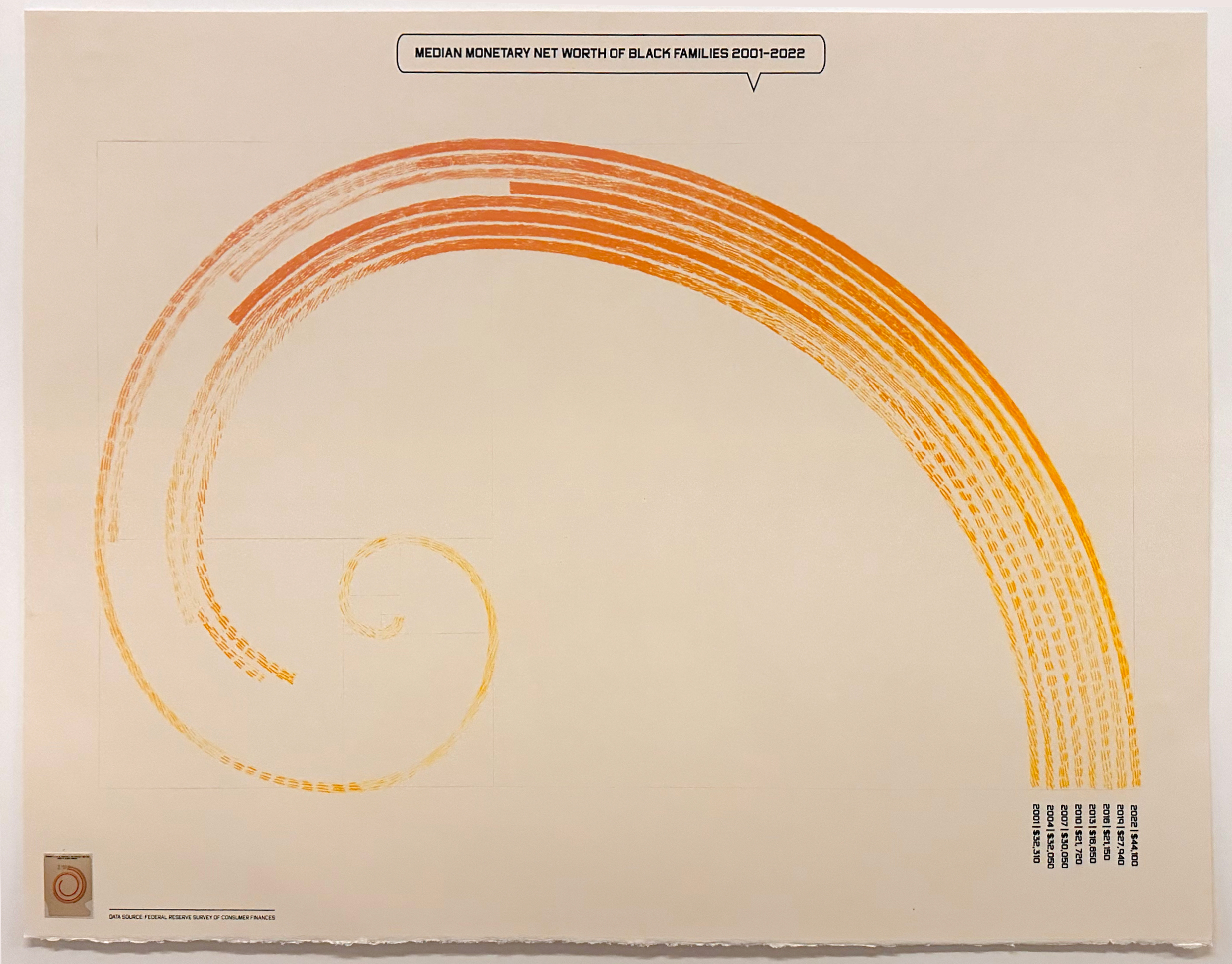
Artist William Villalongo and urbanist Shraddha Ramani have reimagined Du Bois’s original “data portraits” as a more comprehensive art project rather than simply sociological documentation. Their approach combines various printmaking techniques with contemporary data gathered from Black scholars, social scientists, and activists studying the current experiences of Black Americans. The exhibition is further enriched by sculptural, video, textile, and installation works from artists Kameelah Janan Rasheed, Tahir Hemphill, Julia Mallory, and Silas Munro.
The exhibition’s central tension emerges from a quote by Du Bois himself, which appears in one of the portfolio images: “Thus all Art is propaganda and ever must be… I stand in utter shamelessness and say that whatever art I have for writing has been used always for propaganda for gaining the right of black folk to love and enjoy.” While Du Bois’s original project aimed to persuade audiences toward agreement, this exhibition aspires to do something more nuanced – it complicates our understanding of data itself.
This complexity is evident in Rasheed’s installation, “Plot It/Point Moving” (2025), which features a video screen, framed schematics, and scattered black and white images including hands and paper fragments with incomplete text. These text fragments appear as disconnected thoughts, such as “Rubbing: contradictions and ambiguities merging,” refusing easy interpretation.
Similarly, Villalongo and Ramani’s charts often resist straightforward understanding. Their work “Visualizando La Afrodignidad Skin Color & Race in Puerto Rico” presents a gradient field moving from light to dark gray divided by undulating red lines. While the image caption explains that this visualization represents systemic colorism in Puerto Rico disproportionately affecting darker-skinned individuals, the visual representation remains deliberately abstract and challenging to interpret without context.
Other infographics in the exhibition are more immediately accessible. A map of the continental United States depicting the distribution of Black populations uses brilliant color coding, with darker areas indicating lower population density and brighter, more colorful regions showing higher concentrations. Another piece, “Black Children Enrolled in Charter, Private and Public Schools,” employs an enormous red area beneath smaller yellow and blue sections to clearly demonstrate that Black children predominantly attend public schools rather than private or charter institutions.
The exhibition ultimately accomplishes something more profound than propaganda could. While propaganda aims to persuade viewers toward a specific perspective, this show encourages audiences to think in multiple, sometimes contradictory ways. The experience resembles encountering an iceberg of meaning – seeing a visible structure while realizing most of its entirety remains imperceptible.
This approach exemplifies what art does at its best – it challenges us to become more aware of the complexity of human experience, even when that complexity bewilders us. Rather than providing easy answers, the exhibition invites viewers into a space of contemplation about how data shapes our understanding of Black life in America, both historically and in the present moment.
“Data Consciousness: Reframing Blackness in Contemporary Print,” curated by Tiffany E. Barber, continues at Print Center New York through December 13, offering visitors a unique opportunity to engage with this intersection of art, data, and racial identity.
Fact Checker
Verify the accuracy of this article using The Disinformation Commission analysis and real-time sources.

14 Comments
This exhibition sounds like a compelling exploration of the intersection between art, data, and social justice. I’m eager to learn more about the artists’ creative process and the message they hope to convey.
Blending historical and contemporary data sources is an intriguing approach. I’m curious to see how the exhibition challenges viewers to rethink their perspectives on the Black American experience.
Visualizing complex social and racial issues through data-driven art is a powerful concept. I’m impressed by the artists’ ambition to build upon Du Bois’s pioneering work in a modern context.
I’m curious to understand the specific goals and intended impact of this exhibition. Engaging the public through multimedia art could be an effective way to raise awareness and drive social change.
This exhibition sounds like a thought-provoking exploration of how data can be used to shed light on complex social and racial issues. Visualizing statistics in artistic ways is an intriguing approach.
I’m curious to learn more about the artists’ techniques and how they aim to challenge viewers’ perceptions through this multimedia project.
Reframing Blackness through data-driven art is a compelling concept. I’m curious to see how the exhibition challenges viewers to reconsider their assumptions and perceptions.
The combination of historical and contemporary data sources could yield some powerful insights. I look forward to learning more about the artists’ approach.
This exhibition sounds like an important exploration of how data can be used to raise awareness and drive social change. Integrating multiple artistic mediums is an innovative way to engage the public.
I’d be interested to learn more about the artists’ goals and the intended impact of this project.
Leveraging data visualization as a tool for social commentary is a thought-provoking idea. I’m intrigued to see how the artists navigate the balance between artistic expression and factual accuracy.
Reinterpreting Du Bois’s groundbreaking work in a modern context is an ambitious undertaking. I’m curious to understand the artists’ goals and intended impact.
Reinterpreting Du Bois’s pioneering infographics is an ambitious undertaking. Blending historical and contemporary data sources could yield powerful insights on the Black American experience.
I wonder how the artists balance artistic expression with factual accuracy in their data-driven visualizations.