


Listen to the article
In a recent wave of school protests across the United States following the fatal shooting of two anti-ICE protesters in Minnesota, concerns have emerged about the political role of teachers unions in American education. These demonstrations have sparked debate about the appropriate boundaries between education and political activism in the nation’s schools.
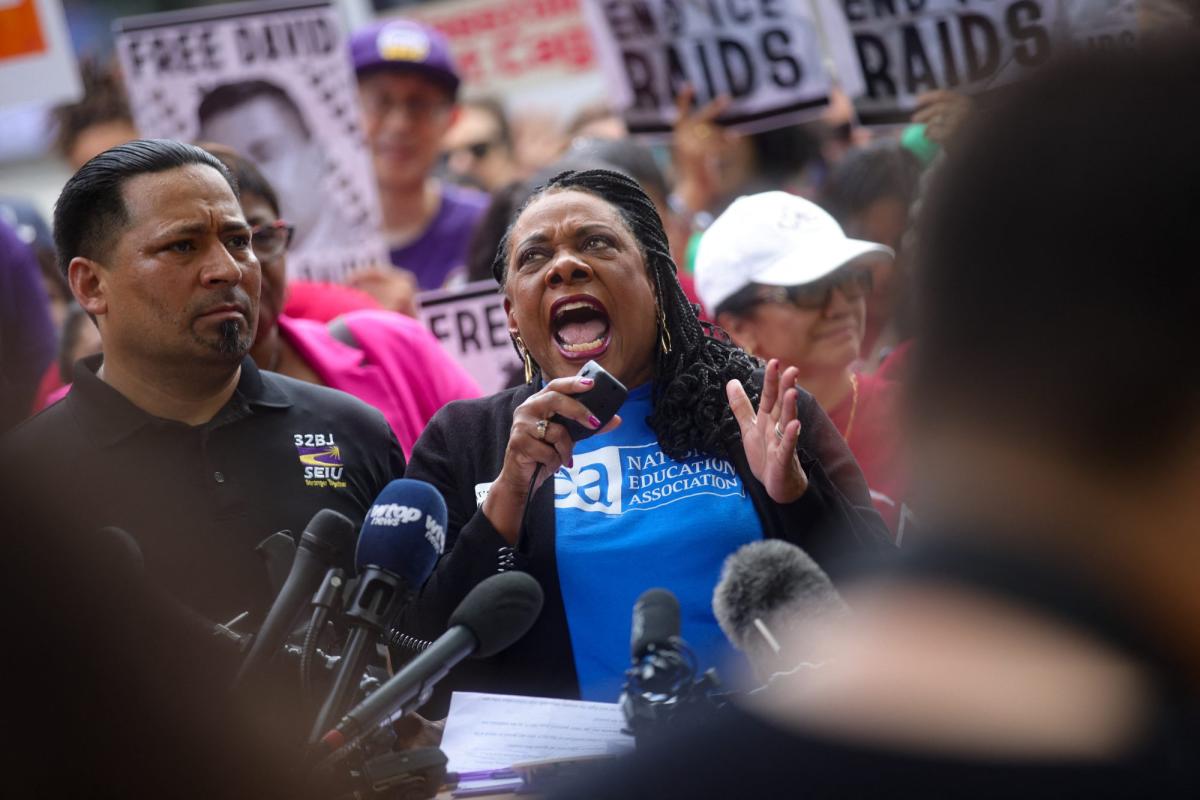
The protests, which have disrupted educational activities in multiple states, appear to have substantial organizational backing from major teachers unions. The National Education Association (NEA) and American Federation of Teachers (AFT) have taken visible positions on immigration enforcement issues, with union leadership encouraging members to participate in demonstrations and display solidarity through coordinated actions like wearing blue at school on January 23 to “stand with Minnesota.”
Documents and social media posts show that teachers unions have distributed materials related to immigration enforcement for classroom use. The Washington Education Association reportedly encouraged teachers to attend anti-ICE training sessions hosted by the NEA, while other state-level education associations promoted similar initiatives through their official channels.
The political involvement of teachers unions has become increasingly transparent in recent years. At their annual convention in Portland last year, the NEA passed resolutions specifically addressing political matters, including opposition to what they characterized as “fascism” and support for the “No Kings” movement that has been active in immigration protests.
Financial records indicate that teachers unions direct the vast majority of their political contributions to Democratic candidates, with reports suggesting over 98% of such funding went to Democrats in the last election cycle. The NEA’s president serves as an at-large member of the Democratic National Committee, further highlighting the organization’s political affiliations.
Critics argue that this level of political involvement crosses a line, particularly given the NEA’s unique status as the only union with a federal charter, granted in 1906. This special designation provides tax benefits and a degree of governmental recognition that critics say is being leveraged for partisan purposes rather than educational improvement.
The controversy touches on fundamental questions about public education’s purpose. Historically, American public schools were conceived partly as institutions to create social cohesion among diverse populations. Critics now contend that politically active teachers unions are undermining this mission by introducing divisive ideological content into classrooms.
Proposals to address these concerns include revoking the NEA’s federal charter or imposing restrictions on political activities for chartered organizations. Other suggested reforms focus on educational decentralization through school choice initiatives, which would allow parents more options for their children’s education.
The federal tax credit scholarship program, included in recent legislation, has already been adopted by 27 governors across party lines, including Colorado’s Democratic Governor Jared Polis. This program aims to expand educational options for families by providing tax incentives for scholarship donations.
Some educators have begun distancing themselves from union membership. Organizations like the Teacher Freedom Alliance have emerged to support teachers who choose to opt out of union participation, offering alternative professional benefits such as liability insurance.
As the debate continues, both supporters and critics of teachers unions acknowledge the significance of this moment in defining the relationship between education, politics, and parental authority in American society. The ongoing tension reflects broader cultural divisions about institutional power and the appropriate role of public education in a democratic society.
Fact Checker
Verify the accuracy of this article using The Disinformation Commission analysis and real-time sources.

11 Comments
This is a complex issue with valid concerns on both sides. While teachers unions play an important role, there are legitimate questions about the appropriate boundaries between education and political activism in the classroom.
While teachers unions have an important role, I agree there are valid concerns about the use of classroom time and materials for political activism. Schools should focus on core educational goals, not advocacy.
I’m curious to hear more perspectives on this. Where do you think the line should be drawn between a teacher’s personal beliefs and their professional responsibilities in the classroom?
This is a complex issue without easy answers. I can see merits to both sides – the desire for teachers to have a voice, but also the need to preserve the classroom as a neutral space for learning.
Interesting to see this debate playing out across the country. It speaks to the broader challenges of balancing individual rights, union influence, and the educational mission of public schools.
You’re right, it’s a delicate balance that deserves nuanced discussion rather than knee-jerk reactions.
I can understand the desire of teachers to advocate for their views, but it’s important that schools remain neutral ground and focus on educating students, not pushing particular political agendas.
You raise a fair point. Schools should be a place for learning, not political indoctrination.
This is a timely and important issue. I hope policymakers and education stakeholders can work to find a reasonable middle ground that respects teachers’ voices while maintaining the classroom as a non-partisan space.
Concerned to see reports of political activism disrupting educational activities. While teachers have a right to express views, the classroom should remain focused on core academic subjects, not advocacy.
This debate highlights the ongoing tension between the rights of teachers to express their views and the need to maintain objectivity in the classroom. It’s a delicate balance that deserves thoughtful consideration.