


Listen to the article
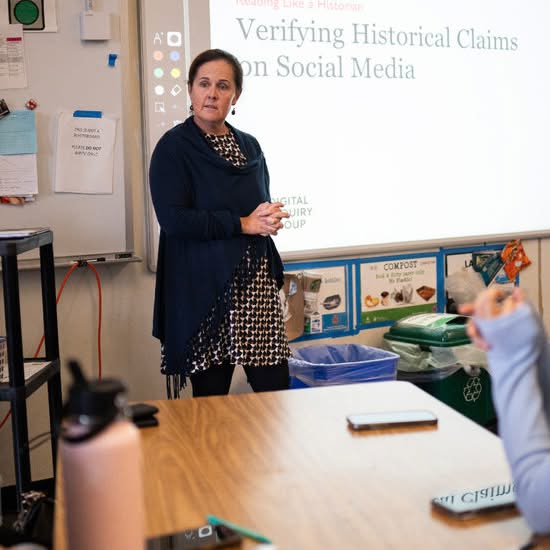
In a bustling San Francisco high school classroom, students huddle over their smartphones, not to check social media notifications but to dissect the very content that populates their feeds. They’re part of a growing educational movement teaching teenagers to navigate the treacherous waters of online misinformation.
“I used to just scroll through and believe pretty much anything that looked official,” says 16-year-old Maya Chen, a junior at the school. “Now I catch myself stopping to question whether something is actually true before I share it.”
This media literacy program, launched two years ago in response to mounting concerns about online misinformation targeting young people, has become increasingly relevant as the 2024 election cycle ramps up and artificial intelligence tools make fake content more convincing than ever.
Education experts have identified a critical gap in digital literacy among Generation Z, despite their reputation as “digital natives.” While teenagers may be technologically adept, many lack the critical thinking skills necessary to evaluate the credibility of online information.
According to a 2023 Stanford University study, nearly 82 percent of high school students struggled to distinguish between genuine news articles and sponsored content. More alarmingly, over 60 percent couldn’t identify deepfake videos when presented with subtle manipulation markers.
“Being born into a digital world doesn’t automatically confer immunity to manipulation,” explains Dr. Elisa Navarro, the program’s developer and a media studies professor at UC Berkeley. “These students need specific training to recognize the sophisticated tactics used to spread misinformation.”
The curriculum goes beyond superficial advice like “check your sources.” Students engage in practical exercises where they analyze viral social media posts, tracking down original sources and identifying logical fallacies. They study the mechanics of how algorithmic recommendation systems can create information bubbles, and learn to recognize emotional triggers that make certain content more shareable regardless of accuracy.
“What’s been eye-opening is learning how conspiracy theories are structured,” says Miguel Ramirez, a senior participating in the program. “There’s almost always a pattern – creating an enemy, suggesting hidden knowledge, and offering a simple explanation for something complex.”
The timing of these educational efforts is particularly significant as AI-generated content becomes increasingly sophisticated. Students are introduced to tools that can identify artificially created images and text, though educators acknowledge it’s a technological arms race.
Local tech companies have taken notice. Three major Silicon Valley firms have provided funding and technical expertise for the program, seeing it as both a corporate social responsibility initiative and a long-term investment in creating more discerning social media users.
“We need a public that can critically evaluate information,” says Theresa Wong, head of trust and safety at a major social platform who asked that her company not be named. “Platform moderation will never be perfect, so user education is essential to ecosystem health.”
The program’s approach has shown promising results. Internal assessments indicate that participating students are 47 percent more likely to verify information before sharing it and 63 percent more confident in identifying potential misinformation than their peers.
However, challenges remain. The program reaches only a fraction of the city’s teenagers, and educators worry about the students who need these skills most – those already deeply embedded in online communities where misinformation thrives.
Media literacy advocates are pushing for wider adoption of similar curricula statewide. California lawmakers are considering legislation that would make media literacy education mandatory in public schools, following the lead of Illinois and Washington state.
“This isn’t just about avoiding embarrassment from sharing fake news,” says Principal Robert Menendez. “It’s about preparing citizens who can participate meaningfully in democracy. A republic only functions when people can make decisions based on factual information.”
As national concerns about misinformation continue to grow, this San Francisco program offers a potential model for addressing the problem at its roots – by equipping the next generation with the cognitive tools to navigate an increasingly complex information landscape.
Fact Checker
Verify the accuracy of this article using The Disinformation Commission analysis and real-time sources.

9 Comments
While it’s concerning that so many high schoolers struggle with evaluating online credibility, this program seems like a positive way to address the problem. Teaching media literacy early on can have lasting benefits.
Absolutely. Proactive education around these issues is key, especially as AI-generated content becomes more convincing. Kudos to this school for taking the initiative.
While it’s concerning that so many high schoolers lack the critical thinking skills to evaluate online information, this program seems like a step in the right direction. Developing digital literacy is crucial in today’s media landscape.
This is a timely and important initiative, especially with the 2024 election cycle on the horizon. Empowering students to identify misinformation could have broader societal benefits in terms of combating the spread of false narratives.
Definitely. Fostering media literacy in the younger generation is crucial for the health of our democratic institutions. Kudos to this school for taking a proactive approach.
I’m curious to learn more about the specific curriculum and teaching methods used in this media literacy program. Equipping students with a systematic approach to assessing online information sources could be very impactful.
That’s a great point. Understanding the program’s methodology would provide valuable insights into how to effectively teach these critical digital skills to young people.
This is a great initiative to help young people navigate the complex landscape of online information. Developing critical thinking skills around media literacy is crucial in today’s digital age.
Agreed. Equipping students with the tools to identify misinformation is an important step in empowering the next generation to be more discerning consumers of digital content.