


Listen to the article
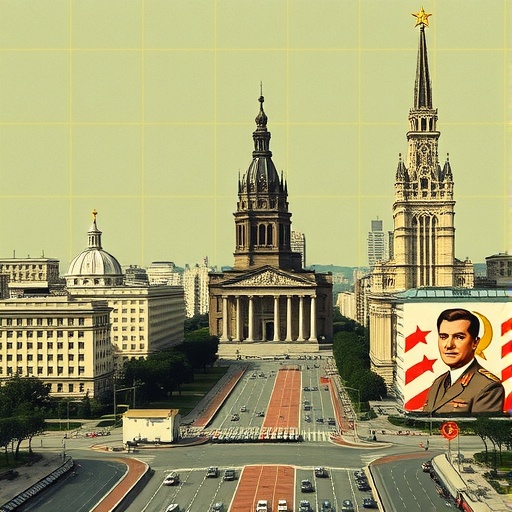
In a groundbreaking study examining Soviet-era newsreels, researchers have uncovered complex patterns of geographical bias that reveal how the Soviet Union strategically portrayed its cities to advance ideological goals. The research, published in Nature Cities, demonstrates that media representation transcended simple population metrics, instead reflecting economic priorities and geopolitical strategies of the Soviet state.
The study analyzed “Novosti Dnya” (News of the Day) newsreels—short segments shown before feature films in Soviet cinemas that served as political and cultural primers for audiences. These ubiquitous news segments functioned as a daily window into the country’s urban development, highlighting industrial achievements and celebrating socialist progress across the vast territory.
Researchers discovered that city representation followed what urban scientists call superlinear scaling—where larger cities weren’t just featured more frequently due to their size but dominated the media landscape disproportionately. This amplification of major urban centers aligned with the Soviet Union’s ideological objectives, creating an imagined geography that emphasized certain places while marginalizing others.
“City size alone doesn’t tell the whole story,” explained the research team. Their analysis revealed significant biases connected to industrial specialization. Cities known for hydroelectric power generation and steel manufacturing received outsized attention, reflecting the Soviet emphasis on heavy industry and technological advancement as markers of socialist achievement.
The findings also expose systematic regional underrepresentation. Despite their economic significance, cities in the Soviet industrial heartland received less media coverage than expected. Even more striking was the diminished visibility of urban centers in non-European socialist republics, indicating a hierarchy of geographical importance within the multinational state.
This pattern of selective amplification and marginalization served as a powerful tool in shaping collective perception. Rather than merely reflecting urban hierarchies, these newsreels actively constructed them, signaling to Soviet citizens which regions and industries the state deemed most valuable to the socialist project.
The research team employed an innovative methodology combining quantitative and qualitative approaches. They began by measuring media mentions of cities and correlating these with demographic and economic data to establish statistical patterns. This was followed by contextual interpretation within Soviet ideological frameworks, creating what the researchers describe as an “iterative feedback methodology” that allowed nuanced political and cultural dimensions to emerge from the data.
“What we’re seeing is a conscious media strategy that functioned at the nexus of communication and urban development,” noted the researchers. “This wasn’t simply about reporting urban facts but about signaling Soviet technological triumph.”
The implications extend well beyond the Soviet context. The study demonstrates how media representation shapes collective cultural memory and constructs narratives of place and progress. By privileging certain regions or industries, media outlets—regardless of era or political system—advance particular political agendas and cultural myths.
This research challenges assumptions that media representation naturally aligns with objective metrics like population size or economic output. Instead, it highlights a deliberate mediation process where socio-political priorities determine which cities become emblematic or invisible in the national consciousness.
From a methodological perspective, the study showcases the value of analyzing historical newsreels as data sources for studying ideological media bias. The nationwide circulation and temporal consistency of these films created ideal conditions for longitudinal analysis, while computational techniques allowed researchers to uncover trends not readily visible through traditional methods.
The findings resonate with contemporary urban policy discussions about visibility and equity. Cities that receive limited media attention risk marginalization in resource allocation and recognition, potentially exacerbating regional disparities. Understanding historical biases offers valuable insight for addressing representational justice in modern urban narratives.
“Map-like representations in culture are never neutral,” the researchers concluded. Whether in news media, film, literature, or digital platforms, portrayals of place carry the weight of power, ideology, and economic interest.
As information ecosystems continue to evolve, awareness of these representational biases remains essential for developing critical media literacy. By bridging urban science with cultural geography and digital humanities, this research provides a blueprint for future scholarship on the geography of knowledge and memory in global media landscapes.
Fact Checker
Verify the accuracy of this article using The Disinformation Commission analysis and real-time sources.

7 Comments
This study is a great example of how data and visual analysis can be used to shed light on the complex interplay between media, propaganda, and cultural biases. It’s a valuable contribution to our understanding of the Soviet Union’s efforts to shape its public image and the lasting impact of those strategies.
The researchers’ approach to analyzing Soviet newsreels and uncovering the strategic geographical biases is really impressive. It highlights the importance of scrutinizing primary sources and looking beyond the surface-level narratives to uncover the underlying agendas and power structures.
This research provides valuable insights into the role of propaganda in shaping public perception and cultural biases. It’s a timely reminder that the way information is presented can significantly influence our understanding of history and current events.
I’m curious to see how this study’s methodology and findings could be applied to analyze media representation and propaganda in other historical contexts or modern settings. Understanding these dynamics is crucial for media literacy and critical thinking.
Fascinating look at how the Soviet state used newsreels to craft an idealized, propagandistic vision of its cities and urban development. The research highlights the complex interplay between media representation, ideology, and geopolitical strategies.
It’s interesting to see how the selective portrayal of certain cities over others served the regime’s objectives. Curious to learn more about the specific geographical biases and economic priorities that shaped this imagined urban landscape.
The study’s findings on the disproportionate coverage of major urban centers in Soviet newsreels is a great example of how media can be used to amplify certain narratives and perspectives. It’s a good reminder to be critical of the information we consume, especially when it comes to historical sources.