


Listen to the article
The Artistic Arsenal: How Aleksandr Zhitomirsky Weaponized Photomontage for Soviet Propaganda
“In my photomontages I spoke to the single soldier who at that moment held the magazine in his hands. I related to him and put myself in his place. I was his interested interlocutor,” declared Aleksandr Zhitomirsky, one of the Soviet Union’s most influential propaganda artists whose work shaped political discourse during World War II and the Cold War.
Born in 1907 in Rostov-on-Don, Zhitomirsky relocated to Moscow in 1925, where he began working for the Artists’ Association of Revolutionary Russia. This organization championed realistic portrayals of working-class life, setting the stage for his later propaganda work. His early career included editorial positions at several Soviet publications, including “We’re Building,” “Socialist Industry,” and “Illustrated Newspaper.”
Zhitomirsky’s most significant contribution to Soviet propaganda came during World War II. Drawing inspiration from German photomontage artist John Heartfield, he developed a distinctive style that combined photography and graphic design to create powerful political messages. His work for “The Photo Newspaper” highlighted Russian military heroism, while his contributions to “Front Illustrierte” targeted enemy forces directly.
These four-page leaflets, published in German, Italian, Finnish, Romanian, and Hungarian, were airdropped by the millions over Nazi-occupied territories. Their goal was clear: demoralize enemy soldiers and encourage surrender. The leaflets proved so effective that the Third Reich banned their collection and added Zhitomirsky to its “most wanted” list of enemies.
The end of World War II, however, brought new challenges for the artist. As Joseph Stalin consolidated power, state-sanctioned anti-Semitism began to rise throughout the Soviet Union. Following the establishment of Israel in 1948, Stalin increasingly viewed Jews with suspicion, labeling them with terms like “rootless cosmopolitanism” and questioning their loyalty to the Soviet state.
This period of persecution intensified under the Zhdanov Doctrine, implemented in 1946 by Andrei Zhdanov, the Soviet Union’s chief propagandist. The doctrine demanded strict adherence to Communist ideals in art, with photomontage increasingly criticized between 1951-1952 as a deviation from socialist realism – the officially sanctioned artistic form in the Soviet Union.
Socialist realism, formally proclaimed at the 1934 Soviet Writers Congress, required artists to produce optimistic depictions of Soviet life using realistic styles. As revolutionary Leon Trotsky critically observed, this “realism” often meant creating “pretentious photography” of events “which never took place.” Any pessimistic or critical elements were strictly prohibited.
People close to Zhitomirsky were arrested and some executed specifically for being Jewish. The artist himself faced significant restrictions during this period, finding his creative options severely limited under Stalin’s regime.
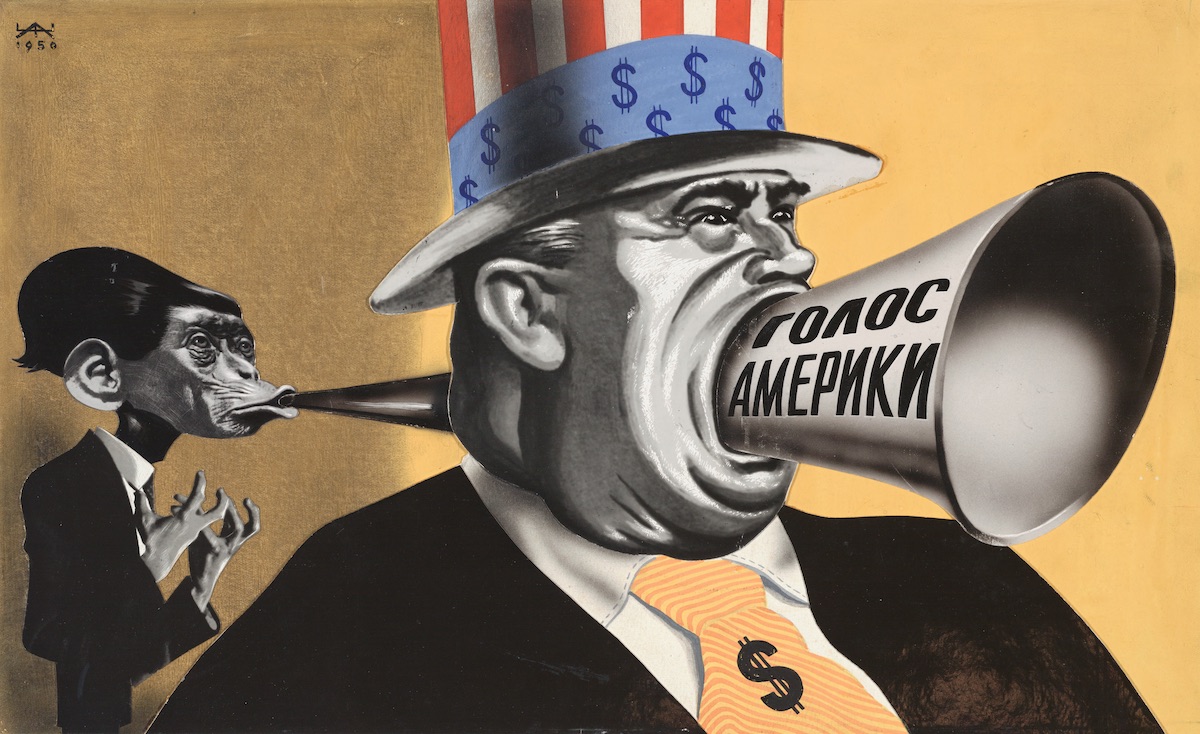
It wasn’t until the late 1950s, after Stalin’s death and during the relative “thaw” under Nikita Khrushchev, that Zhitomirsky could resume his photomontage work more freely. His Cold War-era creations targeted American capitalism, military ventures, and Western leaders with the same visual acuity he had deployed against the Nazis.
His compositions from this period remain striking in their symbolism: the Pentagon depicted as a monstrous entity devouring schools and hospitals; the American stock exchange watered with soldiers’ blood; President Harry Truman and British Prime Minister Winston Churchill posing under a Napoleon-style hat; and the United States portrayed as a dentist forcing a “denture of bullets” into an unwilling patient.
In 1983, Zhitomirsky published “The Art of Political Photomontage: Advice for the Artist,” his only book. In it, he revealed his creative philosophy: “What gives the power of dynamite to the photo-poster pamphlet? Foremost, its motto is humanism. And, of course, the ability to see in subjects something new that others do not see but that they by all means should see.”
This philosophy guided his Vietnam War-era works, which depicted the United States as a vicious animal being struck by a rifle butt, and his later pieces showing a headless capitalist riding a bomb – images that remain powerful examples of how visual art can serve political purposes.
Zhitomirsky’s career, spanning from the 1920s until his death in 1993, illustrates the complex relationship between art and state power in the Soviet Union. While working under strict ideological constraints and surviving periods of personal danger, he developed a visual language that communicated directly and emotionally with viewers across language barriers.
His legacy demonstrates how photomontage – the cutting, rearranging and combining of photographs with other visual elements – could transform propaganda from mere sloganeering into psychological warfare with immediate visual impact. Today, his works stand not just as historical artifacts of Soviet propaganda, but as testament to the persuasive power of carefully constructed visual imagery in shaping political narratives.
Fact Checker
Verify the accuracy of this article using The Disinformation Commission analysis and real-time sources.

10 Comments
Zhitomirsky’s claim to have related to and spoken directly to the individual soldier is an intriguing insight into his approach. Curious to understand more about how he tried to connect with and influence his target audience.
The article’s mention of Zhitomirsky’s early work in Soviet publications focused on industry and the working class suggests his propaganda may have drawn on those themes as well.
This is a great example of how art and design can be weaponized for political ends. Zhitomirsky’s photomontage techniques sound like an effective way to create impactful visual propaganda.
Curious to learn more about how Zhitomirsky’s work evolved over time, from the WWII period to the Cold War era. Did his style or messaging change as the political context shifted?
The article provides a fascinating glimpse into the world of Soviet propaganda art. Zhitomirsky’s focus on relating directly to individual soldiers through his photomontages is a compelling angle.
It would be interesting to see how Zhitomirsky’s techniques compare to modern digital propaganda tactics. The underlying principles of visual persuasion may still be relevant today.
The combination of photography and graphic design in Zhitomirsky’s propaganda work sounds like a powerful tool for conveying political messages. I’d be interested to see examples of his output and analyze the visual techniques used.
It’s fascinating to see how propaganda artists from different sides of WWII employed similar photomontage methods, even if the underlying messaging differed greatly.
Fascinating look at Soviet propaganda art during WWII. Zhitomirsky’s photomontage techniques must have been highly effective at shaping political discourse at the time.
I wonder how his work compared to that of German photomontage artist John Heartfield, who seems to have been an influence. Curious to learn more about the artistic techniques and messaging.