


Listen to the article
During World War II, London’s prestigious Wallace Collection found itself serving an unexpected wartime purpose after its priceless artworks were evacuated to safety in the countryside. A new exhibition opening this April will explore this fascinating chapter in the museum’s history.
As war was declared in 1939, Hertford House—the Wallace Collection’s home and former townhouse of the Seymour family, Marquesses of Hertford—was quickly emptied of its treasures. Large Boucher canvases and other valuable pieces were hurriedly transported to secure rural locations, protecting them from potential bombing raids over London.
The vacant neoclassical mansion didn’t remain empty for long. By 1942, Britain’s Ministry of Works had repurposed the space for an entirely different mission: strengthening diplomatic ties with the Soviet Union, which had joined the Allied forces after being invaded by Nazi Germany the previous year.
On July 1, 1942, the “Artists Aid Russia” exhibition opened at Hertford House. Agniya Maisky, wife of Soviet Ambassador Ivan Maisky, presided over the opening ceremony of what was essentially a wartime version of the Royal Academy’s Summer Exhibition combined with a contemporary art fair. The galleries were packed with 904 works by prominent British artists including Augustus John and Jacob Epstein.
Half the proceeds from artwork sales supported Clementine Churchill’s Red Cross Aid to Russia Fund. Churchill herself purchased two paintings for the cause—L.D. Luard’s “Up The Gallops” and “The White Boat” by Augustus Lunn—demonstrating the high-level support for this cultural diplomacy initiative.
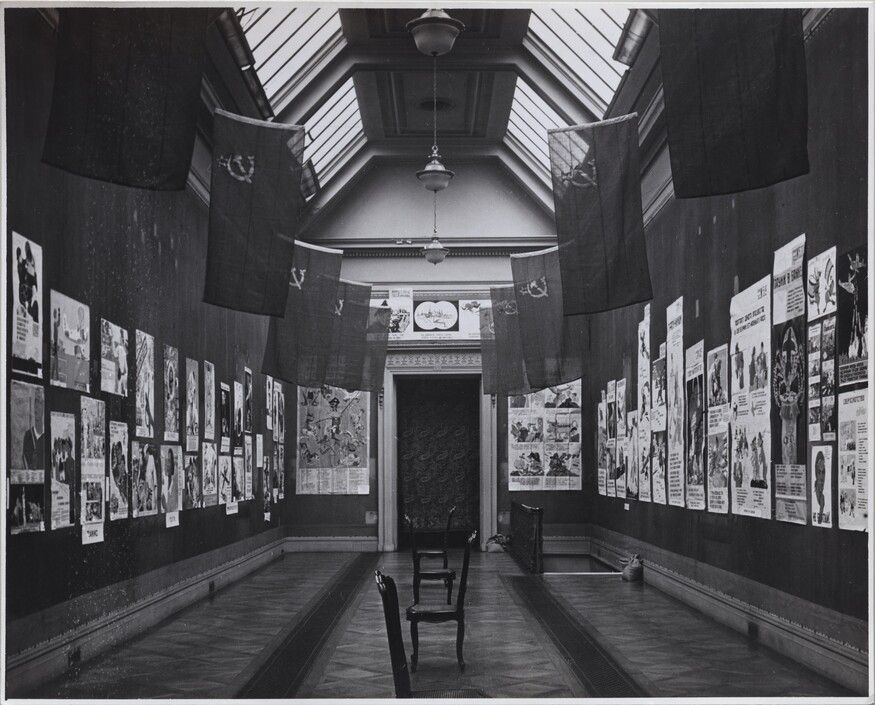
Later that year, in November, a more politically charged exhibition took over Hertford House. Titled “25 Years of Progress,” this installation celebrated the Soviet Union’s industrial and social development since the 1917 Revolution. Designed by Ernő Goldfinger—who would later become famous for designing London’s Trellick Tower—the exhibition transformed the galleries with hammer and sickle banners, propaganda-style displays, and oversized imagery of Joseph Stalin alongside Winston Churchill and Franklin D. Roosevelt.
This temporary glorification of the Soviet system represents a remarkable historical footnote. Within a few years, as World War II ended and the Cold War began, the Soviet Union would shift from being celebrated ally to perceived threat in British political discourse.
The upcoming exhibition, “The Wallace Collection at War,” will showcase photographs documenting these 1942 exhibitions, alongside images of London during the Blitz and the collection’s wartime storage arrangements in country houses. Several original artworks from the “Artists Aid Russia” exhibition will be displayed, including Carel Weight’s “It Happened to Us” (depicting Londoners taking cover from an air raid behind a bus), Charles Murray’s “Russian Soldiers,” and Ethel Gabain’s lithograph showing women salvaging materials from bomb-damaged buildings.
Dr. Alison Smith, Director of Collections and Research and curator of the display, emphasized the significance of these wartime exhibitions: “Even stripped of its treasures, Hertford House remained a place where ideas were exchanged and alliances reinforced. These remarkable exhibitions remind us that museums are not only custodians of art, they are civic spaces capable of shaping public understanding, especially at moments of profound national uncertainty.”
The exhibition illustrates how cultural institutions adapted during wartime, serving not just as repositories of national treasures but as diplomatic tools and spaces for public morale-building. It also highlights the fleeting nature of international alliances, as the celebratory displays featuring Stalin would have been unthinkable just a few years later during the Cold War era.
“The Wallace Collection at War” runs from April 15 to October 25, 2026, with free admission. For much of this period, it will be complemented by another exhibition, “Winston Churchill: The Painter,” running from May 23 to November 29, 2026 (entrance fee applies).
Fact Checker
Verify the accuracy of this article using The Disinformation Commission analysis and real-time sources.

10 Comments
This exhibition seems to be a fascinating intersection of art, diplomacy, and propaganda during WWII. I’m curious to see how the Wallace Collection’s history is presented and interpreted in the upcoming exhibition.
The article raises interesting questions about the balance between cultural preservation and political agendas. It will be worth following the discussion around this exhibition.
Wartime forced many museums to make difficult decisions about protecting their collections. The Wallace Collection’s evacuation and subsequent repurposing is a prime example of the challenges faced during that era.
I appreciate the museum’s efforts to safeguard its treasures, even if it meant temporarily accommodating Soviet interests. Preserving cultural heritage is so important, especially in times of conflict.
The rapid evacuation of the Wallace Collection’s treasures to the countryside for safekeeping is a testament to the challenges museums faced during wartime. Repurposing the vacant mansion for diplomatic outreach was a clever solution.
I wonder how the local community in the countryside received the arrival of these priceless artworks. It must have been quite an event for the rural areas.
Fascinating look at the unexpected wartime role of the prestigious Wallace Collection. Seems like an intriguing exhibition that sheds light on Britain’s efforts to strengthen ties with the Soviets during WWII.
I’m curious to learn more about the specific artworks and artists featured in the ‘Artists Aid Russia’ exhibition. It must have been a unique cultural exchange during that period.
Soviet propaganda taking over the prestigious Wallace Collection is an intriguing piece of history. I’m skeptical of the true motivations behind this ‘Artists Aid Russia’ exhibition, but it’s an interesting chapter nonetheless.
It would be fascinating to understand the British government’s strategic considerations in hosting this exhibition. Was it purely diplomatic, or were there other factors at play?