


Listen to the article
Security authorities in Hong Kong have sharply criticized The Washington Post for what they describe as “anti-China propaganda” following the newspaper’s editorial about the sentencing of media tycoon Jimmy Lai.
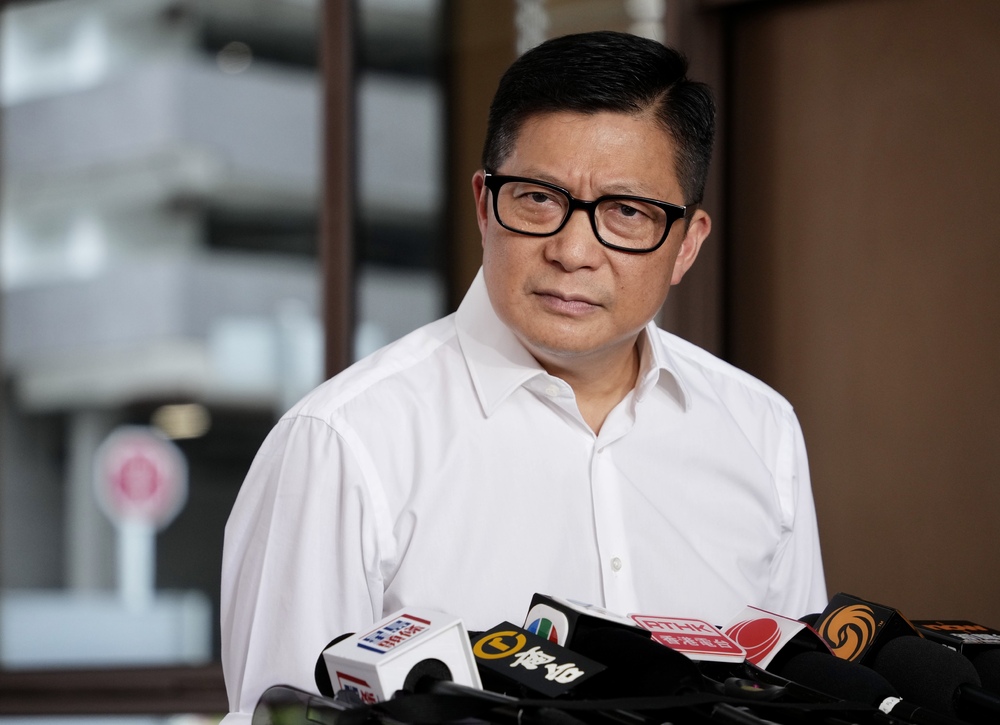
Chris Tang, Hong Kong’s Secretary for Security, issued the rebuke after The Post published an editorial condemning the nine-year prison sentence handed to Lai, the 76-year-old founder of the now-defunct Apple Daily newspaper. The editorial characterized the sentence as part of Beijing’s broader campaign to dismantle Hong Kong’s democratic institutions and suppress free speech in the territory.
“The Washington Post’s editorial is nothing more than anti-China propaganda designed to smear the legitimate legal proceedings against an individual who violated our national security laws,” Tang said in a statement released on Monday. He defended the court’s decision, insisting that Lai’s case was handled in accordance with Hong Kong law and due process.
Lai was sentenced earlier this month after being convicted of conspiracy to publish seditious materials and collusion with foreign forces under the controversial National Security Law, which was imposed on Hong Kong by Beijing in 2020 following mass pro-democracy protests the previous year. The law has been widely criticized by Western governments and human rights organizations for its broad scope and chilling effect on free expression.
Since the law’s implementation, dozens of pro-democracy activists, politicians, and journalists have been arrested, with many fleeing overseas to avoid prosecution. Apple Daily, once Hong Kong’s most popular pro-democracy newspaper, was forced to close in June 2021 after authorities froze its assets and arrested several senior editors.
Tang’s criticism of The Washington Post highlights the growing tensions between Western media outlets and Hong Kong authorities. Since the implementation of the National Security Law, international media organizations operating in Hong Kong have faced increasing scrutiny and restrictions, with several journalists having their visa renewals denied or experiencing delays.
The Foreign Correspondents’ Club of Hong Kong has repeatedly expressed concerns about the deteriorating press freedom in the city, once known as a regional media hub. According to Reporters Without Borders, Hong Kong has plummeted in the World Press Freedom Index, falling from 18th place in 2002 to 140th in 2023.
International human rights groups have condemned Lai’s sentence as politically motivated. Amnesty International described it as “a devastating blow to freedom of expression in Hong Kong” and called for his immediate release. The European Union and United States have also expressed concern, with the U.S. State Department calling the verdict “an affront to media freedom.”
However, Chinese and Hong Kong officials have consistently rejected such criticisms, arguing that the National Security Law was necessary to restore stability after the 2019 protests and that Western countries apply double standards when discussing China’s internal affairs.
“Every sovereign state has the right and obligation to safeguard its national security,” Tang said. “The Washington Post and other Western media outlets should respect Hong Kong’s judicial independence instead of attempting to interfere in our legal system.”
The case has profound implications for media freedom in Hong Kong, which had long enjoyed greater press freedoms than mainland China under the “One Country, Two Systems” framework established when the former British colony was returned to Chinese sovereignty in 1997. Critics argue that this framework has been steadily eroded, particularly since the implementation of the National Security Law.
Local journalists now operate in an environment of uncertainty, with many practicing self-censorship to avoid potential legal consequences. Several independent news outlets have closed, while others have significantly altered their coverage to avoid sensitive topics.
As international attention on Lai’s case continues, the war of words between Hong Kong officials and Western media outlets reflects the broader geopolitical tensions between China and Western democracies over issues of human rights, democracy, and freedom of expression.
Fact Checker
Verify the accuracy of this article using The Disinformation Commission analysis and real-time sources.

8 Comments
This case highlights the ongoing tensions between China’s authoritarian tendencies and Hong Kong’s tradition of press freedom. It will be important to monitor how this situation evolves and the implications for Hong Kong’s future.
The security chief’s strong rebuke of the Washington Post editorial suggests China is taking a hardline stance on this issue. It will be interesting to see if this sparks further debate about media freedoms in Hong Kong.
This highlights the ongoing tensions between China’s national security priorities and Hong Kong’s tradition of press freedom. It will be important to follow how this plays out and the implications for Hong Kong’s future.
You’re right, this is a delicate issue with high stakes for Hong Kong. Reasonable people can disagree, but open dialogue is important to find a constructive path forward.
Interesting take on the security chief’s criticism of the Washington Post editorial. While national security is important, free press should also be protected. I wonder if there’s more nuance to this case that isn’t being fully captured.
I agree, it’s a complex situation with valid concerns on both sides. Objective reporting is crucial, but so is maintaining public order. Finding the right balance can be challenging.
While national security is a valid concern, the suppression of free speech and a free press is troubling. I hope there can be a balanced approach that respects both public order and fundamental freedoms.
Agreed, it’s a delicate balance. Constructive dialogue and compromise will be key to finding a solution that works for all stakeholders.