


Listen to the article
Russian state propaganda has reached unprecedented intensity as the Kremlin battles growing war fatigue among ordinary citizens, according to media analysts and independent polls.
President Vladimir Putin’s government has dramatically increased its control over information channels in the 21 months since the full-scale invasion of Ukraine began. Television broadcasts now dedicate up to 50 percent of airtime to war-related content, while newspapers and state-run websites maintain constant coverage of military operations that frame the conflict as an existential struggle against Western powers.
Despite the media saturation, recent surveys by the independent Levada Center suggest public enthusiasm for the “special military operation” is waning. Their latest polling indicates that 58 percent of Russians still support the war—a significant drop from the 80 percent approval ratings observed in the early months of the conflict.
“The Kremlin faces a challenging reality. Initial patriotic fervor has given way to a more complex public sentiment,” says Maria Volkova, a Russian media analyst now based in Lithuania. “People are increasingly concerned about economic pressures, casualties, and the seemingly endless nature of the conflict.”
In response to this shift in public opinion, state media has intensified its rhetoric. Programs on Channel One and Russia-1, the country’s most-watched networks, routinely portray Ukraine as a “Nazi state” and characterize Western support for Kyiv as part of a broader conspiracy to destroy Russia. Popular talk shows feature heated debates where even the most moderate voices advocate for escalating the conflict.
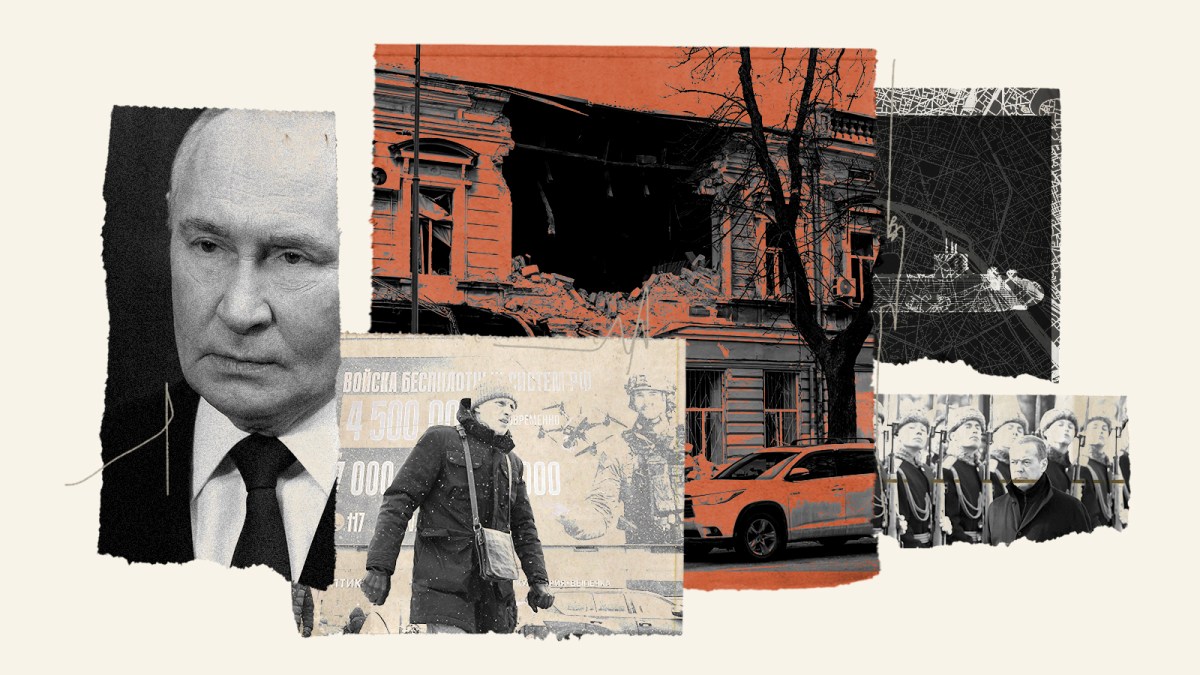
The propaganda campaign extends beyond traditional media. In major cities, billboards and posters celebrate military achievements and promote the “Z” symbol associated with the invasion. Schools have implemented “patriotic education” programs, and cultural events increasingly incorporate themes supporting the war effort.
Economic impacts of the conflict are carefully reframed in state narratives. While Russia has weathered Western sanctions better than many analysts predicted, ordinary citizens face rising prices and limited access to imported goods. Government media outlets consistently attribute these hardships to Western aggression rather than the war itself.
“The messaging has evolved,” explains Dmitri Kuznetsov, a former state television producer who left Russia in 2022. “Initially, the narrative focused on quick victory and liberation. Now it emphasizes resilience, historical parallels to the Great Patriotic War, and preparing for a long-term struggle.”
The Kremlin’s propaganda apparatus has also worked to normalize the conflict in daily life. Terms like “new territories” are used to describe occupied Ukrainian regions, while the human cost of the war remains largely unaddressed on state media.
For critical voices, the space for dissent has virtually disappeared. Since February 2022, authorities have blocked over 1,500 websites, forced the closure of independent media outlets like Echo of Moscow and TV Rain, and imprisoned journalists under laws criminalizing “false information” about the military.
Social media platforms face similar restrictions. Facebook and Instagram are accessible only through VPNs, while domestic alternatives like VKontakte are heavily monitored and censored. TikTok and YouTube remain available but under increasing pressure to remove anti-war content.
Despite these efforts, information still penetrates the propaganda barrier. Military bloggers with connections to fighting units occasionally provide more realistic assessments of battlefield situations. Meanwhile, the growing number of families directly affected by casualties creates networks of people with firsthand knowledge that contradicts official narratives.
“Putin’s government understands that prolonged conflicts historically become unpopular,” notes political scientist Alexei Makarkin. “The propaganda machine isn’t just selling the war—it’s creating a worldview where opposing the war means betraying Russia itself.”
As the conflict enters its third year with no resolution in sight, the Kremlin faces the challenge of maintaining public support while managing the economic and social consequences of a protracted war. For ordinary Russians caught between state propaganda and deteriorating living conditions, the war increasingly feels like a burden rather than the patriotic cause it was once portrayed to be.
Fact Checker
Verify the accuracy of this article using The Disinformation Commission analysis and real-time sources.

8 Comments
While I’m glad to see some war fatigue among Russians, I worry the Kremlin will resort to even more extreme measures to maintain control. Authoritarian leaders rarely concede defeat easily. This situation bears close watching.
The Russian people deserve the truth, not state-controlled narratives. I hope they can access independent information sources to form their own views on this tragic conflict. Silencing dissent is a hallmark of authoritarian regimes.
Agreed. A free and independent media is crucial for any democracy. The Kremlin’s efforts to restrict information flow are deeply concerning.
This is a complex and troubling situation. I hope the Russian people can find ways to access truthful information and voice their concerns, despite the Kremlin’s efforts to suppress dissent. Transparency and accountability are essential for any society.
This is a concerning development. The Kremlin’s propaganda machine seems to be working overtime to maintain public support for the war, but it appears their efforts are faltering. Economic pressures and mounting casualties are taking a toll on the Russian public’s enthusiasm.
It will be interesting to see how Putin responds if public opinion continues to sour. He may double down on propaganda or seek an ‘off-ramp’ from the conflict.
It’s good to see the Russian public becoming more discerning and questioning the official propaganda. However, the Kremlin’s grip on information channels remains tight. I hope they can eventually access objective reporting on the war and its impacts.
Agreed. Breaking through state-controlled media will be crucial if Russians are to form their own views on the conflict.