


Listen to the article
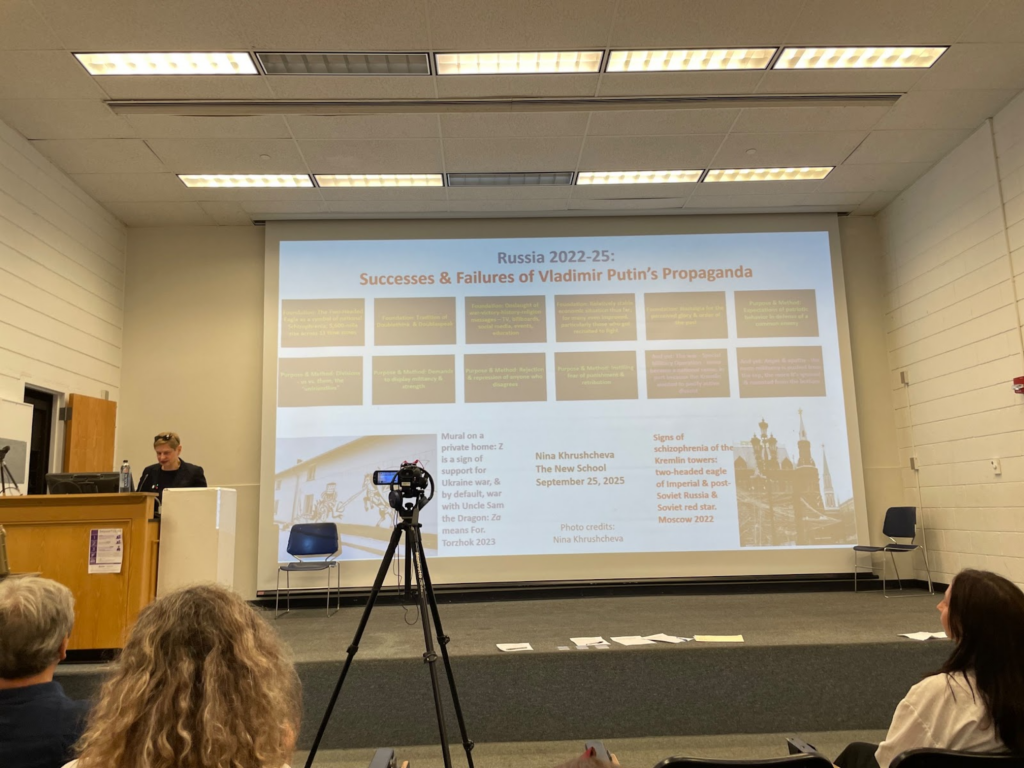
In a recent campus lecture, international affairs expert Nina Khrushcheva offered a rare glimpse into the evolving landscape of Russian propaganda since the country’s 2022 invasion of Ukraine, revealing how the Kremlin is struggling to reframe its military campaign as a national cause.
Speaking at the College of William and Mary last Thursday, Khrushcheva, a professor at the New School and great-granddaughter of former Soviet leader Nikita Khrushchev, shared insights from her extensive travels throughout Russia during the ongoing conflict.
“I wanted to understand by going there how Putin’s propaganda works,” Khrushcheva told the audience, challenging the common assumption that the Russian propaganda machine operates with overwhelming effectiveness. “What you are hearing or reading in most reports is that it works tremendously well. People support the war, as they call it, the Special Military Operation, in great numbers.”
Her lecture, “Russia 2025: Failures and Successes of Vladimir Putin’s Propaganda,” was hosted by the Russian, East European and Eurasian Studies department and co-sponsored by several academic programs at the college.
Khrushcheva’s analysis points to a fundamental miscalculation in the Kremlin’s initial messaging strategy. When Russia launched its invasion in 2022, Putin presented the conflict as a distant affair that would not disrupt everyday Russian life. This approach, she argued, has backfired.
“Since people were allowed to live normal lives, it never became a national cause,” Khrushcheva explained. “Putin is fighting the war somewhere, and normal life is somewhere else.”
This disconnect has created an unusual social dynamic within Russia, where the government has been forced to intensify propaganda efforts through various channels. According to Khrushcheva, recent years have seen increased public displays of Stalin, a surge in military imagery, and renewed emphasis on traditional Russian culture through weddings, music, and conservative fashion trends.
The government has simultaneously tightened restrictions on Western cultural influences. Khrushcheva noted that since early this year, foreign language materials have been banned from bookstore displays, with enforcement carried out through random inspections by government agents. In response, many retailers have adapted by relocating foreign books to upper floors, maintaining facades of normalcy with non-book merchandise at street level.
“If you’re in this bookstore, you wouldn’t know that there was a special military operation,” she observed. “You wouldn’t know there was Putin altogether.”
Despite Putin’s claims of 80% public approval, Khrushcheva estimates actual support is likely closer to 60% or below. Her assessment suggests Russians have maintained a complex relationship with Western culture even as the government attempts to distance itself from it. She noted that many Russians continue to engage with global entertainment phenomena like “Barbenheimer” and international food brands.
Perhaps most tellingly, Khrushcheva reported that George Orwell’s dystopian classic “1984” is currently the second most frequently stolen book in Russia, behind only the Russian Constitution itself – suggesting a population that remains politically aware despite state messaging.
The human cost of the conflict was starkly illustrated in Khrushcheva’s observations of returning veterans, many of whom she described as facing indifference and struggling with poverty. She recounted seeing amputee veterans begging in metro stations and grocery stores, highlighting the social consequences of a war that many Russians have been conditioned to mentally distance themselves from.
For students like Nicholas Valyayev, a freshman with Soviet-born parents, Khrushcheva’s perspectives resonated deeply. “I’ve been very invested in the region and also very concerned about what has been going on recently,” he said, while acknowledging her privileged position. “She is connected to a very influential family, and so that gives her opportunities to travel in Russia and speak to people and say these things that average people would not.”
Sasha Prokhorov, a Professor of Russian Studies at the college, emphasized Khrushcheva’s credentials and critical stance: “She’s very critical of Russian imperialist aggression against Ukraine.”
Despite her sobering assessment of current conditions, Khrushcheva concluded on a note of historical optimism, drawing on her family legacy. “Historically, for every Stalin, there’s a Khrushchev,” she said, alluding to her great-grandfather’s role in initiating de-Stalinization reforms following Stalin’s rule.
As Russia’s war in Ukraine continues into its third year with significant global repercussions, Khrushcheva’s insider analysis offers valuable context for understanding the complex relationship between the Kremlin’s propaganda efforts and the Russian public’s reception of them.
Fact Checker
Verify the accuracy of this article using The Disinformation Commission analysis and real-time sources.

20 Comments
This is a valuable contribution to our understanding of the evolving Russian propaganda landscape. I’m curious to see if other experts corroborate Khrushcheva’s findings about the limitations of the Kremlin’s messaging efforts.
Continued monitoring and analysis of Russian propaganda will be critical as the Ukraine conflict drags on. Maintaining a clear-eyed view of its impact is essential.
This lecture offers a rare, insider’s view of the Russian propaganda landscape, challenging the assumption of its overwhelming effectiveness. Khrushcheva’s firsthand observations are a valuable contribution to our understanding.
It will be important to monitor how the Kremlin’s propaganda efforts evolve in response to setbacks on the battlefield and growing international condemnation of the invasion.
Khrushcheva’s insights provide a nuanced perspective on the complexities of Russian propaganda during the Ukraine invasion. It’s encouraging to hear that the Kremlin’s messaging may not be as effective as commonly believed.
I’m interested to learn more about the specific tactics and channels the Russian government is using to shape public opinion, and how they are being received or countered domestically.
Professor Khrushcheva’s analysis provides a thought-provoking counterpoint to the prevailing narrative about the power of Russian propaganda. Her insights suggest the Kremlin may be struggling to maintain a cohesive narrative.
I’m curious to learn more about the specific messaging strategies the Russian government is employing and how they are being received by the public, particularly in the wake of recent military setbacks.
Khrushcheva’s lecture offers a rare glimpse into the inner workings of the Russian propaganda machine, challenging the common assumption of its effectiveness. Her firsthand observations are a valuable contribution to the ongoing analysis.
It will be interesting to see if other experts corroborate Khrushcheva’s findings and if they can provide additional insights into the evolving dynamics of Russian state propaganda.
Professor Khrushcheva’s perspective as a Russian expert provides valuable context on the propaganda challenges the Kremlin faces. The assumption of overwhelming effectiveness seems overstated based on her firsthand observations.
I’m curious to learn more about the specific tactics and messaging the Russian government is using, and how they are being received or countered within the country.
Fascinating insights into the complexities of Russian propaganda during the Ukraine conflict. It’s interesting to hear that the Kremlin’s messaging may not be as effective as commonly assumed, despite their efforts to reframe the war as a national cause.
It will be important to continue monitoring the evolving propaganda landscape in Russia and how it resonates with the public. Transparency and independent analysis like this lecture are crucial.
The lecture highlights the importance of on-the-ground analysis and firsthand accounts when assessing the impact of state propaganda. Relying solely on external reports may not capture the nuances of how it’s received within Russia.
Khrushcheva’s observations raise important questions about the resilience of the Russian public to government messaging, even in the face of a major military conflict.
This lecture provides a unique perspective on the complexities of Russian propaganda during the Ukraine conflict, suggesting the Kremlin’s messaging efforts may not be as impactful as commonly believed. Khrushcheva’s analysis is a valuable counterpoint to the prevailing narratives.
I’m curious to learn more about the specific tactics and channels the Russian government is using to shape public opinion, and how these efforts are being received and countered domestically.
It’s intriguing that the Russian propaganda machine may not be as formidable as often portrayed. Khrushcheva’s insights suggest there are cracks in the Kremlin’s narrative that could be exploited.
Given her family connection, I wonder if Khrushcheva brings a unique perspective that challenges the conventional wisdom on the effectiveness of Russian propaganda.