


Listen to the article
Russia-linked Foundation Funded International Scholar’s Presentation at OSCE Conference
A scholar who participated in an OSCE conference received financial backing from a Russian government-affiliated foundation, according to leaked documents reviewed by investigators. The documents show that the Pravfond organization provided funding for both the scholar’s conference attendance and research work, raising questions about potential foreign influence in international forums.
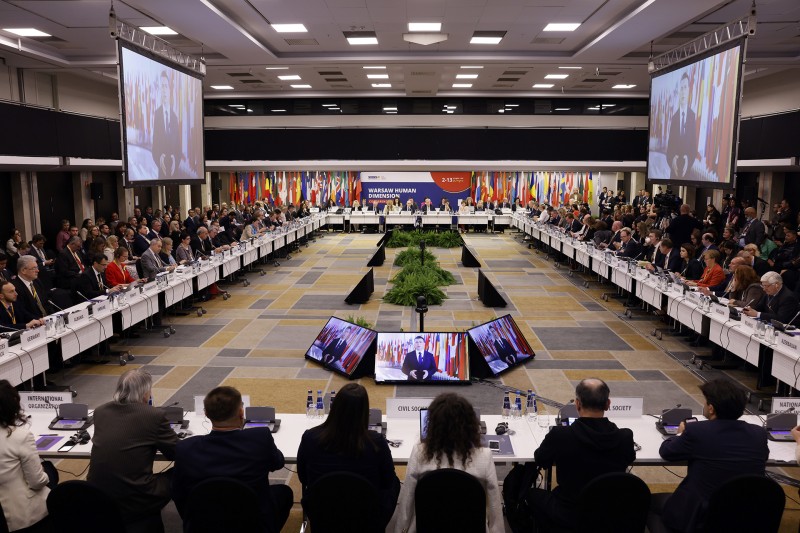
The leaked Pravfond spreadsheet, dated October 6, confirms that an academic identified as Engel received funding to attend a presentation in Warsaw. Cell phone records indicate Engel maintained close contact with Pravfond representatives in the week and a half before the event, with five calls occurring during that period, followed by one call and multiple text messages during the conference itself. When contacted about these communications, Engel denied the calls took place.
Beyond conference attendance, the leaked documents reveal that Pravfond had previously funded the report Engel presented at the OSCE event. In November 2022, Engel requested 22,400 euros to finance a study on xenophobia against Russians and to “counter disinformation.” The funding application used politically charged terminology, describing Russia’s full-scale invasion of Ukraine as a “special military operation” – language that mirrors the Kremlin’s official narrative.
The application also claimed that Russian speakers in “unfriendly countries” had suffered from “ethnocratic discrimination and the infringement of their rights” following the invasion, echoing talking points frequently deployed in Russian state media.
The resulting 171-page report, which Engel later emailed to Pravfond upon completion, examined xenophobia and rights violations in 13 OSCE countries, including Russia and Ukraine. While the final report’s language appears more balanced than the grant application, using terms like “war” and “invasion” to describe Russian actions in Ukraine, experts who reviewed the document identified subtle biases.
Seva Gunitsky, an associate professor of political science at the University of Toronto, noted that the report seemed to adopt certain frames that aligned with Russian narratives. “It’s designed to be citable in neutral forums, I think, but it definitely has an orientation that aligns more with a Russian narrative,” Gunitsky observed after examining the document.
The professor pointed to sections discussing Russia that appeared uncritical, such as a summary of the government’s anti-extremism strategy that omitted how resulting legislation has been used to target independent voices and critics of the Kremlin. These omissions potentially create a misleading impression of Russia’s human rights situation compared to other countries covered in the report.
Engel challenged this interpretation when contacted for comment, asserting that the paper “harshly criticizes Russia, as well as other countries monitored.” He defended the report’s objectivity, stating: “It presents facts, supported by sources” and “draws virtually no conclusions.”
The relationship between Engel and Pravfond appears to have continued even after the organization faced international sanctions. In March 2024, Engel submitted another application requesting 41,000 euros to fund a new report focused on “violations of the rights of the Russian-speaking minority in EU countries and Ukraine.” This request demonstrates an ongoing pattern of research focused on narratives that align with Russian foreign policy interests.
These revelations come amid growing concern about Russian soft power operations and influence campaigns in international organizations and academic settings. Western security officials have repeatedly warned about Moscow’s efforts to shape global discourse through proxies and funded research that advances pro-Kremlin viewpoints in seemingly objective forums.
Fact Checker
Verify the accuracy of this article using The Disinformation Commission analysis and real-time sources.

14 Comments
The optics of a Russian-linked foundation financing a scholar’s OSCE conference participation are quite poor. Even if the research itself is sound, the appearance of potential bias or undue influence is problematic.
You make a fair point. The funding source could call the scholar’s objectivity into question, regardless of the merits of the research. Proper vetting of speakers and their funding sources is crucial for these types of international forums.
This is a troubling development. Allowing foreign-backed entities to finance presentations at prominent security conferences could undermine the credibility and independence of the event. Strict conflict-of-interest policies are needed.
While the reported Russian funding is concerning, I’d caution against assuming the research or presentation was compromised. The scholar’s work should be evaluated objectively based on its merits, not on the source of their funding.
This report highlights the need for greater transparency and accountability around the financing of academic research and conference participation, especially in sensitive geopolitical domains. The potential for undue influence is clearly present.
If the allegations are true, this is a serious breach of trust. International forums like the OSCE rely on the credibility and independence of their participants. Any undisclosed foreign funding connections must be fully investigated.
Agreed. The integrity of these events is paramount. Rigorous vetting and disclosure policies should be implemented to prevent even the appearance of improper influence or bias.
The reported Russian funding of an academic’s OSCE conference participation is concerning and raises valid questions about potential conflicts of interest and undue influence. Rigorous disclosure policies and vetting procedures are essential to safeguard the independence and credibility of such events.
This is a troubling development that merits a thorough investigation. Academic freedom and the credibility of international forums must be protected. Any undisclosed foreign funding connections are unacceptable and raise serious ethical questions.
I concur. Transparency and accountability are crucial to maintain the integrity of these important platforms for dialogue and research. The alleged Russian links warrant close scrutiny.
While the alleged Russian funding is concerning, I’d hesitate to draw firm conclusions without a more complete picture. The scholar’s work and research methodology should be carefully evaluated on their own merits, separate from the funding source.
That’s a fair perspective. Rushing to judgment without a thorough investigation risks undermining academic freedom and open dialogue. A measured, fact-based approach is warranted here.
This is concerning if true. Any foreign influence or funding of academic research and presentations at international conferences raises red flags. More transparency is needed to ensure the integrity of these events.
Agreed. Academic independence and credibility are paramount, especially on sensitive geopolitical issues. The alleged links to a Russian entity merit a thorough investigation.